The UK’s most powerful government-built AI supercomputer, Isambard-AI, cost £225m
The Botley Road bridge cost roughly the same
Apparently our frontier AI capacity and one bridge are comparable national investments
Target cross reactivity in the Adaptyv competition is a perfect use case for BindCraft2 natively.
Try it out here:
Overview + modalities: https://t.co/WoExYKWc9m
Code: https://t.co/O8pr6jH99t
BindCraft1 variant by Lennart Nickel and Paul Kittner
https://t.co/sEHT2LHHqh
Releasing the model weights and technical report of Kimi K3.
Kimi K3 is our most capable model: a 2.8T MoE model with native visual understanding and a 1M-token context window.
New model architecture: 2.5x the intelligence per unit of compute, not just more params.
Alongside Kimi K3, we're opening up more of the stack behind it — high-performance attention kernels, MoE communication library, and infrastructure for running agent environments at scale.
Model weights: https://t.co/7m7eEg6Y0B
Tech report: https://t.co/yeu6cjpMCT
Tech blog: https://t.co/YTfiMSNM1f
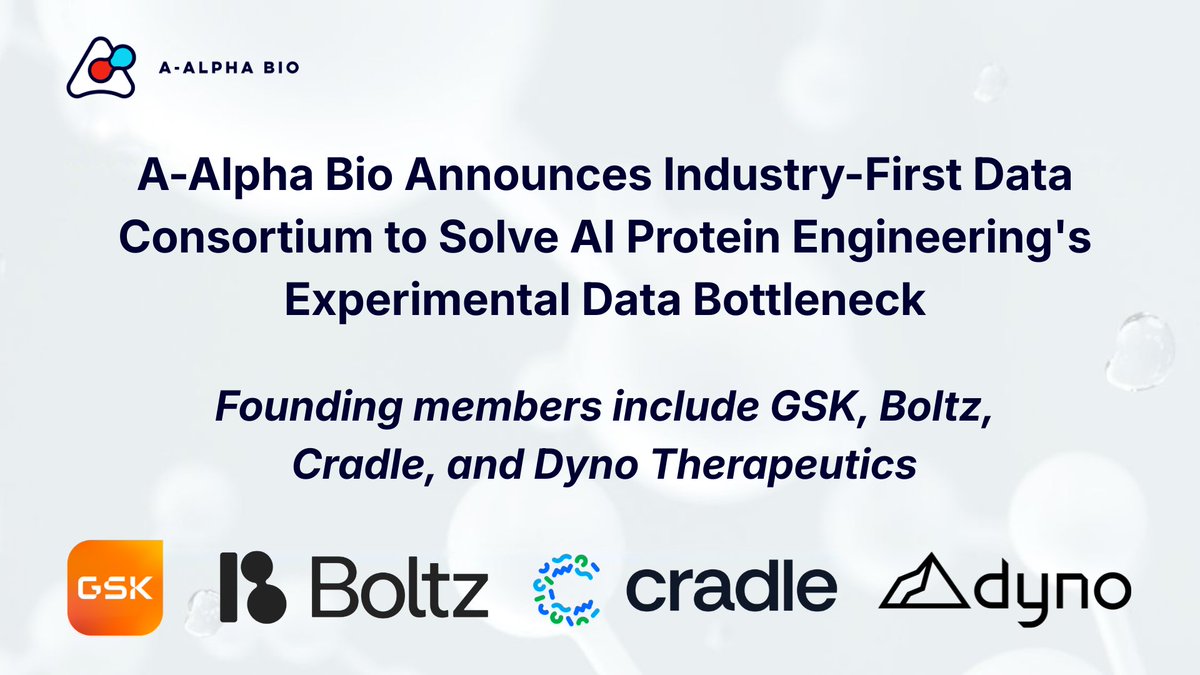
Excited to announce a major partnership with GSK based around our latest frontier models!!!
Two UK-based companies, one landmark AI x Bio agreement. Proud of what this says about the UK’s frontier ecosystem 🇬🇧
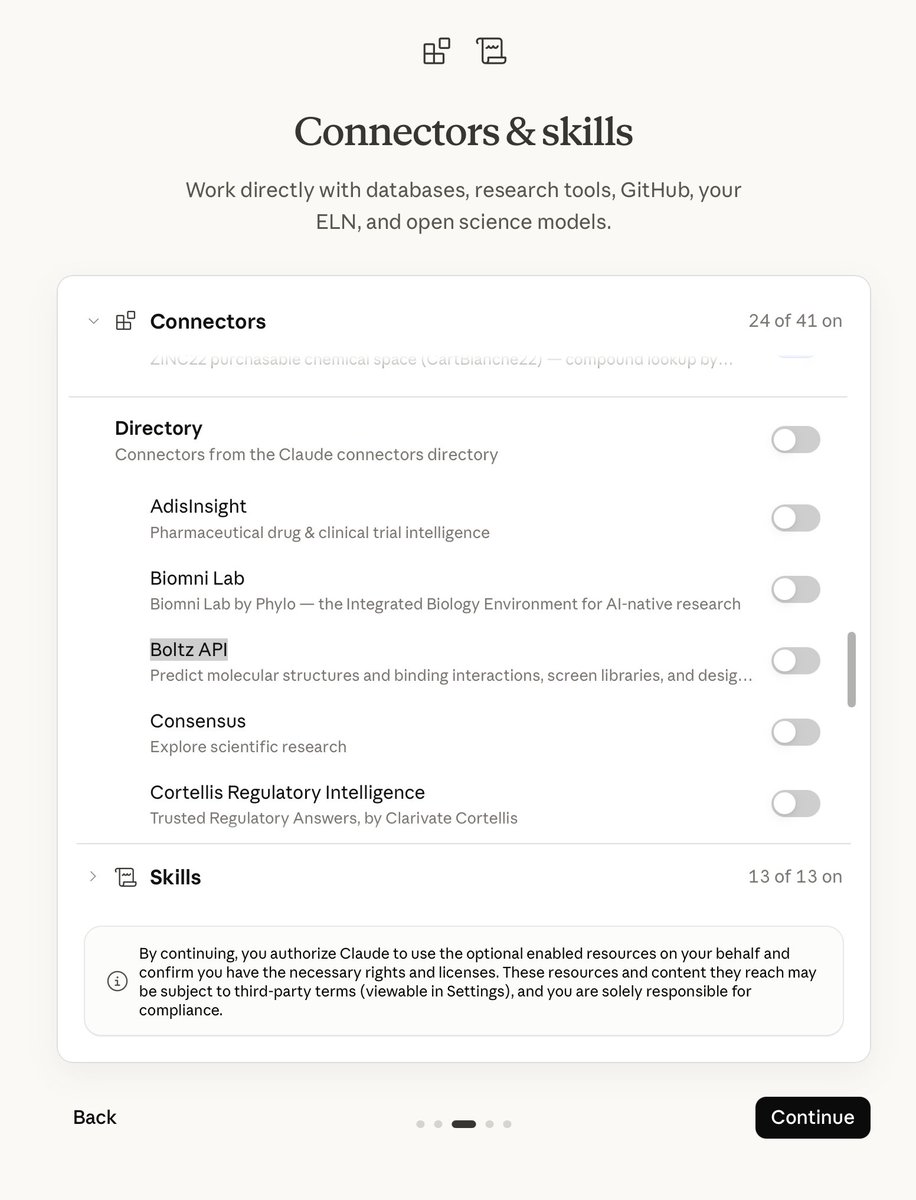
This was a really cool product to work on. Using an agent to set up and launch molecular design campaigns feels like magic
I'm especially excited about what AI science agents mean for education. I don't come from a science background, so joining Boltz to work on tools for scientists has meant diving into an environment of new concepts and jargon. Without LLMs, that barrier might have been impenetrable.
I'm hopeful that young budding scientists and old guys like me making a career shift will use Claude Science + Boltz to learn about molecular design and experiment with vibe biology.
Grateful for the opportunity to work on ambitious initiatives like this one with the great scientists and engineers on the Boltz team.
Amazing to see this blog post by @Xaira_Thera building on our recent note on evaluating binder design models!
Nice standards for calling a candidate a binder :)
Let's spread more awareness about reasonable binder classification and reporting!
https://t.co/RLLHBH5tDN
Excited to launch Biomni everywhere: web, desktop, mobile, and MCP!
Our vision is simple: biological research should happen wherever inspiration strikes. Whether you’re at your bench or riding the subway, Biomni is there when the idea hits. Start a new binder from your phone, then continue seamlessly across devices.
We're also launching Biomni MCP, so you can access Biomni’s biology capabilities wherever you work:
We're giving away $2,000 in credits to every company and $100 in credits to every academic to try our new BoltzMol-1 and BoltzProt-1 pipelines via the new Boltz API.
Thanks for sharing Chaitanya! Glad you found the ideas interesting!
I would only push back on "in line w/ releases from other labs on the frontier of protein and antibody design". The other frontier models from Isomorphic and Chai are not available under API and can only be used by scientists within these companies or a couple of pharmaceutical partners. This is the difference between a model being accessible by every scientist vs only very few.
Today we're excited to announce a major collaboration with @TakedaPharma to deploy our frontier models across their entire organization.
Takeda scientists now get access to BoltzMol-1, BoltzProt-1, and fine-tuned models for biomolecular modeling and design.
I'm incredibly proud of our team for shipping BoltzMol, BoltzProt, and our new API. Both models delivered experimentally validated hits for over 50% of the targets we tested. They're also an architectural step change: no longer a single neural network run end-to-end, but pipelines of multiple models that require complex orchestration and large GPU fleets to run at scale. We put in long engineering hours to build the infrastructure needed to get these pipelines into everyone's hands. We can't make it free, but we worked hard to make it a cost-effective choice, and accessible to everyone.
Don’t get fooled: these designs are still far from zero-shot therapeutic biologics. BoltzProt-1 does not remove the need for downstream optimization, but it can give you a meaningful head start by reducing the time and cost required to reach strong starting points for your therapeutic program.
We are releasing a blog post to highlight some of the challenges in classifying binders from denovo design models and to propose a more rigorous evaluation protocol from what we often observe in the field (including our own past work)!
https://t.co/6Fz2yUqWn3
New papers and an API to use our SOTA binder design models: cheap, easy, and we provide the compute!
Our blogpost describing our small molecule design model, our protein design model, and our API: https://t.co/kEyiYLGRQs
API includes .mpc for LLM use!