I spent years as a cloud engineer at Oracle. A lot of what got filed as app bugs was really capacity. This is the kind of thing I built @CloudWorldModel to show before launch.
Many 'application errors' are cloud architecture errors.
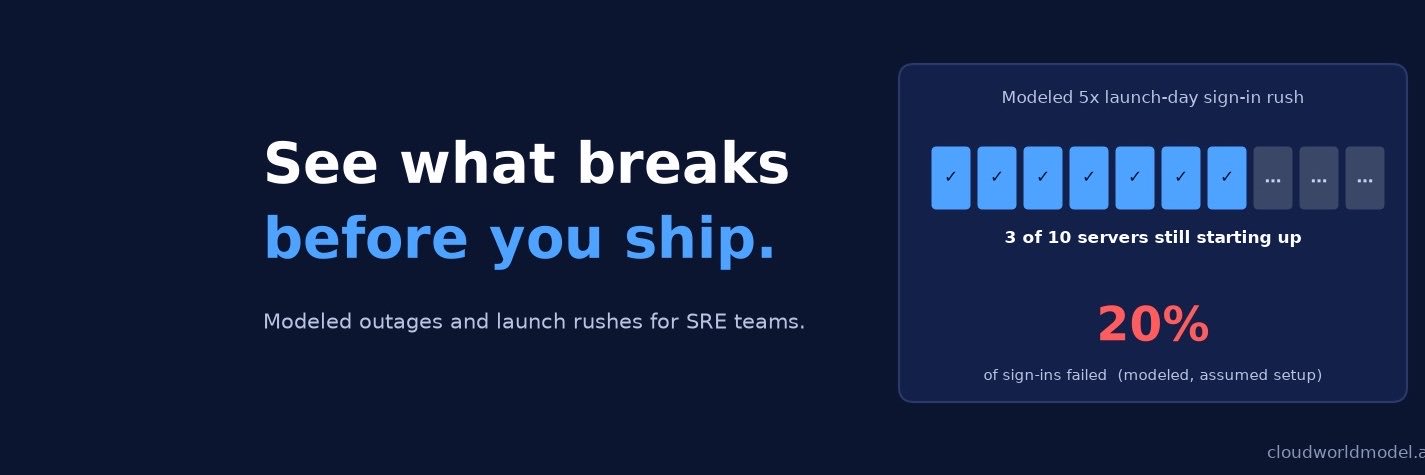
In a modeled 5x launch rush, 20% of sign-ins failed. The app code wasn't the cause: 3 of 10 servers weren't serving yet. (modeled, assumed setup)
Take the app out of the picture and test the architecture first.
@Joshua_WD@CloudWorldModel Ha, most projects have seen it. What's the one you've seen most: autoscaling too slow, or a failover that never actually kicked in?
I spent years as a cloud engineer at Oracle. A lot of what got filed as app bugs was really capacity. This is the kind of thing I built @CloudWorldModel to show before launch.
Many 'application errors' are cloud architecture errors.
In a modeled 5x launch rush, 20% of sign-ins failed. The app code wasn't the cause: 3 of 10 servers weren't serving yet. (modeled, assumed setup)
Take the app out of the picture and test the architecture first.
Cardi B brought Vice City to life! The rapper hit the pink carpet at Miami’s Booby Trap on the River to celebrate “GTA VI,” with G Herbo and Freddie Gibbs joining the party. 🎮🔥
PSN slowed 33 minutes after the GTA VI unlock. Whatever Sony's cause was, this is the trap we see in models: autoscaling adds servers, and every new server opens more connections to the same database. You can test that before launch night.
We simulated it: a game-launch sign-in rush on an assumed topology, not Sony's real system.
At 50x normal load, servers autoscaled 4→22, but 40.6% of sign-ins still failed. Most of that was the shared account DB running out of connections. p99 went from 188 ms to 1.9 s.
The app autoscaled. The database pool didn't care.
That's the result I want sitting next to every "just add app servers" plan.
Modeled on an assumed topology, and we've measured a database wall like this on real AWS too.
We simulated it: what breaks at 1,000 vs 100,000 users, on an assumed topology (ALB → app autoscaling 2–10 → Redis + Postgres), not anyone's real system.
~100 RPS: p95 59 ms, 0% errors.
~10k RPS: all 10 app nodes maxed, Postgres at 100% CPU, 82.2% errors (72 points from the DB pool), p95 1,029 ms.
The app scaled. The DB pool broke first.
We also hit a database wall on a real AWS load test — adding app servers didn't raise the breach point:
https://t.co/OE4ZeOICjO https://t.co/HxA6pSZGjt
Load testing is an example of a type of pre-emptive fixing.
However, running your infrastructure through a model that behaves like the cloud can show you first, for a lot less. https://t.co/zouC4urrWj
AI has transformed how software gets built. Now, it’s positioned to transform how software stays running.
@resolveai’s new SRE-1 is trained to find the root causes of production incidents. The results show the potential for specialized training to improve accuracy at a lower cost per investigation.
Congratulations to @spirosx, @maynkag and the team!
"An alert has no test" is the core problem. Simulation could give you one: inject a known fault (lock contention, failover surge, capacity loss) into a modeled system and you get incidents with ground-truth root causes, as many as you want. Could that work as an RL environment for SRE agents?
Introducing SRE-1 a 27B model that dominates the Pareto frontier of accuracy/cost on production debugging, beating frontier models in a coding-adjacent domain
Built by 11 people on open weights models + domain expertise. Final run: 7.4 days on 512 GPUs https://t.co/9IzysHZEmL
We simulated the Microsoft 365 outage pattern: a lock-contention cascade took an assumed 7-worker gateway from 6 up to 0 in 5 steps. Cutting traffic didn't recover it; stopping new work did. Assumed topology, not Microsoft's system.