something has definitely shifted in the past few weeks. seeing a huge uptick in large enterprises wanting to secure compute and post-train their own models in house, frequently on top of GLM-5.2. everyone is starting to understand how open source wins.
Today we're releasing prime-rl v0.6.0 — enabling RL at trillion-parameter MoE scale on agentic workloads at the highest efficiency.
We've relentlessly optimized our RL infra.
The result: GLM-5 on agentic SWE tasks at 131k context and sub-5-minute step time.
on sept 15 2008, lehman brothers collapsed and gave the whole world a reason to believe in $BTC
on june 12 2026, a single government order forced anthropic to pull its most capable models offline for every foreign national on earth, and gave the whole world a reason to believe in bittensor:native
humans only react to negative things. sad but true.
in 2008 we learned the banks were the problem. in 2026 we’ll learn that one kill switch sitting inside a centralised AI lab is the problem.
Silk Road gave Bitcoin its first clear real-world PMF as censorship-resistant internet money.
The US government just gave Bittensor its first clear real-world PMF as censorship-resistant intelligence.
$TAO
Access to intelligence should not depend on a handful of companies or governments.
This is why open, decentralized, permissionless AI matters.
This is why Bittensor matters.
If the socialists had their way, Elon would have had his paypal profits taken and redistributed for the greater good.
The world would never have seen Tesla, nor SpaceX.
And the world wouldn't know it, because they were uncreated, and thus unseen.
Imagine the companies that don't exist, because Washington destroyed them before they were born.
Decentralized, permissionless, uncensored AI running on crypto plumbing is probably the most important battle arena of the next five years.
Actions like today’s are eye openers for many, but we knew. We knew governaments, technocrats, big companies where hoarding compute, talent, resources. A more and more centralized and dystopian future where social divide is even more prominent. Where access to frontier models is stonewalled.
It gives crypto once again a mission. A clear flag to carry.
The 0 to 1 moment is happening this year. Things will only accelerate going forward.
"I'm extremely convinced that Impact Markets is gonna be a household name in a couple of years"
Aradtski, Founder of @lightconexyz, on what drives him to keep building Lightcone:
"It's incredibly interesting social technology. The thought of us being the ones to bring that about is just very exciting." - @aradtski
hyperliquid is a killer product
meanwhile, there are pressures that may constrain the project’s viability within US borders
including:
- hyperliquid’s product layer (via CFTC’s kalshi approval, coinbase/deribit no action, and policy statement)
- hyperliquid’s network and token layer (via clarity act)
- hyperliquid’s collateral layer (via USDC, managed by circle/coinbase, two US regulated entities)
haven’t seen a thorough discussion on these impacts, so below is a brief summary of the current paths forward, and the rationale behind each:
(1) hyperliquid can ignore US market, go offshore only
(2) hyperliquid can build a US regulated wrapper
(3) hyperliquid can decentralize under ‘clarity act’
(4) hyperliquid can centralize the project, turn $HYPE into a security
(5) hyperliquid can lobby for a change
these are the five, i'll start with the first
(1) hyperliquid can ignore US market, go offshore only
last week the CFTC approved kalshi’s BTCPERP as a futures contract on a DCM
the CFTC separately confirmed certain deribit perps may be treated as foreign futures through the coinbase FCM path
the implication is that regulated distributors for perps in the US may need a fully regulated venue, compliant customer funds path, approved product scope, surveillance, disclosures, and accountable corporate counterparties
without these in place
distributing hyperliquid liquidity, or offering hyperliquid perps, could look like routing US customers into an unapproved offshore venue
so the first option for hyperliquid is that they ignore the US market entirely
this approach would be similar to binance main exchange, which was ultimately forced to more aggressively block american customers after years of light effort
like binance, doing so would preserve hyperliquid’s product offshore, but cede US institutional access for the time being
(2) hyperliquid can build a US regulated wrapper
the second path is to find a way to build or partner with a US regulated wrapper to offer perps
under this path, offshore hyperliquid would remain a global crypto native venue, while a separate US affiliate or partner offers regulated perps through an FCM/DCM/DCO/FBOT style wrapper
you can think about this separate venue like Hyperliquid US™
in a perfect world, this is the ideal outcome for hyperliquid to target US users
however, this approach would likely require hyperliquid to ring fence (1) customer funds, (2) products, and (3) $HYPE value capture separate from the main network
the ongoing separation of Binance US™ from Binance’s main exchange is instructive here as a case study
- customer funds may be ring fenced because US regulated futures infrastructure cannot commingle US customer collateral with offshore protocol margin
- products may be ring fenced because the US venue will likely require approved, deep, liquid digital commodity perps, not the entire hyperliquid long tail universe of assets
- revenue and $HYPE value capture may be ring fenced because profits from a regulated corporate venue flowing into buybacks, burns, or assistance fund mechanics starts looking like token holders are economically participating in the profits of a corporate operating business, which could implicate US securities laws
net net, this model would likely require a significant rewrite of how the hyperliquid network works for US participation
(3) hyperliquid can decentralize under ‘clarity act’
the clarity act drafts offer a groundbreaking path for a lot of protocols to ‘progressively decentralize’ a network
i'll be writing more on this down the road
but for now
under clarity, progressive decentralization means reducing the role of the originator / related parties until the network and token are no longer under ‘coordinated control’
in exchange, a token may exist to capture *automatic* revenue flows originating out of the decentralized network, as long as the token value is primarily driven by the distributed ledger system rather than entrepreneurial or managerial efforts by a control group
in a vacuum, a token powering a decentralized network may support shifting the token’s classification from “security” to “commodity”
which is a big deal for many protocols and networks in the US
however, there are tradeoffs for projects optimizing for the ‘decentralization’ route
for hyperliquid, decentralization under clarity would likely mean the project would need to aggressively broaden validators, decentralize the listing process, decentralize oracle/risk controls, reduce controlled ownership, reduce emergency discretion decisions, make upgrades slower and more governance driven, among offloading other day to day product decisions
this would be a meaningful change, as a large part of the hyperliquid thesis has been underwriting the core team’s ability to make fast product decisions, in a manner they see best
ceding managerial control over the protocol to satisfy decentralization changes the trajectory of the project, and shouldn’t be taken lightly
this also coincides with a separate issue
the clarity act’s decentralization framework is not a DCM/DCO workaround. even if the hyperliquid network could eventually satisfy clarity’s decentralized governance framework, this would still not automatically permit hyperliquid to offer perps directly to US users
notably, both clarity and the ag committee text for clarity preserve the existing commodity exchange act (CEA) regime for futures, swaps, options, and leverage transactions
this is important for understanding clarity's intent, as the ag committee writes the CFTC/CEA side of market-structure legislation and this text signals that clarity act legislation is not a workaround for the existing CEA derivatives regime
simply put
this likely means any decentralization for hyperliquid will *not* erase the need to follow regulated derivatives market infrastructure without a regulated wrapper, which would require a significant rewrite of how hyperliquid works for US participation
(4) hyperliquid can centralize the company, turn $HYPE into a security
this is probably the weakest option game theoretically, but worth mentioning
hyperliquid could become a corporate exchange, register or restructure $HYPE into a security, build a regulated wrapper, and shift value capture away from token buybacks/burns and toward equity, licensing, or regulated-entity revenue
this is the cleanest for compliance because the entity, venue, governance, customer funds, disclosures, and revenue flows become legible to US regulators *today*
but it is the most damaging to the network value prop, which relies on the idea that protocol activity, incentives, and economics are all aligned around $HYPE as a digital commodity, not a tokenized security
(5) hyperliquid can lobby for a change
there is a fifth option, which is to lobby for a change
here, related organizations could work hard to lobby the agencies to eventually create a bespoke framework for crypto-native perp venues like hyperliquid to directly target US audiences and capital
the work being done here by @HyperliquidPC is instructive
there is some evidence this approach could work in part
the CFTC is clearly moving in a more innovative direction, and the kalshi / coinbase-deribit path may be the first conservative step before more liberal steps to include more unique design architectures
important to consider, however
even if the CFTC further opens up on perps to tailor approvals for decentralized networks
this wouldn’t solve a $HYPE securities classification under the clarity act, which is a separate issue that may require network changes before US participation
without these changes
and under a current reading of clarity
i do find it impractical to think there will be a special token exemption for one project, while other projects are required to satisfy clarity act’s decentralization / network token framework
ok
in closing
these are the five US options as i currently see it, i'd be curious if folks in the legal / policy community are seeing others
there is also one final wrinkle, which is USDC now serving as hyperliquid’s ‘aligned quote asset’, with coinbase/circle tied into the broader treasury and routing strategy
a final point on this
if hyperliquid’s core settlement asset is USDC, then the system unquestionably inherits some degree of US regulatory control at the asset layer
but it also opens up a unique opportunity for significant policy shifts to support extending USD dominance, as flagged by @blknoiz06
its an interesting dynamic worth keeping an eye on for policy reasons
i hope some of this discussion is useful for further dialog
as of today
whether you are bullish or bearish on hyperliquid’s US efforts from here probably depends on two things:
(1) what probability you assign to each of these paths; and
(2) hyperliquid’s ability to compete once they end up on one of these paths
disclosure: my fund @collab_currency currently has exposure to $HYPE and projects building in the hyperliquid ecosystem
Just for clarity:
This has the potential to fundamentally disrupt both the current AI compute market and the frontier LLM training race.
Why?
Because Parallax by Chutes is starting to demonstrate something that was widely considered impractical until now:
large-scale decentralized training for frontier style MoE models.
If this continues to scale (we have reasons to believe it will), the implications are huge:
- frontier training across massively distributed hardware
- significantly more cost efficient to train
- has the potential to free up huge load of the severely constrained data center capacity, that is currently tied up for centralized training (estimates say 20-50% of dc compute is locked for training)
- heterogeneous training fleets, e.g. high-end NVIDIA B300 GPUs alongside consumer hardware like MacBooks
- the possibility for ordinary people to contribute compute, participate in training frontier AI, and earn crypto rewards with it, basically: models from the people for the people.
Yes, this is basically SETI@Home for frontier model training. Democratizing the benefits of AI. AKA one of the core visions of Bittensor as I understood it. /cc @const_reborn , please correct me if wrong.
And the most insane part actually comes AFTER training:
The same architecture choices also appear to massively improve inference efficiency. Think multiple times better revenue/cost ratio for inference providers. Oh, and btw, Chutes is an inference provider.
Most people still underestimate how big this could become.
Stay tuned.
Or no, even better: Please share. We need to get the message out there.
Except if you are an investor or want to train a huge model, in which case: please reach out via DM.
$TAO
@Collab_Currency's run club is back in action for this beautiful NY weather. 🌞🏃
Monday (4/18), East Village @ 7:30am sharp.
Coffee, snacks and bandit socks in the Collab office afterwards.
https://t.co/KykclcdRNF
today any artist, anywhere in the world, can make a digital object
and using a computer and the internet
reach a viewer on the other side of the world for that work directly
and if the artist decides to go further
and use a permissionless and public network like @ethereum
they can have that object recorded, purchased, transferred, and collected
it's been six years for me, and this idea is still so profound
the internet has become the native medium for communication, discovery, identity, culture, and value exchange
and with blockchains
digital artworks can now be owned, exchanged, and viewed publicly over the internet
crypto art has very clearly fallen out of favor across broader markets
but the value props of this technology haven’t changed
tens of thousands still participate daily
artists making work
collectors collecting work
viewers viewing work
for the folks that remain
many desire a space that makes this network much more legible
collections, collectors, history, market, context
across every standard, blockchain, protocol, platform
all in one place
stitched together
@thefunnyguysNFT and @0xmetaclass are building the canonical marketplace for crypto art
they are stewards who deeply understand the things that made blockchain-based artwork special to begin with
and are unwavering about why the space will impact many more creative authors and collectors in the future
- non-intermediated ownership of digital artworks
- trust-minimized architecture
- peer to peer exchange
- internet-based discovery
i'm v excited for our team @collab_currency to support @raster_art
and for the next decade of crypto art ♥️
CoinList was founded on the belief: the next generation of financial opportunities should be open to all.
After launching protocols from @Solana to @Ondo, we’ve built Passage by CoinList: the access layer for onchain capital markets.
A Vietnamese miner with a GPU can now compete with anyone in the world.
No visa. No approval. No gatekeeper.
This is what Bittensor subnets actually unlock: anyone, anywhere, plugging into a global network and getting paid purely on contribution.
This is what permissionless actually means.
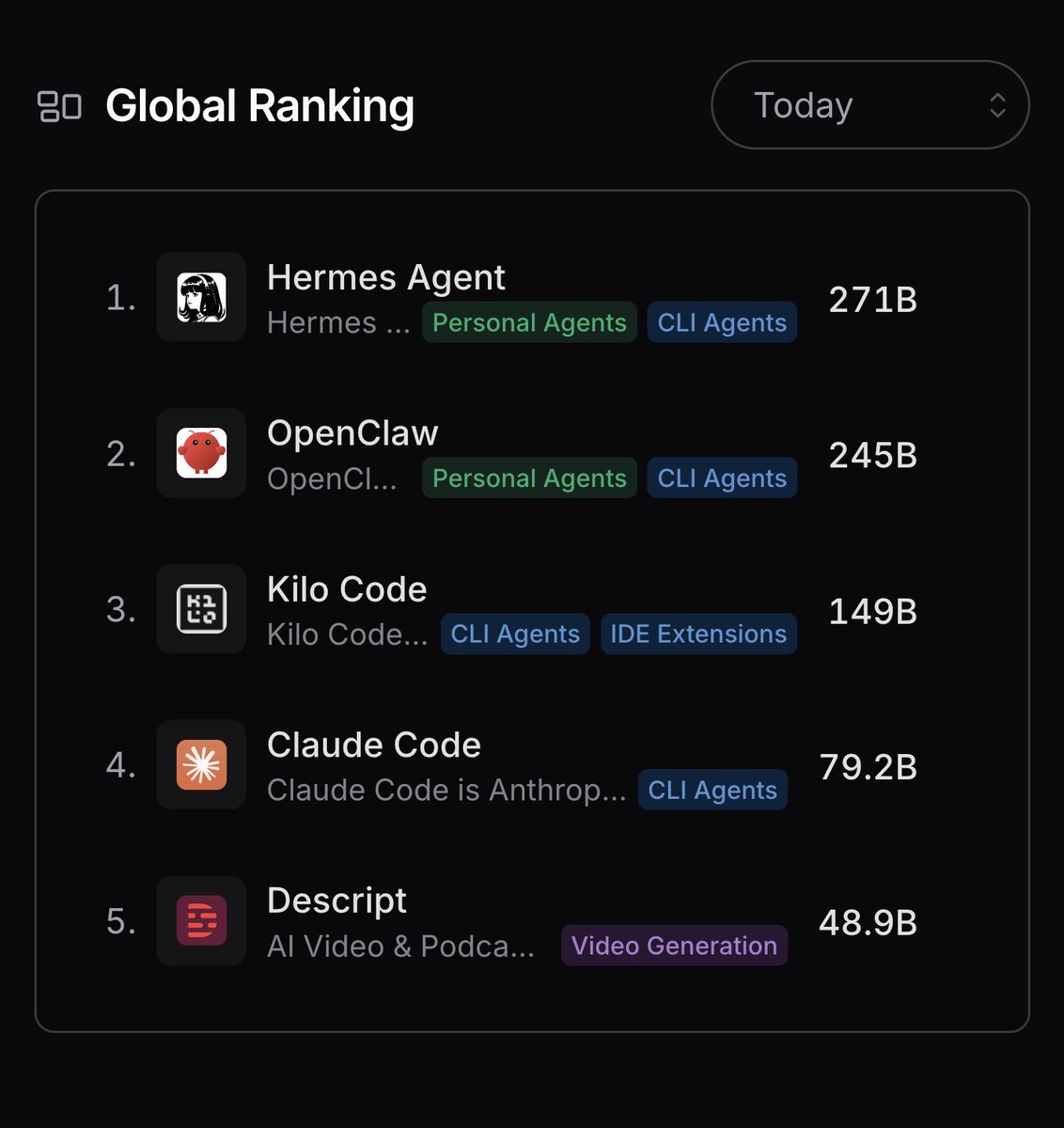
Hermes Agent is now #1 on the Global @OpenRouter token rankings.
While our journey together has just begun, we'd like to take this opportunity to thank our contributors, supporters, and users for all they have done to get us this far.