A passion for studying financial markets, global macro and behavioural finance. Striving to make the quantum leap in my knowledge base and productivity. Gen-Z.
There won't be any work life balance...
You can have many things in your life, just not at the same time ⚖️
Being successful at something, means saying NO to most other things you would actually want.
You can always use the gold bars to balance what you lost later ⭐️
This is a really interesting paper about stock performance.
If you bought $AMD at the close every day and sold at the open the next day, over decades you’d have gotten a whopping +4,555,517% return.
But if you bought at the open every day and sold at the close the same day, you’d have lost almost everything – down -99.94%.
This pattern holds across every major market globally. This just reiterates that time IN the market beats anything else.
Other examples:
$MU: overnight +138,330,342% – intraday -99.92%
$NVDA: overnight +221,715% – intraday -99.7%
Same stocks. Completely opposite outcomes depending on when you hold it, overnight risk premium pays, intra day trading doesn’t.
The most comprehensive Hermes Desktop tutorial on the internet NOW is LIVE.
You'll learn sessions, profiles, artifacts, cost savings, and real use cases for making money and building startups with Hermes agents.
Whether you're already running Hermes or haven't started yet, this is the episode for you.
@AlexFinn says this is the moment Hermes overtakes OpenClaw. S/o to Alex for walking me through it.
"It's now the best way to use AI agents on your computer"
I do think the desktop app of Hermes looks almost like an Apple product.
Everything you need to know about Hermes Desktop App/agents in 43 minutes
This episode is 100% free. No ads. @startupideaspod
I just want to see you win on the internet. And I think Hermes can help.
Plus, It's fun thing to play with this weekend. Share this with a friend. Link below.
YT: https://t.co/O4Ih4K87SQ
Watch
Everyone says Singapore property is a great investment.
But did it actually beat the stock market over 30 years?
I ran the numbers across condo, landed, HDB 4-room and 5-room — vs the S&P 500.
The answer will surprise you. [1/8]
If you want a deeper understanding of your unconscious habits and how to break free from them, try this exercise daily.
Backwards Review Exercise
Rudolf Steiner, widely considered one of the greatest minds of the 20th century, recommended mentally reviewing the events of your day in reverse order, starting from the present moment and moving back to the beginning of the day.
At the end of the day, sit quietly and mentally go back through everything that happened. Try to remember conversations, reactions, emotions, movements, and small details as clearly as possible. Some people do it before sleep, others in the morning so they stay more awake during the exercise.
A useful way to do it is backwards. Start from the present moment and move step by step toward the beginning of the day. This requires more attention because the mind cannot rely on automatic memory flow.
One of the most interesting parts of the exercise is seeing how the mind reacts to certain experiences. Small events often stay in our thoughts for hours without us understanding why. Someone says something irritating, looks at us a certain way, or reacts unexpectedly, and the moment keeps replaying in the mind long afterward.
Later, while reviewing the day calmly, it becomes easier to see what actually caused the reaction.
Usually it is not only the event itself, but identification with some image, expectation, insecurity, or habit.
For example, imagine making a joke you personally find harmless, but the other person becomes offended. Even after apologizing, the interaction keeps replaying in your head. During the review you may suddenly realize the discomfort came from wanting approval or from disliking being misunderstood. Without reflection, these patterns usually remain unconscious.
This exercise slowly reveals how mechanical many reactions are. You begin noticing recurring emotional patterns, roles you play, and thoughts that repeat automatically. Some people discover they are constantly trying to appear intelligent, helpful, spiritual, funny, or important without realizing it. The moment that image is threatened, emotion appears immediately.
Neville Goddard later expanded on a similar idea through what he called revision.
While mentally replaying the day, if you come across an unpleasant event, you consciously reimagine it the way you would have preferred it to happen. Instead of reliving the event exactly as it occurred, you replace it in imagination with the desired version and fully experience it that way.
At first many people think revision means making reality only slightly better. But the idea is to imagine the experience exactly as you wanted it to happen, not just a small improvement of the original event.
The most difficult part of all these exercises is keeping attention from wandering. The mind naturally moves from one association to another automatically. You begin reviewing your day and suddenly find yourself thinking about something completely unrelated.
The practice makes it very clear how little control most people actually have over their own thinking.
With consistency, however, memory improves, concentration becomes stronger, and awareness of yourself deepens naturally.
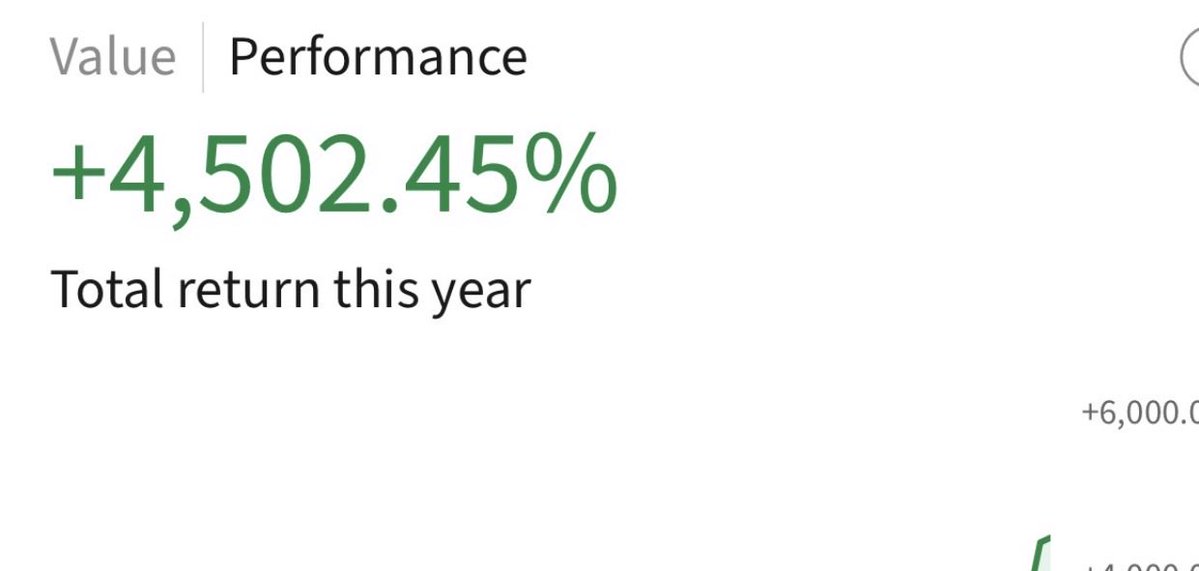
We are doing SO good.
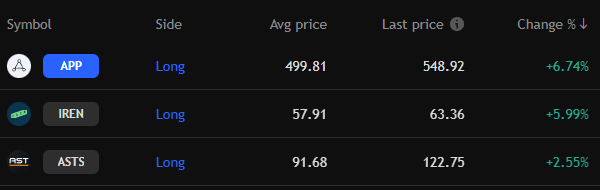
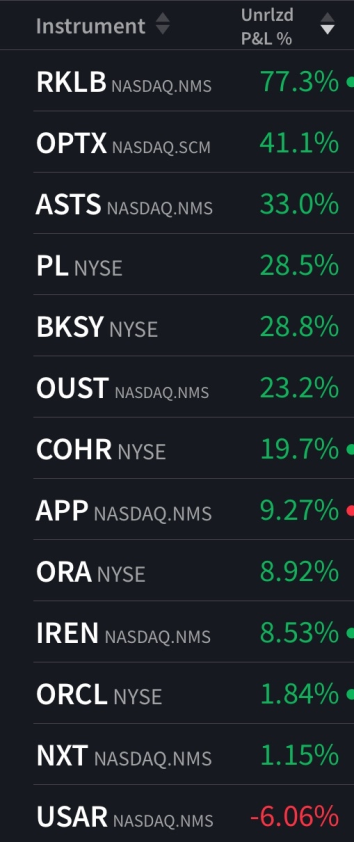
Our biggest winners - all SPACE:
$RKLB +77% $BKSY +28% $ASTS +33% $PL +28%
$OPTX +41% (last week's position)
leading today we are $app +6% $iren +6%
We bought these together. Live. In real time.
We're making this money TOGETHER.
Today i will buy one more, hunting the next ideas, and sharing them with you.
This IMO is extremely bullish
It might seem silly because it's the same as buying $SIVE $AAOI $LITE $COHR separately, but no
There is a reason why the $LYTE ETF is mega-bullish
As I mentioned before, photonics is super unknown to retail investors, so you understand
The ~ % of people who know about companies in the sector:
Semiconductors ~ 85/95% $NVDA $TSMC $AMD
Memory ~ 55/70% $SNDK $MU Samsung
Photonics/CPO ~ 5/10% $SIVE $AAOI $COHR
Now that you understand how unknown photonics is, think for a moment
If when the $DRAM ETF came out we saw a huge rally in the memory sector
What is supposed to happen when this Photonics ETF becomes a reality
If memory is much better known and there was already a ton of flow coming from retail investors who didn't have the knowledge or the guts to buy individual stocks in the sector
Then here, where much fewer people know about photonics, two things are going to happen IMO;
- Since people know less about it, less capital will come in compared to $DRAM, but the sector is tiny compared to memory
So even if it's less capital, it will have a much bigger impact and everything will shoot up vertically
- The other thing is that this would be a massive showcase for the entire sector, as people will discover companies they didn't even know existed
That translates into more and more flow coming in
This is mega-bullish IMO
(Divulgation: The image is fake, is just an example)
For me, who graduated from LIU 55 years ago, to pass along what I’ve learned over those 55 years to the graduating class of 2026 was a déjà vu joy.
If you want to learn in 15 minutes the most important things I’ve learned in the last 55 years, you can read my commencement speech here.
You don't.
You build a skill that prints money, then you scale it.
18-30 year olds who actually got rich didn't "find the right opportunity."
They learned how to sell something people want, then did it over and over until the numbers got stupid.
Ecom, Agencies, SaaS, Newsletters, Courses, Real estate. Doesn't matter.
The vehicle is irrelevant if you can't sell.
> Pick one thing.
> Get good at selling it.
> Scale it and don't stop until you hit your number.
That's it.
Nobody wants to hear that because it's not "get cash in an instant" vibe
But every 25 year old with real money did some version of that
Learn or perish.
Ex-GS Commodities Chief Jeff Currie's appearance on X is a historic event. Jeff is an absolute must-follow, and the below 10-tweet 🧵is an absolute must-read.
Heed this advice: Make the time to read the whole thing, all 10 tweets, carefully, at least twice.
This week, I spent 8 hours reading 50+ articles about AI.
And I learned more in 1 day than most will in an entire year.
Highly recommend you read these 8:
Today, Leopold Aschenbrenner's Situational Awareness 13F drops.
The 24 year old former OpenAI researcher turned a viral AGI manifesto into a multi-billion dollar hedge fund.
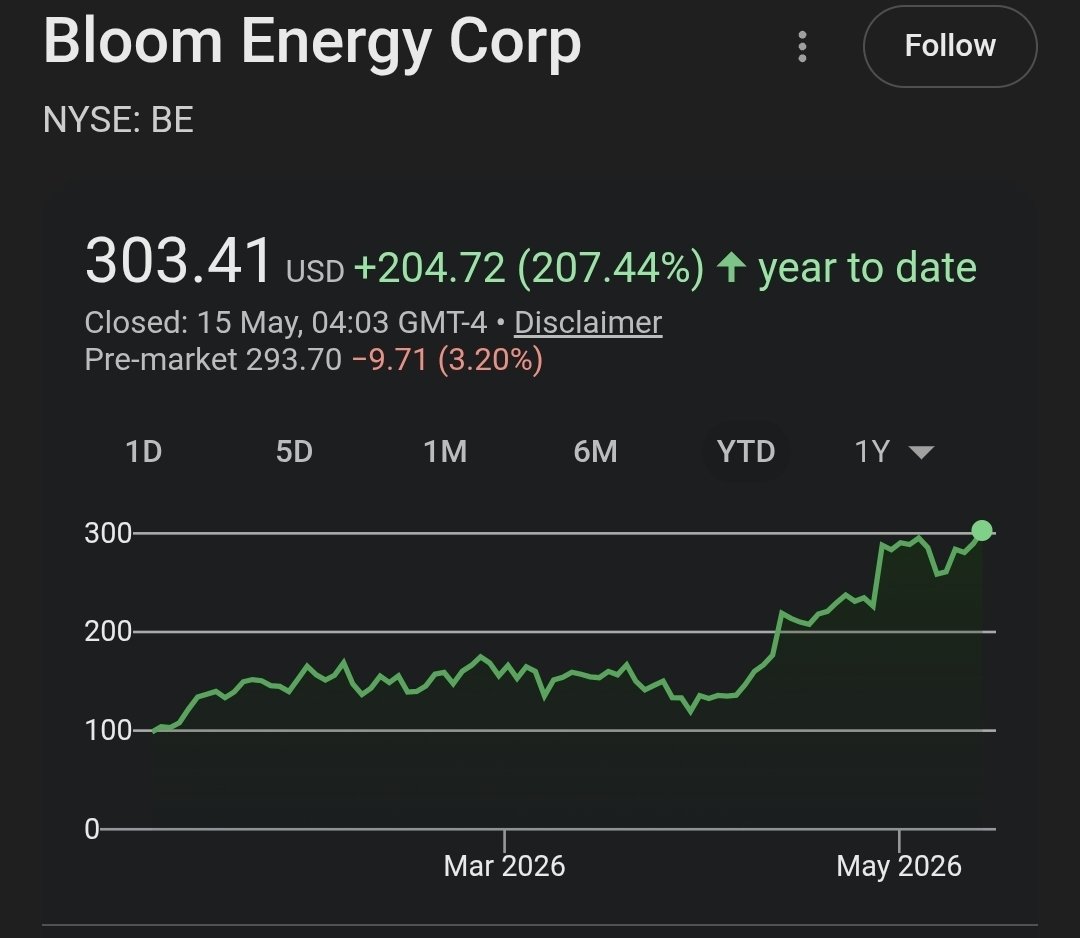
His #1 position: Bloom Energy $BE, already up +200% YTD and 1,400% over the past year.
His thesis was simple:
> AGI is bottlenecked by electrons, not chips.
> Hyperscalers can't wait years for grid hookups, so they're racing to plug data centers into on-site fuel cells.
> Bloom sells the fuel cells.
He saw it months before the rest of the Street.
Expect every name in today's filing to be picked apart.
“In most of our decisions, we are not betting against another person. Rather, we are betting against all the future versions of ourselves that we are not choosing.”
~Annie Duke
Thinking in Bets
book summary in 4k







![Chicky_Think's tweet photo. Everyone says Singapore property is a great investment.
But did it actually beat the stock market over 30 years?
I ran the numbers across condo, landed, HDB 4-room and 5-room — vs the S&P 500.
The answer will surprise you. [1/8] https://t.co/y6mV94YP67](https://pbs.twimg.com/media/HKMGNvCagAATK_P.png)