How to get better response rates with email surveys?
Surveys embedded in an email, generally have better response rates than CTA with the survey link.
With Gradian, you can now embed the first question of your survey in the email. The remaining questions will be on a dedicated survey page, shown after the user clicks the email.
Fork your dependencies, trim them to only your use case, never update unless it breaks for your users. I’ve been vocal about this for 10+ years. I’ve always said that updating is way riskier than latent bugs (which can be tracked and CVEs monitored).
If you are updating a dependency, it’s on you to analyze every single commit in the full transitive set of dependencies. If you dont see anything compelling, dont update!
I remember at HashiCorp once in awhile an engineer would try to update a dep or replace a DIY lib with an external one and id always ask “show me the commit we need.” Dont update for the sake of it.
Feeling pretty swell about this mentality with all the supply chain attacks happening.
Hello, Hello,
Episode 1 of my new podcast, Hardware is hard, but…, is now live on YouTube https://t.co/gRPaHEd6Im
We honestly couldn’t have dreamt of a better first conversation than this one with the OG of Indian startups, @sbikh (1/n)
With Claude code and now GPT-5 all you need to know is how to write a good PRD (requirements). If you know what you want and you can express it in words, you can make it. #ChatGPT5#claudecode#productmanagement
More and more, I have lost conviction that “minimum viable products” make sense for product development.
It makes no sense to release a product with the core flow and then dismiss its viability after the aggregate data says people aren’t using it.
Instead, founders should have a fundamental belief about what people want—and they should keep iterating until that value is correctly surfaced.
In practice, this means you should keep a steady flow of new users as you add components to the product, seeing if it solves a core part of the activation and signup loop.
The only part that could possibly be “half-baked” is those individual components. But even those need sufficient quality so there are no confounding factors that distort the signal.
Your competitor had different hypotheses, different metrics, different user needs, different business needs or they may be simply wrong. Talk to your users. #UserLedGrowth#ProductManagement
Founders, you want a customer-centric culture, so you invest in customer feedback tools. The problem is that most tools charge per user basis, forcing you to limit access to save costs.
Sharing login credentials doesn't help either. Instead, it conveys that customer-centricity isn't your top priority.
As a result, only a few see raw feedback. The rest get processed versions that strip away the joy and anguish that your end user took the time to share.
This pricing model undermines your efforts to create a truly customer-centric organization.
That's why FeedbackSpark has no limit on team members. We're creating a solution that encourages broad access and deep engagement with customer voices, not one that puts up barriers and reduces people to numbers.
Take us for a spin. The first 250 feedbacks are on us. https://t.co/F2Csd9ku8L
@hnshah "Focussing on ICP doesn't mean you are excluding rest of the market, and therefore limiting your growth and reach" from this article https://t.co/wfJwarnpxc by @asmartbear
This is particularly true for B2B products. You cannot compete with an MVP in an established market, especially if you do not know what the minimum is.
Even in B2C, users expect nothing less than a high-quality product. They do not want to be a test subject for a subpar or poorly developed product.
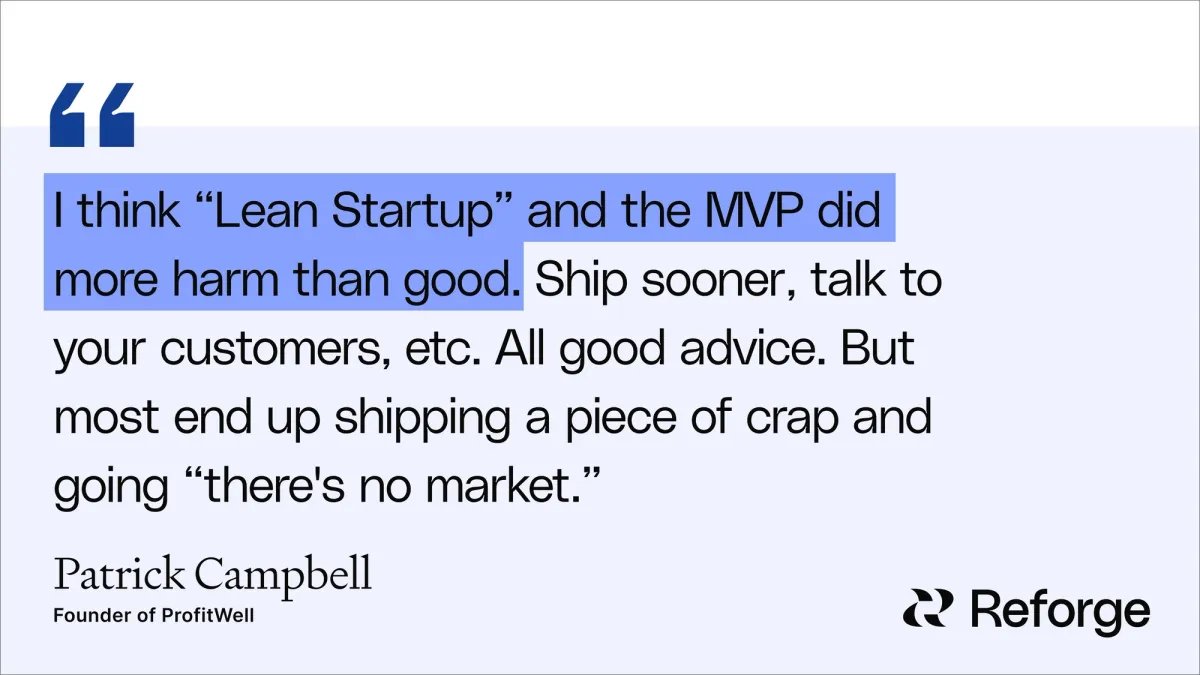
@Patticus puts is far more bluntly, saying that the Lean Startup and the MVP did more harm than good, resulting in a lot of people shipping a piece of crap and going "there's no market"
At Facebook, I coined a term called Filipino Product Market-Fit:
Every year a product manager would observe their new product getting intense adoption in the Phillipines and proclaim their idea was working. Directors would quickly staff the team and alert their VPs of the newfound discovery—only to find out that the pattern was not reproducible in other countries.
The Philipines has one of the highest time-spent online in the world and they will try literally anything for a few days.