Very happy to share our article on parametric control of low-dimensional manifolds! https://t.co/ZfEoSLU870
What neural mechanisms support generalization in temporal tasks? How can neural dynamics be controllable by inputs? ⏬
Connectome datasets alone are generally not sufficient to predict neural activity. However, pairing connectivity information with neural recordings can produce accurate predictions of activity in unrecorded neurons
https://t.co/EWaBaM7soD
So happy to see this work out!
We studied when brain connectomes can be used to accurately predict neural activity, and when they can't.
Happy to chat more about it, please do reach out if interested.
https://t.co/ZRTzBRpUV7
In one sentence: We studied how multiple neural regions with random connectivity interact through low-dimensional communication subspaces.
I wanted to thank the reviewers as well for their thoughtful comments.
Please reach out if you have any thoughts on the work!
Very happy to see this work published with amazingly talented David Clark!
For David's updated summary, check him out on the bluer platform.
https://t.co/iGRrYvsasC
New preprint with @mBeiran on a theory of multiregion recurrent neural networks! We study networks where regions have a mix of random and structured connectivity, with low-rank “communication subspaces” between regions enabling selective activity routing.
https://t.co/AbyrLJwedm
We are pleased to announce the newest recipients of our Shenoy Undergraduate Research Fellowship in Neuroscience (SURFiN). These 75 talented undergrads will gain hands-on experience as they contribute to #neuroscience research. https://t.co/QfjgxJ26Mg #science
Looking forward to presenting my postdoc work at
@TheoreticalWide
this Wednesday (April 3rd)! Tweeprint still to come... in the meantime, here is the fresh preprint ⏬
Applications are now open for 2024–2025 Shenoy Undergraduate Research Fellowship in Neuroscience (SURFiN) program! Deadline to apply is 5/1. Read more about eligibility and see if there is a lab near you: https://t.co/ZmsbNYRQdk
Happy to share our new work studying the dynamics of interacting multi-region recurrent neural networks!
Dynamical mean-field theory, low-rank communication subspaces, inter-region currents... check the preprint below to find out more:
New preprint with @mBeiran on a theory of multiregion recurrent neural networks! We study networks where regions have a mix of random and structured connectivity, with low-rank “communication subspaces” between regions enabling selective activity routing.
https://t.co/AbyrLJwedm
I am very excited to announce that I will start my own lab at the Grossman Center at @UChicago_Brains in late winter 2024! I am looking forward to working alongside with its members and the rest of the Dept. of Neurobiology. I'll start hiring soon, reach out if interested!
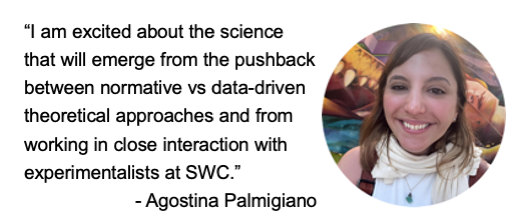
We are delighted to announce that Dr Agostina Palmigiano (@APalmigiano) will join the Gatsby Unit as Lecturer in January, developing data-driven theoretical approaches to uncover neural mechanisms underlying cognitive functions.
Learn more at https://t.co/sJaIdH1YWw
The brain has bottlenecks: places where lots of cells pass information to only a few cells. That might actually be a good thing. New research by @SMusciMol & Ashok Litwin-Kumar on @NatureNeuro suggests bottlenecks help us learn and sense the world:
https://t.co/C6tLI4ESIy
Our News & Views related to this interesting work by @jason_z_kim and @DaniSBassett, about engineering recurrent neural networks, is out!
Read it here (free access link): https://t.co/4pE3sMwxaT
Written with @guachitaspencer and @KanakaRajanPhD
Have you ever wanted to program dynamical models directly into your RNNs the same way you do computers? Ever wanted to extract the analytical model your RNN has learned? find out how here! https://t.co/5SfpfqTWWj. Here's a game of pong programmed into an RNN.
It was a very fun and stimulating collaboration. Thanks for the opportunity and congratulations to @MarkHisted, Bradley @akitakeb, Hannah @hmdougla and colleagues. A wonderful team!
New work from @HistedLab on changes in cortical activity when learning to detect an optogenetic stimulus, click on the thread below!
Thrilled to have contributed w. @KanakaRajanPhD to the modeling of the results using recurrent neural networks.
Happy to share our recent paper, showing cortical pattern amplification with learning, w/ @KanakaRajanPhD lab,
just pub'd in Curr Biology. 🧠📄
Below in thread: Huge percept. improvement. No vis resp changes. Simple recurrent model. Relationship to recent @PeronLab. +more. 1/14