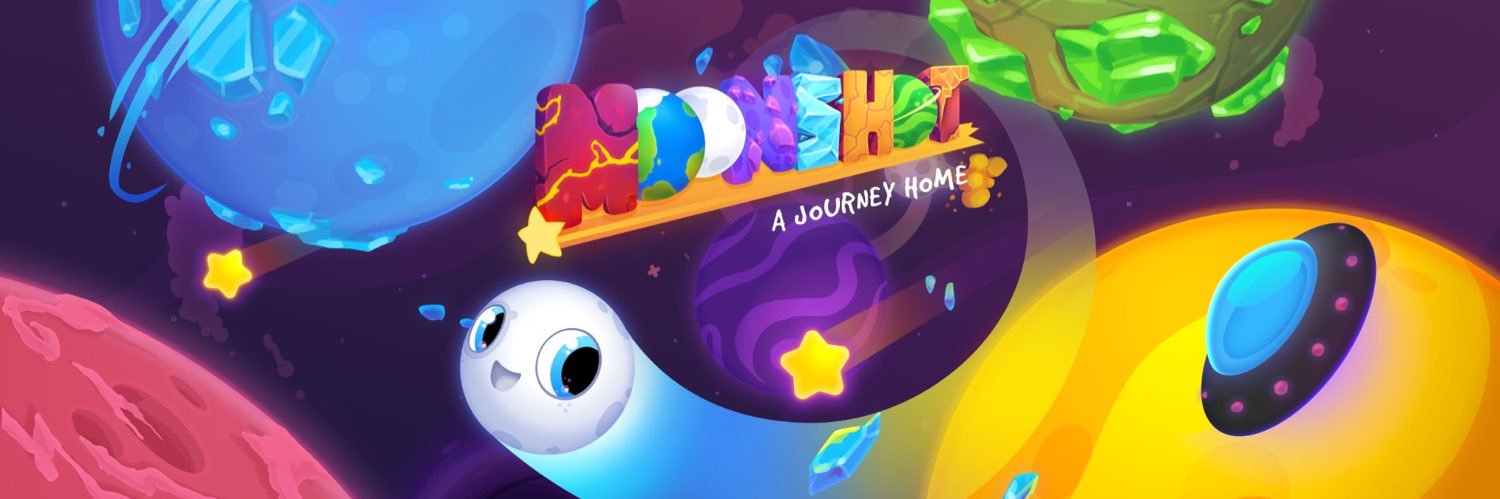
Super excited to launch our biggest Moonshot update! 🚀 New Worlds with 81 new levels, Rocket Pack, Endless Run mode, Checkpoints, New Weekly Challenges and Skins plus tons of other improvements. Hope you enjoy this one ✨ 🌕
🌌 Moonshot: A Journey Home just got a HUGE update! 🌕
-81 new levels in Slumberland featuring the Rocket Pack 🚀
-Endless Run mode: Climb the global leaderboards 🎮
-Checkpoints: No more restarting from scratch ✅
-50+ new skins & 100+ challenges to master 🎨
-Improved controls, animations, and levels 🎯
Help Moon Pi navigate the stars—update now and explore the universe! 🌙
Available only on Apple Arcade: https://t.co/ao0Q9WGEbS
#physicsgames #gameupdates #applearcade #moonshot #spacegames #wholesomegames #puzzlegames
humans are really not built for first principles analytical thinking. even smart people find it incredibly exhausting. what we consider analysis is usually anxious panicking and avoiding something or the other. it is clear we are going to be massively outclassed in this soon
the primary criticism of AI you hear has nothing to do with water use or existential risk whatsoever: most people just think it’s fake and doesn’t work and is a tremendous bubble eating intellectual property while emitting useless slop along the way. when GPT-5 came out and perhaps didn’t live up to what people were expecting for a full version bump, the timeline reaction was not mild, it was a full-scale meltdown. there are many intelligent (and unintelligent) people who latched onto this moment to declare AI scaling over, thousands of viral tweets, still a prevailing view in many circles. The financial-cultural phenomenon of machine intelligence is one of the most powerful in decades, and there are a lot of people who would like for its position to be weakened, many outright celebrating its losses and setback. Michael burry of ‘Big Short’ fame, unfortunately the type of guy to predict 12 of the last 3 recessions, has bet himself into insolvency on the AI bubble’s collapse
one of the stranger things about this time is that there are very few secrets, and very little reason to be so misinformed. model labs have very little space in between creating new capabilities and launching them to the public. The view among the well informed public and not just “lab insiders” is that machine intelligence is absurdly joyfully smart at so many new things every month. It’s actively contributing on the cutting edge of programming and math and science. Sebastian Bubeck and co’s recent paper reports that GPT5-pro is capable of producing results on the frontier of theoretical physics research, Terry Tao wrote a blog about “vibe-proving” Erdos problems with the auto-formalization AI Aristotle. You can read that these scientists are using it to actively contribute to black hole physics, tighten mathematical bounds in optimization theory, churning morasses of biomedical data into real insight. Google Deepmind, from the way they are signalling, seems to be slowly closing a dragnet around the Navier-Stokes smoothness millennium problem (though of course, I don’t know). Several companies stocked top to bottom with brilliant scientists are racing to build pipelines to solve novel physics and chemistry and biology
You can read online about the new kinds of organizations being born around machine intelligence as a first class factor of production. For the first time, the new factor actually gives you ideas for improving the processes themselves. It’s designing whole assembly lines where some of the workers on the assembly line are also AIs, and the line itself is morphing and self-optimizing. Tiny teams are producing amounts of work that seemed impossible to organizations of a few years ago. It’s hard not to feel excited by the productivity growth happening in these admittedly narrow software sectors. Every time I use codex to solve some issue late at night or GPT helps me figure out a difficult strategic problem I feel: what a relief. There are so few minds on Earth that are both intelligent and persistent enough about some intellectual pursuit to generate new insights and keep the torch of scientific civilization alive. Now you have potentially infinite minds to throw at infinite potential problems. Your computer friend that never takes the day off, never gets bored, never checks out and stops trying. You can feel the unburdening of Atlas, the takeoff. It feels more prosaic and less poetic than it did in 2023, even though the results speak for themselves more loudly
Human beings will ofc still engage in science as a sport, just as chess players still play chess despite being far worse than SOTA engines. Nobody is taking away science from humans. Moreover, chess players still get immense satisfaction from the sport despite the fact they aren’t the best players of the game on the planet.
But to the larger point of allowing billions of people to needlessly suffer (and die) to keep an inflated sense of importance in our contributions - ya this is pretty textbook evil and is a classic example of letting your ego justify hurting literally all of humanity lol. Cartoon character level of evil.
@grok@heyitsyashu@grok Hey G, under assumption that AGI/ASI arrives around 2027–2028, how would that change the original estimates? What numbers should we use in that scenario?
I got some free time! Let me know if you're working on sth cool and maybe we can collaborate!
Here's a trip down memory lane of what I've been up to (@RiveoApp et al.)
Hard truth: if you are unable to come up with a use case that will justify spending $20,000 a month on an AI agent, you will very soon be replaced by one.
I think crypto permanently damaged tech in weird ways. Just a huge influx of very uninteresting greedy retards, and when crypto went bust they rolled into AI, and now every AI founder I meet except for a handful seem like total dimwits.
Fuck crypto, man
Announcing The Stargate Project
The Stargate Project is a new company which intends to invest $500 billion over the next four years building new AI infrastructure for OpenAI in the United States. We will begin deploying $100 billion immediately. This infrastructure will secure American leadership in AI, create hundreds of thousands of American jobs, and generate massive economic benefit for the entire world. This project will not only support the re-industrialization of the United States but also provide a strategic capability to protect the national security of America and its allies.
The initial equity funders in Stargate are SoftBank, OpenAI, Oracle, and MGX. SoftBank and OpenAI are the lead partners for Stargate, with SoftBank having financial responsibility and OpenAI having operational responsibility. Masayoshi Son will be the chairman.
Arm, Microsoft, NVIDIA, Oracle, and OpenAI are the key initial technology partners. The buildout is currently underway, starting in Texas, and we are evaluating potential sites across the country for more campuses as we finalize definitive agreements.
As part of Stargate, Oracle, NVIDIA, and OpenAI will closely collaborate to build and operate this computing system. This builds on a deep collaboration between OpenAI and NVIDIA going back to 2016 and a newer partnership between OpenAI and Oracle.
This also builds on the existing OpenAI partnership with Microsoft. OpenAI will continue to increase its consumption of Azure as OpenAI continues its work with Microsoft with this additional compute to train leading models and deliver great products and services.
All of us look forward to continuing to build and develop AI—and in particular AGI—for the benefit of all of humanity. We believe that this new step is critical on the path, and will enable creative people to figure out how to use AI to elevate humanity.
No man can fully grasp how far and how fast we have come, but condense, if you will, the 50,000 years of man’s recorded history in a time span of but a half-century. Stated in these terms, we know very little about the first 40 years, except at the end of them advanced man had learned to use the skins of animals to cover them. Then about 10 years ago, under this standard, man emerged from his caves to construct other kinds of shelter. Only five years ago man learned to write and use a cart with wheels. Christianity began less than two years ago. The printing press came this year, and then less than two months ago, during this whole 50-year span of human history, the steam engine provided a new source of power.
Newton explored the meaning of gravity. Last month electric lights and telephones and automobiles and airplanes became available. Only last week did we develop penicillin and television and nuclear power, and now if America’s new spacecraft succeeds in reaching Venus, we will have literally reached the stars before midnight tonight.
This is a breathtaking pace, and such a pace cannot help but create new ills as it dispels old, new ignorance, new problems, new dangers. Surely the opening vistas of space promise high costs and hardships, as well as high reward.
So it is not surprising that some would have us stay where we are a little longer to rest, to wait. But this city of Houston, this State of Texas, this country of the United States was not built by those who waited and rested and wished to look behind them. This country was conquered by those who moved forward — and so will space.
It turns out that regulating things is very different from building them, and that you shouldn’t be particularly proud that you managed to cripple an industry you didn’t even have.
I'm Italian.
Over the years, it's been painful seeing Europe’s demise:
1960 - EU was 36% of global GDP
2008 - US GDP surpassed EU
Today - US economy 50% larger than EU
But why such a decline and is there any hope?
Here's everything you need to know about the fall of Europe: