this is the first fully generative gaming platform
no code, everything is handled by models
- create a game from one sentence
- world model generates frames in real time as you play
- characters that see you, react & talk back
- set your own rules in plain english goals, items, win/lose
you can try it now and create your own adventures!
Fast Fourier Analysis in action.
Any complex waveform, sound, or shape can be perfectly reconstructed as the sum of simple rotating circles (epicycles).
@JamesMartinSJ@GiveUsThisDayLP Amen father. Also palpable for me this day- “In her motherly care, the Church grants us the mercy of God which prevails over all our sins… at work in the sacrament of reconciliation… day after day in her liturgy the nourishment of the Word and Eucharist of the Lord” CCC 2040
@andrewarruda Lagging slightly behind while others burn the cash can be very high leverage in long run. Like mobile, browsers, PC OS; android behind Nokia blackberry, chrome behind netscape, windows behind Unix
you can instrument capabilities, not competence
for many that have never worked in a scaled organization, the question of how quickly ai can diffuse across the real economy is easy: overnight.
it is self-evident that if a technology offers a better, cheaper, and faster way to do a task, the firm will yield to automation. and if the firm itself doesn't automate, it will lose to a competitor who does.
this is, of course, not how the real world works. organizations are complex machines of flesh, blood, and primarily irrational human behavior.
the market, too, is surprisingly tolerant of inefficiency. large incumbents survive for decades not because they are cost-optimized, but because they possess distribution channels and moats in capital, knowledge, and customer workflow that insulate them from more "efficient" competitors.
many large firms are making massive capital commitments behind ai services this year with the hope of lowering cost, increasing scale, and (unsaid) shaving off some of the exuberant hiring of the zirp years.
my suggestion is that these firms will see almost zero roi from this spend. why? because you can instrument capabilities, not competence.
let me explain.
the adoption of a new capability, like an llm, is an engineering problem. it is deterministic. you purchase the api capacity, you wire up the endpoints, and you measure the latency, the uptime, and the cost per token. you can put it on a dashboard; you can even build a pivot table.
competence, however, is not an engineering problem. it is a human one. you cannot "instrument" an employee's ability to decompose their workflow into machine-understandable steps. a cio cannot deploy a patch that teaches legal departments to view ai as "acceptable risk" rather than a strict "no."
to prove this, think through a task you complete every day—the kind of task that might yield to automation—and begin diagramming it.
how much of that workflow was automatable pre-llm? i would guess more than you suspect.
why have you not automated this to date? because firms make all kinds of decisions that don't strictly optimize for speed, margin, and scale. that is the uncomfortable truth of the firm.
for organizations to become "llm native"—that is, to hand over a meaningful amount of human workflows to these models—we will need to see a reevaluation of skills on the scale of the internet build-out.
remember: most firms got the internet in the 90s; most did not use it to its full economic potential until 2020.
the gap between 1999 and 2020 was not a lack of fiber optic cable. it took thirty years for the "competence" of remote work and digital commerce to catch up to the "capability" of tcp/ip.
executives can buy all the compute they want. they can instrument the capability until their dashboards overflow. but until they do the messy, un-instrumentable work of rewiring entire organizations to trust and utilize these tools, the long march will drag on.
Wow! Super impressive work by the new Amazon FAR team (from Covariant acquisition).
Mapping long sequences of human motion (>30 sec) on robots with a differing shapes or interating with objects (box, table, etc) of different size. Enabling easier in-simulation data-augmentation and zero-shoot transfer.
Super impressive and huge help to reduce the need for human teleop data (which is very complex to gather for humanoids)
Dataset trajectories on Hugging Face (search OmniRetarget), full code framework to come soon
Project page has some pretty three.js interactive demos
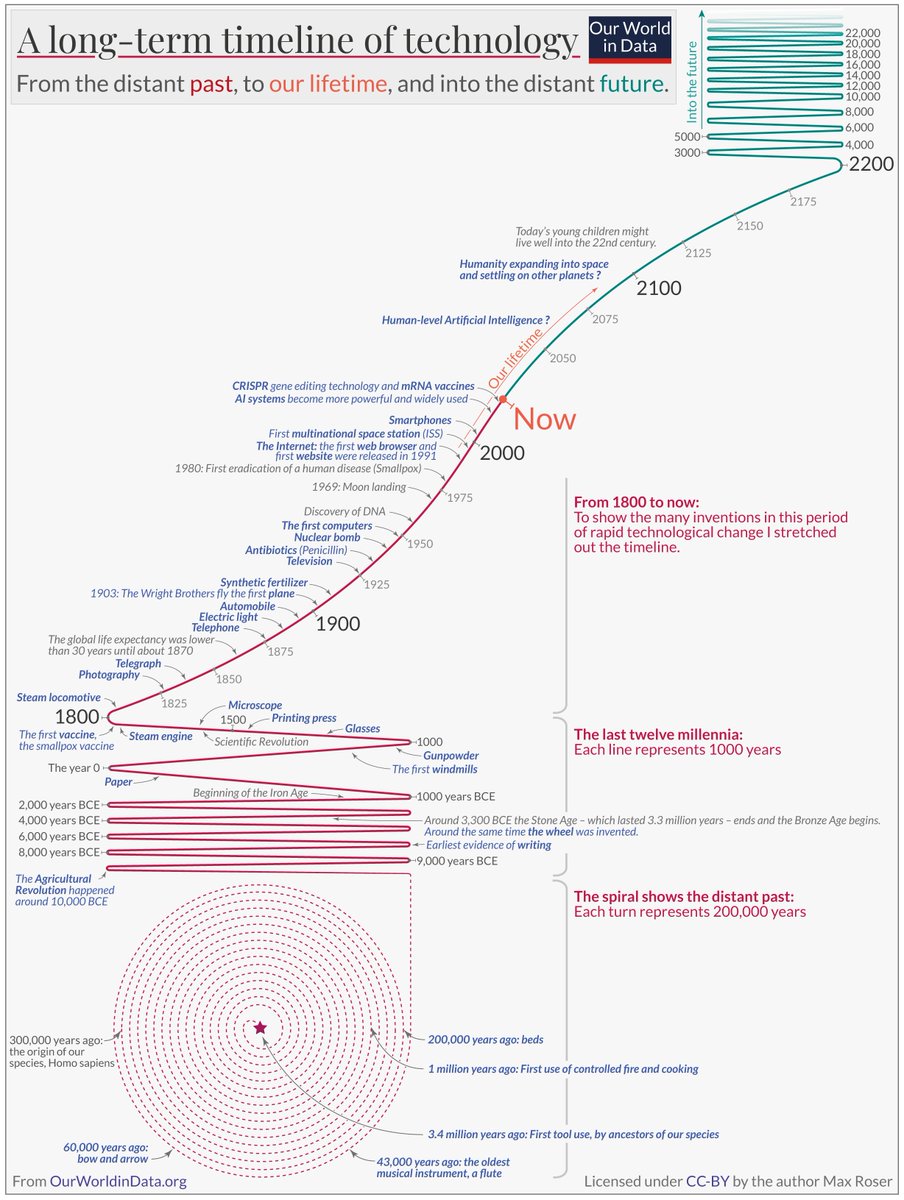
Technology can change the world in ways that are unimaginable until they happen.
Switching on an electric light would have been unimaginable for our medieval ancestors. In their childhood, our grandparents would have struggled to imagine a world connected by smartphones and the Internet.
Similarly, it is hard for us to imagine the arrival of all those technologies that will fundamentally change the world we are used to.
We can remind ourselves that our own future might look very different from the world today by looking back at how rapidly technology has changed our world in the past.
One insight to take away from this long-term perspective is how unusual our time is.
Technological change was extremely slow in the past — the technologies that our ancestors got used to in their childhood were still central to their lives in their old age.
In stark contrast to those days, we live in a time of extraordinarily fast technological change. For recent generations, it was common for technologies that were unimaginable in their youth to become common later in life.
Did you know that with nano architecture ceramics can become flexible?
Aluminum oxide trusses built with hollow struts and ~10nm wall thickness will compress and return to its original shape.