Acoustic neuromas, also called vestibular schwannoma, are benign, slow-growing tumors that can affect hearing and balance. We join @ANAssociation to help sponsor #ANAwarenessWeek2023. Learn more about #acousticneuroma in our Health Topics Library at https://t.co/Y7fCSPtIUK.
@drjonathanchung You are right. There is a volumetric benefit, but with these small / earliest stage tumors - there was no clinical benefit in the 4 year perspective. I think the results justify the conservative approach with postponed treatment until proven growth.
@singhv2003 We don’t have any difficulties with lost to follow-up in our country. The patients adhere. But this can be different elsewhere, like in the US: https://t.co/9dUSQAkSVt
@aswinchari@PatrickGrover4@drtintin99 If lost to follow-up is an issue, there is a benefit. The tumor will likely not grow. If patient is adherent to the MRI controls, it is clinically safe to wait for growth. More long term follow up is needed for the most controversial topic (hearing). We are working on that.
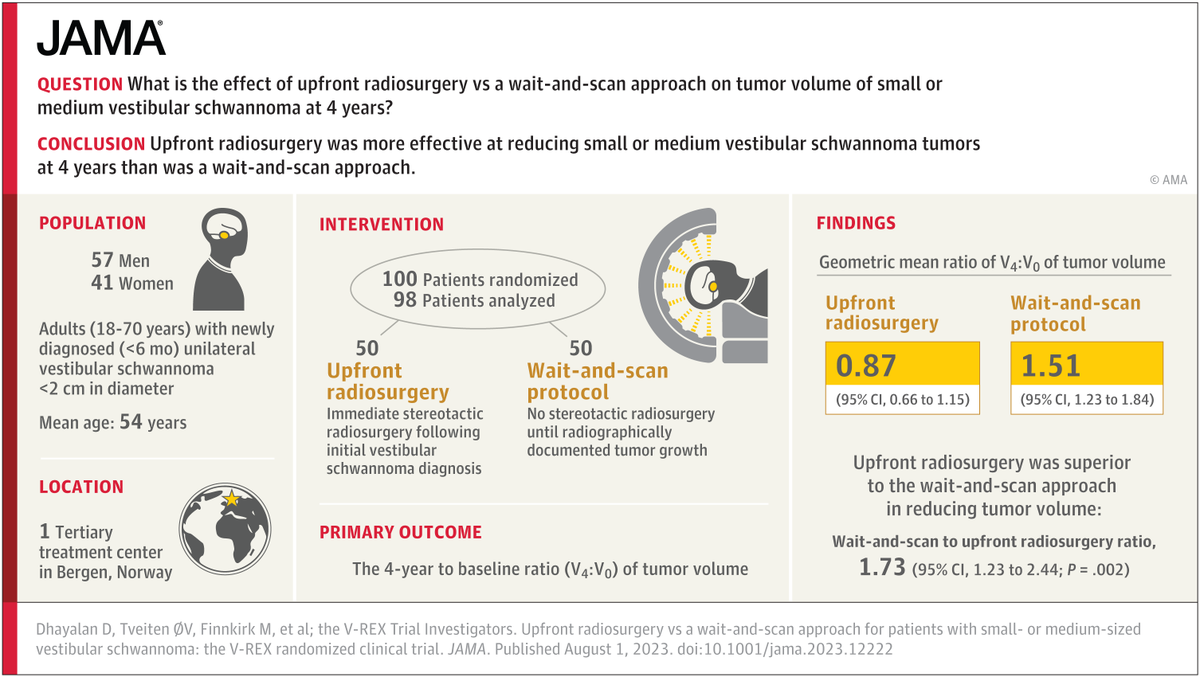
“Among patients with newly diagnosed small- and medium-sized vestibular schwannoma, upfront radiosurgery demonstrated a significantly greater tumor volume reduction at 4 years than a wait-and-scan approach with treatment upon tumor growth”-JAMA #gammaknife https://t.co/2rz70vS56d
Among patients with small or medium vestibular schwannoma, a treatment strategy consisting of upfront radiosurgery was more effective at reducing tumor volume at 4 years than was the initial wait-and-scan approach. https://t.co/Qv3YZVsq2Q