Me, as a trauma/acute care surgeon, when I remember that other surgical specialists can get 44 RVU for an operation...😡🤬
Our general surgery people sold us out on this issue 😐
(Read the 🧵though - it’s a good one about the philosophy of fellowships)
📢 New publication alert!
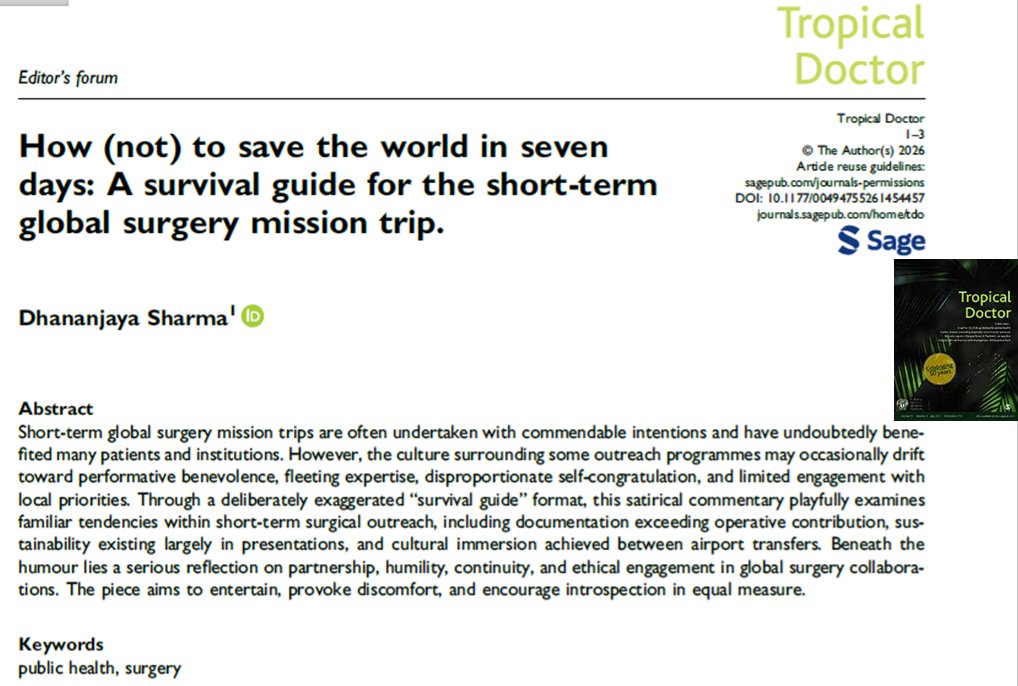
“How (not) to Save the World in 7 Days” - A satirical survival guide to short-term global surgery missions
😄✈️🌍
Humor aside, the paper reflects on humility, ethical engagement in global surgery collaborations and the fine art of not confusing visibility with value
The satire aims to amuse, provoke discomfort, and encourage introspection in equal measure
🔗 https://t.co/0xSPY1lBmk
#GlobalSurgery #GlobalHealth #MedicalSatire #AcademicSurgery #GlobalHealthEthics #MedTwitter
A key challenge for the future of medical training.
A new study suggests simulations can teach procedures, but not always the intuition, touch and practical judgement clinicians develop through real-world experience. #healthcare
https://t.co/gGF2p5a4TE
Humans just flew around the Moon for the first time in 50 years. So what comes next and are we actually ready for it? This month's Planetary Report goes deep on the physiology of long-duration spaceflight, the policy forces shaping human exploration, and the technology bridging Apollo to Artemis.
Download the PDF version for free: https://t.co/mn6WvrxTWn
For two decades, ESA has sent a medical doctor to brave the cold at remote Concordia station in Antarctica.❄️
This unique environment -isolated, confined and extreme–mirrors many of the psychological and physiological challenges astronauts face in space. #spaceanalogs
For AI we need “a minimum safety standard before a system can be built and released. This is how we handle nuclear power, airplanes, buildings, elevators, hairdressers and sandwich makers. Is it too much to ask of trillion-dollar AI corporations?” https://t.co/oZTxKi2nvv
Eric Schmidt saying the quiet part out loud: "What I don't like about [China's AI] is that it's all open source which means it's largely uncontrolled and not controlled in any way by us."
He adds, "if that makes you feel any better," that only 2 or 3 countries can be independent AI powers.
In other words, it's all about hegemony: the ideal scenario is a world where AI is controlled by the US - and the fewer countries that can resist that, the better.
Src for the video: https://t.co/Gk5iAMtBqa
Two things can be true at the same time:
- AI is already revolutionizing medicine through more accurate diagnoses;
- Doctors should learn how to use AI, when not to use it, when its outputs are wrong, and what to do when it is not available.
My full article below.
Still early, but for LMICs, AI may relieve a core bottleneck: scarce frontline clinical capacity
Impact requires primary health care systems that can capture the diagnostic data & turn encounter-level intelligence into longitudinal, preventive, high-touch, population-based care
#Opinion#AI Won’t Fix Physician #Burnout — Giving Them More Autonomy Will - AI documentation tools are genuinely useful. But they are treating a symptom, not the disease. The disease is that physicians have lost control over how they work. https://t.co/I42HFcVln0
From love songs to lullabies, songs spanning the globe—despite their diversity—exhibit universal patterns, according to the first comprehensive scientific analysis of the similarities and differences of music across societies around the world.
Learn more on #WorldMusicDay: https://t.co/1zGEZN2TZv
Motor cortex signals span far more than one body part: across 45 movements, every recorded region carried distinguishable information about the entire body, hinting the classic motor homunculus is too neatly partitioned. @nature https://t.co/m1EGOUJaCd