This is the fifth company in my Precision Engineering series — after Azad Engineering, Sona BLW, Sansera, and Macpower — OBSC Perfection
I keep saying this series will wrap soon, and it keeps giving me another name I can't skip. OBSC Perfection is a company that started with a single CNC machine and has quietly turned itself into a multi-process engineering powerhouse. Let me walk you through why.
What started as a CNC shop is now a build-to-print platform
OBSC operates on a "build-to-print" model — they manufacture highly complex, precise metal components to their clients' exact designs. That started with CNC machining. It doesn't stop there anymore.
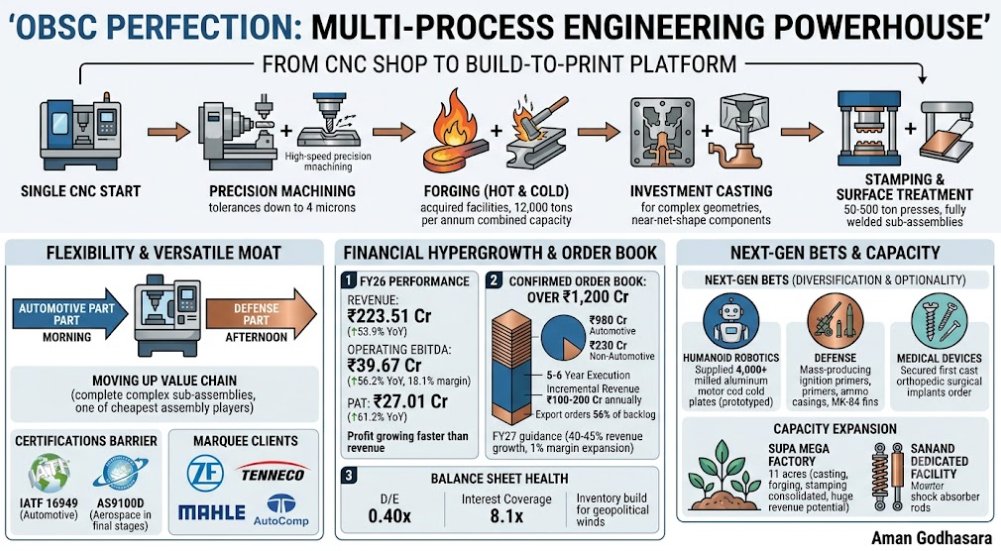
-->Precision Machining — multi-axis turning and high-speed precision machining, capable of tolerances down to 4 microns across 100+ product profiles.
-->Forging (Hot & Cold) — acquired facilities in Faridabad, combined capacity of 12,000 tons per annum, for high-strength, large components with minimal material waste.
-->Investment Casting — for complex geometries and near-net-shape components.
-->Stamping & Surface Treatment — recently acquired stamping presses ranging from 50 to 500 tons, aimed at producing fully welded sub-assemblies.
Four manufacturing processes, brought in-house one acquisition at a time. That's not a company staying in its lane.
Where the revenue actually comes from
-->By industry — Automotive dominates at 85.6%, followed by Marine (6.3%), Defense (5.6%), and Renewables (2.5%).
-->By geography — 80.4% domestic, 19.6% exports, reaching 17 countries including the USA, Germany, and Italy.
-->Key products — shock absorber rods (8-9% of revenue), sensor bosses, electronic percussion fuze parts, and fasteners.
Still heavily automotive today. Where this gets interesting is what they're building toward.
The moat here is about flexibility, not just capability
-->Fungible machinery — because they're a build-to-print manufacturer, the same CNC machine cutting an automotive part in the morning can be reprogrammed for a defense part by afternoon. That's real insurance against a downturn in any single industry.
-->Moving up the value chain — by bringing casting, forging, and stamping in-house, OBSC is positioning to sell complete sub-assemblies instead of individual parts. Management's own framing: this makes them one of the cheapest assembly players in India, since they're not buying raw parts from external competitors.
-->Certifications as a barrier — they hold IATF 16949 for automotive and are in the final stages of securing AS9100D for aerospace. That certification alone takes most companies years to clear.
-->Marquee clients — ZF, Tenneco, MAHLE, and Tata AutoComp, the last of which connects them into Tesla's supply chain.
Now the numbers :-
-->Revenue: ₹223.51 Cr in FY26, up 53.9% YoY.
-->Operating EBITDA: ₹39.67 Cr, up 56.2% YoY, at an 18.1% margin (19.5% including other income).
-->PAT: ₹27.01 Cr, up 61.2% YoY, at a 12.1% margin.
Profit growing faster than revenue, which is growing faster than 50% — that's a company scaling and getting more efficient at the same time.
The balance sheet is healthy, with one honest caveat
-->Debt-to-Equity: 0.40x, interest coverage at 8.1x — comfortable room to borrow if needed.
-->ROCE: 18.0%, ROE: 15.7% — both strong, though management was upfront that these compressed slightly from FY25 due to a recent IPO and a ₹43.3 Cr preferential issue expanding the equity base. Worth knowing the ratios dipped for a structural reason, not a performance one.
-->Cash Conversion Cycle: 101 days, up 7 days YoY — management deliberately built up inventory to navigate geopolitical headwinds like the West Asia conflict and tariff issues, ensuring zero supply disruption for clients. A conscious trade-off, not a working capital problem.
The order book is what actually locks in the next several years
-->Confirmed order book of over ₹1,200 Cr — ₹980 Cr Automotive, ₹230 Cr Non-Automotive — to be executed over the next 5-6 years, adding roughly ₹100-200 Cr of incremental revenue annually. Export orders make up 56% of this backlog.
-->FY27 guidance: another 40-45% revenue growth, with a 1% margin expansion expected from higher-margin export orders.
Where the capacity is coming from
-->Supa, Maharashtra — ~11 acres acquired for ₹17-18 Cr to build a consolidated "Mega Factory" housing casting, forging, and stamping under one roof. At peak utilization, this single plant has revenue potential of ₹700-800 Cr.
-->Sanand, Gujarat — a dedicated facility primarily to supply shock absorber rods to Tenneco, expected to generate ~₹40 Cr in revenue.
And then there's the part that genuinely surprised me — the next-gen bets
-->Humanoid robots — they've supplied over 4,000 prototyped aluminum milled cold plates, used to cool motors in humanoids, for a major global project.
-->Medical devices — secured their first order for cast orthopedic surgical implants made of high-chrome/cobalt.
-->Defense — mass-producing ignition primers for artillery guns, ammunition casings, and MK-84 bomb fins.
A company that's 85% automotive today is already shipping components into humanoid robotics and defense ammunition. That's the kind of optionality you don't often see priced into a name this size.
Why I'm sharing this
85.6% automotive concentration means this business still lives and dies with that cycle until the diversification genuinely scales, and the FY27 guidance of 40-45% growth needs to actually land.
I'm sharing it because a fungible manufacturing base, a 5-6 year visible order book, and real early traction in humanoid robotics and defense are exactly the traits my checklist is built to catch.
Not investment advice. Curious how you'd rank this against Sansera or Macpower in this series — let me know below
#Investing #IndianStockMarket #SmallCap #PrecisionEngineering #OBSCPerfection
💫PROMOTERS ARE GOING ALL-IN 🚀
🗽 Promoters Are Loading Up BIG TIME Up to 9.89% Stake Surge 🔥
Don’t Miss This Massive Spree💡
A MEGA 🧵 Thread 🧵 👇 👇 👇
1 . Aster DM Quality Care Ltd 🔖
#asterdm
Krishna Rao is the CFO of Anthropic, and this is his first podcast appearance.
He joined the company two years ago when run-rate revenue was about $250M. Today it is $30B. He has helped raise ~$75B and is responsible for the procurement and allocation of compute.
I feel lucky we get to hear what it is like to sit inside a company this consequential at a moment this pivotal.
We discuss:
- The cone of uncertainty
- How he allocates compute across Trainium, TPUs, and GPUs
- What investors misunderstand about model companies
- Why the returns to frontier intelligence keep rising
- Platform vs application and where Anthropic builds its own products
- How Anthropic uses Claude internally
I have asked my closing question about the kindest thing more than 500 times. Krishna's answer is one I have never heard before.
Enjoy!
Timestamps:
0:00 Intro
2:38 The Compute Canvas
6:51 The "Cone of Uncertainty"
11:58 Why the Returns to Frontier Intelligence Are So High
16:45 Recursive Self-Improvement
20:20 Scaling Laws
23:30 Sourcing $100 Billion in Compute
28:05 Platform vs. Application Strategy
32:52 Pricing Dynamics
38:48 How Anthropic’s Finance Team Uses Claude
43:24 Raising Capital & Overcoming Investor Skepticism
52:32 Public Perception, Risks, and Government Regulation
57:25 Mythos Release
1:12:33 What Could Derail the AI Revolution?
1:13:47 Biotech and Healthcare
1:15:31 The Kindest Thing
The mathematician who outperformed Buffett, Soros, and Dalio, generated $100B+, avg. 66% returns will teach you more about investing than a $200K MBA.
Bookmark this & give it 1 hour, no matter what. It’ll be the most productive thing you do this week.
🚨 Sam Altman literally gave a 43-minute masterclass on turning ideas into billion-dollar companies.
Most people will never watch it.
And instead of hype, he broke down what actually makes startups work.
No fluff. Just reality.
He explained that ideas don’t matter nearly as much as execution. The difference between something small and something massive isn’t the idea it’s how relentlessly it’s built and improved over time.
He also emphasized that the best founders don’t chase everything. They focus on one thing that truly matters and push it forward with extreme clarity. Distraction kills more startups than competition ever will.
And then there’s scale. Truly big companies aren’t built for a niche they solve problems that millions of people care about. If the market isn’t large enough, the outcome won’t be either.
His biggest insight? Startups don’t win because they’re smarter they win because they stay in the game longer and iterate faster.
That’s why this masterclass stands out.
Because while most people are waiting for the perfect idea…
The best ones are already building.
@CNBC_Awaaz
Rohit Sharma - reliance, must have in your portfolio
Virat Kohli - HDFC bank, phenomenal for years, underperforming for last couple if years
Shreyas iyer - Zomato
Shami - Godrej Poperties, cyclical and goes up in short bursts
I’ve spent a lot of time studying Swiggy & Zomato’s business — there’s one thing which stood out to me in their filings.
Swiggy continues to offer its HDFC co-branded card (10% cashback) whereas Zomato discontinued its both of its RBL co-branded cards (before Swiggy’s card Launched in 2023)
I was surprised→ Per reports, Swiggy isn’t funding the cashback! (more below)
Few points here which are worth highlighting ⤵️
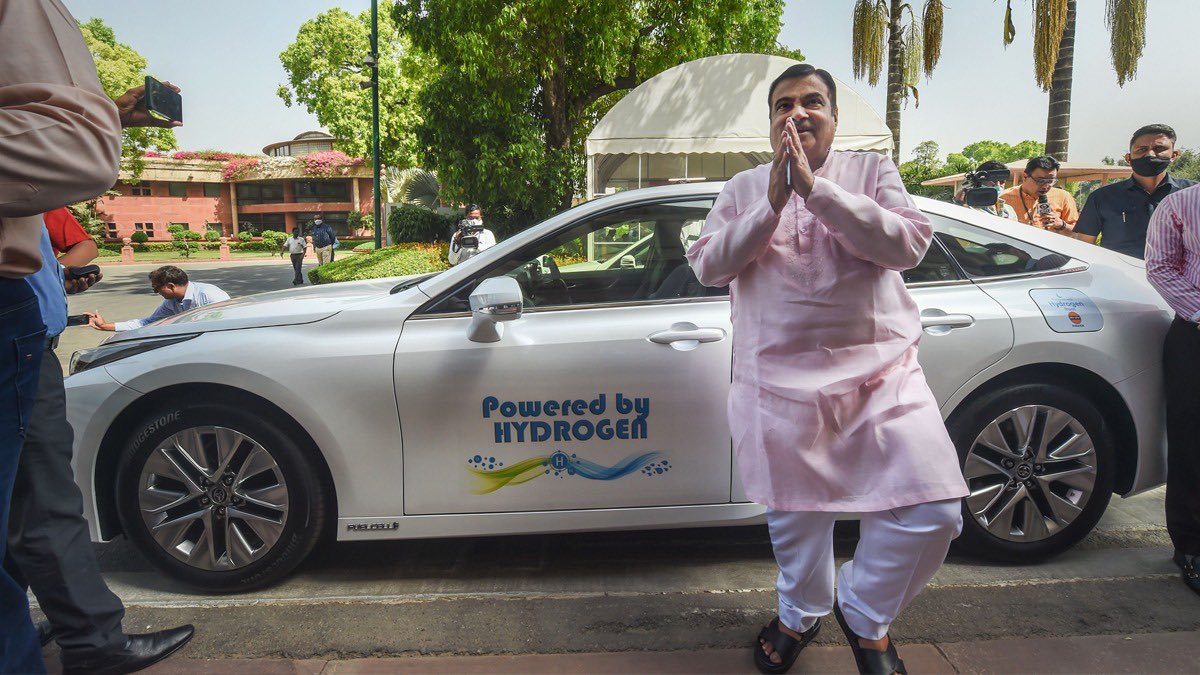
Nitin Gadkari is shifting India from Petrol to Hydrogen instead of Electric
But Elon Musk believes that India is making a grave mistake!
He called hydrogen-powered cars “mind-bogglingly stupid”
THREAD: why Elon might be right🧵
That's a wrap:
If you enjoyed this.
You'll also enjoy my emails.
You'll receive weekly insights on delegation, leadership and EOS implementation.
Grab my free emails here:
https://t.co/r5k5clQne3
This man predicts the future.
He's been fighting wokeism for years & he invested early in Bitcoin, Twitter, and Uber.
And he just said, "A man who regains his voice can never be silenced again".
Naval Ravikant's 4 predictions on social media, attention & wealth creation: