Writing
🌌 THE SOLAR SYSTEM: A MASTERPIECE OF THE UNIVERSE! ☀️🪐
Have you ever wondered how incredible our cosmic neighborhood really is?
At the center of our solar system stands the Sun, a massive star providing the energy that makes life on Earth possible.
Around it, eight fascinating planets travel through space, each with its own unique characteristics:
☿ Mercury – The smallest planet
♀ Venus – The hottest planet
🌍 Earth – Our beautiful home
♂ Mars – The Red Planet
♃ Jupiter – The largest planet
♄ Saturn – The planet of magnificent rings
♅ Uranus – The icy giant
♆ Neptune – The distant blue giant
From the blazing Sun to the mysterious outer planets, our solar system is a breathtaking reminder of how extraordinary the universe is.
✨ The more we explore space, the more mysteries we discover.
🚀 Which planet fascinates you the most?
Drop your answer in the comments and share this cosmic journey with someone who loves space!
Stunning: Light meets shadow in the spiral of the Black Eye Galaxy.
Credit: NASA and the Hubble Heritage Team (AURA/STScI); Acknowledgment: S. Smartt (Institute of Astronomy) and D. Richstone (U. Michigan)
Writing
🌌 THE SOLAR SYSTEM: A JOURNEY THROUGH THE WONDERS OF OUR UNIVERSE! ☀️🪐
Have you ever stopped to think about how incredible our cosmic neighborhood really is?
At the center of our Solar System shines the magnificent Sun, a giant star that provides the energy and light essential for life on Earth.
Around it, eight fascinating planets travel through space, each with its own unique beauty, mysteries, and characteristics.
🚀 Explore the wonders of our Solar System:
☀️ The Sun: The heart of our Solar System and the source of light and energy.
☿️ Mercury: The smallest planet, with extreme temperature variations.
🌍 Venus: A world with a thick atmosphere and scorching surface.
🌎 Earth: Our beautiful home, the only world currently known to support life.
🔴 Mars: The Red Planet, holding clues about its ancient watery past.
🪐 Jupiter: The largest planet, famous for its enormous storms.
💍 Saturn: A magnificent gas giant surrounded by spectacular rings.
🔵 Uranus: An icy giant that rotates almost on its side.
🌊 Neptune: A distant blue world with incredibly powerful winds.
✨ Every planet has a story. Every orbit reveals another mystery.
And every discovery reminds us how vast and extraordinary the universe truly is.
The more we explore space, the more we realize how much we still have to learn.
One Sun. Eight Planets. Countless Wonders.
An Infinite Universe! 🌌
💬 Which planet fascinates you the most, and why?
❤️ Like, repost, and follow for more amazing space discoveries, astronomy facts, and incredible journeys through the universe!
Esta es, sin duda, una de las formaciones más conocidas del firmamento: los Pilares de la Creación. Inmensas columnas de polvo y gas, en el interior de la nebulosa del Águila, a 6500 años luz del Sistema Solar. Aquí, la vemos en el espectro infrarrojo a través del telescopio James Webb, permitiendo ver regiones de las columnas que están colapsando gravitacionalmente (donde están naciendo nuevas estrellas). #FelizLunes
The heart of our galaxy glows like a crowded furnace of ancient stars.
At the center of the Milky Way sits the galactic bulge—a dense, roughly spherical swarm of billions of older stars packed into a region about 10,000 light-years across. Hidden within that brilliant knot lies Sagittarius A*, the supermassive black hole that anchors everything we see in the night sky.
NASA captures the first direct evidence of a massive star swallowing its smaller companion
The merger triggered a powerful eruption, leaving behind clouds of dust that hide the newly formed star. Scientists hope to see the two shine as one in the future
A "S"urprising Hubble view!
The galaxy pair IC 2545 almost appears like an "S" in this image. Both cores of the merging galaxies are still visible in the central region.
IC 2545 is located around 450 million light-years away: https://t.co/8ABG8oyR3k
Ready for a history lesson?📜
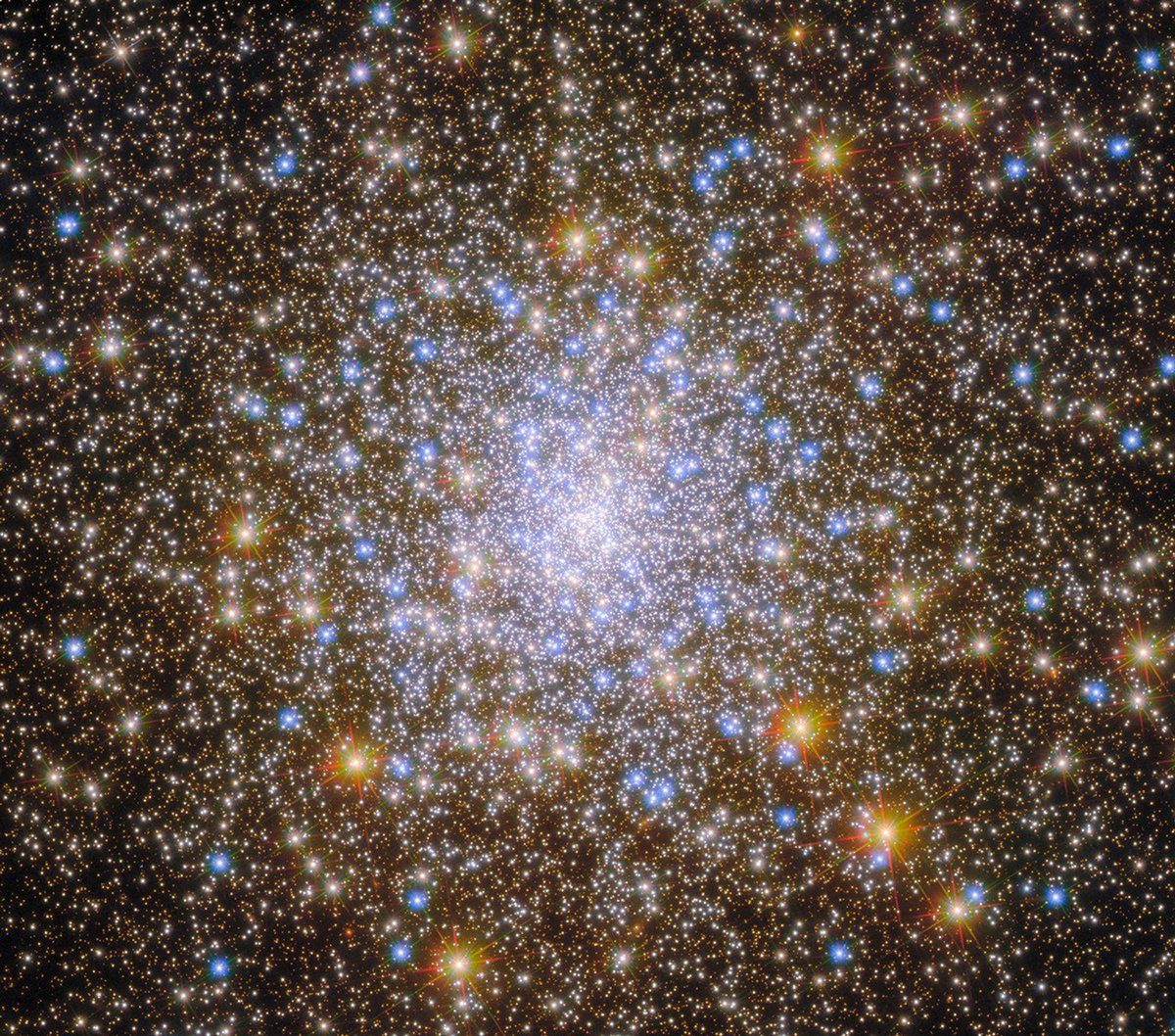
This is a @NASAHubble image of a globular cluster named Messier 30 that contains anywhere from tens of thousands to millions of stars. Astronomers estimate that clusters like this one are 11.5 to 13.5 billion years old!
🔗 https://t.co/o6TAabh6TA