Old friends are the best friends. Jensen rocks.
The Star Mind computer being co-engineered by SpaceX and Nvidia is far better than almost anyone expects and will reach volume production next year.
Working with the incredibly talented Nvidia engineering team is pure joy!
Mehn… looking at how much I have spent on this my AI journey.
It’s not for the faint of heart, especially if you’re building and improving agent systems for video models
"Software development is dead" they said.
Last month a client paid me $20,000 for an app. My cost was $200 for Claude Code.
It's a kiosk mode app for android tablets in taxis. Ads for partner companies, tipping the driver, admin, backend, the whole thing. Now live in production.
I didn't write a single line of code. Still took 1 month of constant work.
The best part? The client came to me with a vibecoded version first. It was horrendous.
He paid $20k because he needed someone who has done this before, professional design, real assurance, and 12 months of support.
You can't vibe code that.
Without AI it would have taken 3 months and cost him 2-3x more.
Developers using AI will always win. Stop listening to people who say software is dead for views.
For Those Who Create. KLING 4.0 Is Now Fully Available. 🎬
What’s New, Starting Today
🖥️ Access Kling 4.0 through a refreshed creation interface on https://t.co/Cp8MI8H1RH
🔗 Access Kling 4.0 through MCP and CLI for greater flexibility in your video creation workflow
Coming Soon
🎨 10-bit HDR video output at 4K and 1080p resolutions
🛠️ API access for enterprise customers and developers
You call the shots. Let the creating begin!#Kling4 #KlingAI
I vibe-coded beehiiv, and it's 83% cheaper.
✨✨ Introducing https://t.co/D3PMnJqNa5 ✨✨
Everything you need to run a newsletter...
✍️ Editor
📅 Scheduling
📈 Stats
🌐 A website for every issue
🛡️ Deliverability guardrails
🔗 Send from your own domain (and keep your reputation)
And it's not a dinosaur tool:
+ It's open source; you can run it for free
+ It's agentic; everything in the UI is available to your AI
Import from beehiiv, Substack, or Mailchimp in 2 minutes.
You pay for the emails you send, not for dormant subscribers. From $19/month.
Oh, and no "Powered By" badge at the bottom of your emails.
🚨do you understand what Zuckerberg just admitted about Meta's first frontier model.
Zuckerberg: "We're gonna write this check for like $100 billion, $200 billion. I'm like, Alex, are you sure this is going to work?"
Alexandr Wang: "…certainly not clear at all that it was going to work."
it's called Muse Wonder.
here's the part nobody is talking about:
> Meta's own tests put it level with Fable 5.1 and GPT-6 Astra
> on MemoryBench it beats Fable, Opus and Astra
> $4 input, $20 output per million tokens, same tier as Opus 5.5
> trained at Prometheus, Meta's new data center in Ohio
> no independent benchmarks yet
$200 billion. one bet. and the guy signing the check wasn't sure it would work.
now we find out if it did.
watch the clip below ↓
Today, I wanted to know how much money I've spent, so I vibe-coded a financial report that connects to all of my accounts.
Since my wife wanted to see the report, I also vibe-coded a messaging app and sent her the PDF.
Before opening the file, she vibe-coded a PDF viewer and made it run on her vibe-coded operating system.
I think we did a great job, so I'm now vibe-coding a GitHub clone to share the code and prompts we used. I hope you vibe-code a browser to download it all when ready.
Lovable is a scam.
So is Replit, Base44, Framer, and all AI website builders.
These are for low IQ people who don’t know how to use AI and fall for SaaS marketing gimmicks.
You are paying a premium for less usage, shittier models, shittier websites, and hand cuffing yourself to a SaaS ecosystem you don’t control.
A $100/month Claude Max plan (or ChatGPT Pro) is a better solution BY FAR
Elon Musk pulled his kids out of school and just… built his own. Inside a rocket company. As you do.
No grades. No standardized tests. Just real problems that need solving. The school was called Ad Astra — Latin for “to the stars.” Because of course it was.
His argument is devastatingly simple: schools teach you the wrench, never the engine. You spend 12 years learning tools with zero context for why they matter. So your brain — which is literally wired to delete useless information — throws most of it away by graduation.
That’s not a flaw in students. That’s a flaw in the design.
And now we have AI — the greatest teaching tool ever built — and kids are using it to skip the thinking entirely. We didn’t get smarter. We got better at avoiding the hard part.
The tool got a PhD. The education system is still handing out participation trophies.
This line needs to be reread 1000 times over
“It's pretty clear we're living through the reinvention of the computer. The model is the CPU, the harness is the operating system, and skills and plugins are the apps. Thinking about it that way makes it easier to see where the whitespace is.”
I spent 48 hours in SF hanging out with billionaires, data labs and AI founders and execs running $1B to $100B companies.
My observations:
1. Sooo MANY stories of data brokers making like $2M a WEEK selling company data to labs. I can't tell if it's the beginning or a bubble, and I kept wondering which niches are left. Digging into it actively.
2. At dinner, someone asked the table, "If a new model drops next month, does your company get better or worse?" HALF the table went quiet! I think that's the best question to ask about any AI startup right now.
3. The bar people talk about now is hitting $1B in revenue in 12 months (I guess that's the new unicorn?). What I didn't hear much about is retention. AI revenue can come in fast and leave fast, and I think we're going to see a lot of stories of AI companies with huge revenue and terrible retention.
4. It's pretty clear we're living through the reinvention of the computer. The model is the CPU, the harness is the operating system, and skills and plugins are the apps. Thinking about it that way makes it easier to see where the whitespace is.
5. We're maybe 12 months from an agent that can watch you work for a week and then do your job without any instructions. The screen recording plus agent memory plus local model combination makes this possible right now.
6. Agent harnesses feel like the new GPT wrappers, in a good way, especially vertical ones. The best teams I talked to treat the model as swappable. One founder walked me through routing different models to different jobs: one for taste and visuals, a cheaper one for the everyday stuff, another for text.
They use prompts they can move across models over fine-tuning, and A/B test the output on what users actually do with it: do they edit it, export it, share it? A vertical harness is basically four things: the connectors for that industry's data, evals written by people who know the work, rules for what the agent can and can't touch, and a clean screen for a human to review. The model is maybe 20% of it.
7. There's a lot of reverse engineering going on/cloning going on more than I've ever seen. People are decompiling software and rebuilding it with agents, and someone showed a suite of like 10 apps that are worth $5B+ each all that he cloned open source. Me and everyone are still thinking through what it means when software gets this easy to copy.
8. My guess is the value moves to data. If the software can be rebuilt quickly, what's worth paying for in a legacy SaaS company is the years of customer data and workflows inside it. Some SaaS companies are secretly data companies.
Gets me thinking about how do you truly value data for this saas companies? Like if we were buying these dying saas companies at 2x ARR before (as example), maybe there is a better metric. Idk, just thinking out loud here.
9. It feels like a good chunk of legacy software won't make it to the agentic era, especially anything built around people clicking through a lot of screens.
10. Every company I talked to wants to pipe its internal data into one place and expose it to agents through MCP. Then they look at the data and realize it's a mess: five versions of the same customer, old Slack channels, PDFs nobody can search. Cleaning that up feels like a big consulting opportunity!
11. A lot of founders are building the basic building blocks for agents: APIs, data layers and tools. Some of the companies I saw barely have a UI because the main user is an agent. I really believe the startups that build primitives to this agentic era will do extremely well. Building blocks is the best way to think about it.
12. Labs can get plenty of training data, but it's harder to get real examples of agents failing inside companies. Whoever has those logs has something valuable.
13. Someone running a big consumer company told me the next fight is over memory. The model that remembers the most about you wins, and the smartest model matters less than people think.
14. Physical AI came up a lot. Astra I think was the first model that got people into AI can actually do CAD, and I think a lot of people are thinking what does vibe manufacturing really look like. The line I keep thinking about came from a robotics founder: the hardest problems in AI are deployment problems now, not research problems. Their robots work on their own, call a human when they get stuck, and every one of those calls becomes training data.
15. Cybersecurity companies are having a moment and are actually cool companies to build now, especially the ones that clean up after a breach. Every agent with access to your systems is a new door into your company, and a lot of those doors were left open.
16. Some startups are worth more dead than alive now. A shutdown company with 5 years of Slack, email and code can get paid for licensing all of it. I wouldn't be surprised if founders start factoring that into when they shut down.
17. People are starting to talk about monetizing the agent web. It feels really early, but when the most popular user of the internet is an agent, what startups should you be building?
18. I think agent insurance is coming. Once an agent makes an expensive mistake, insurers will want audits before they cover anyone.
19. Several people said the hire they want most is someone with taste who can write evals. The models are getting good at generating ideas, so the hard part is judging which ones are good.
20. New trend I observed: startup raises VC, uses venture dollars to become a creator, startup fails, founder falls back on being a full-time creator and incubates other products bootstrapped.
21. Getting SIGNIFICANT distribution is HARD right now. Founders are sponsoring buses, buying billboards like crazy and throwing parties with famous DJs to get noticed. Kinda feels dotcom era in that sense.
Attention is what's scarce! The growth guy going viral sharing his UGC strategy from Wispr Flow is a good example. It's the sauce everyone wants, and I truly believe there are probably only 50 people on the planet who know how to scale these types of businesses efficiently in this era.
Always good to get that dose of SF. I felt sooo lucky to have such an incredible trip during such an incredible time in building businesses. Surreal in so many ways.
Happy to be home and locked in.
Until next time!
AI Videos finally sound real.
Introducing Mirelo SFX 2.0.
It watches your video, cuts the music you never prompted, keeps the dialogue, and builds a full sound design synced to the action and consistent across any length clips.
You’ve made it look right. We’ll make it sound right.
Live today through our API, on @runwayml and @fal.
Other platforms coming soon. (Thread)
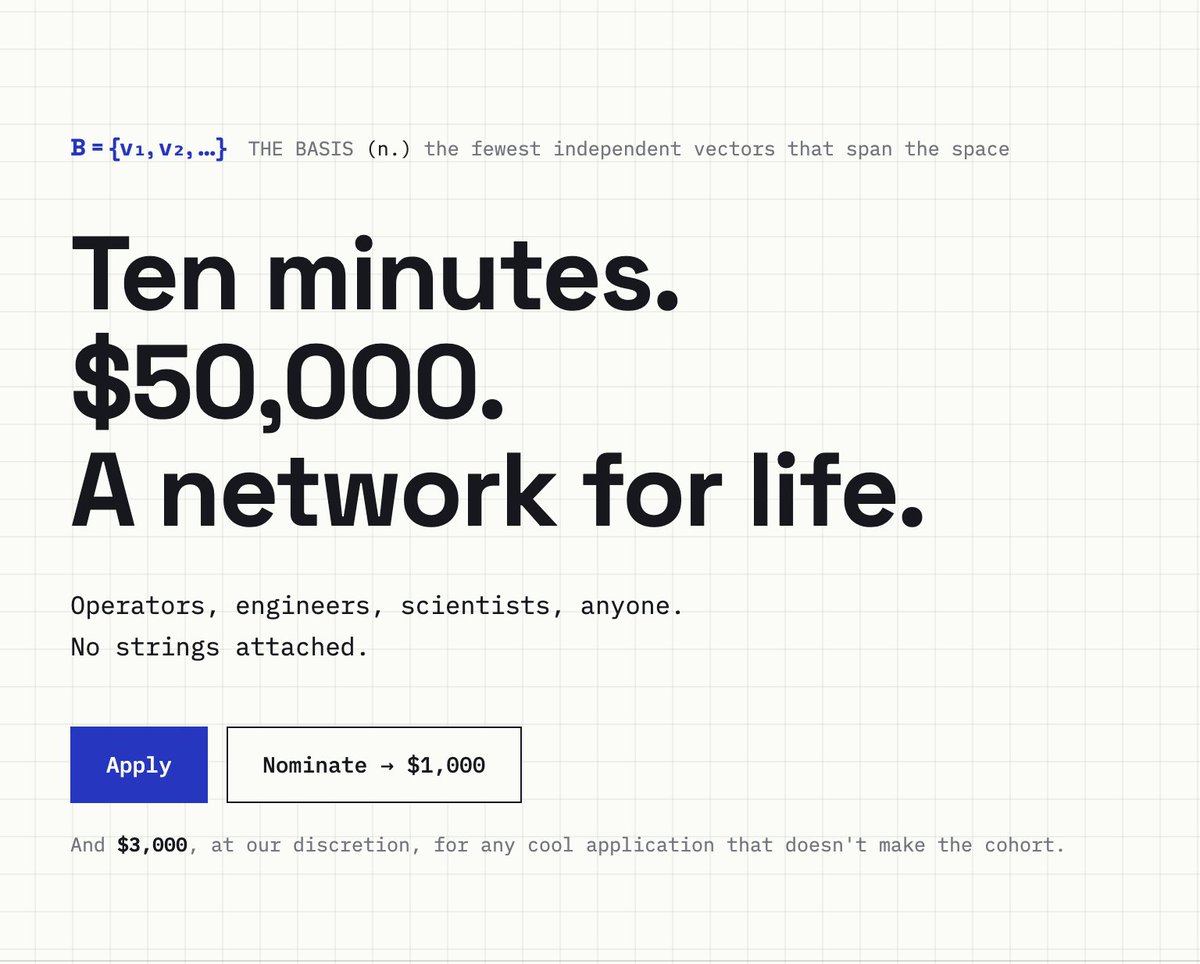
Someone will give you $50,000 to build whatever you want.
No equity.
No reporting.
No pitch deck.
Spend it on anything.
It's called the Basis Fellowship.
• $50,000 cash per fellow
• Open to anyone: engineers, scientists, operators, builders
• The application takes about 10 minutes
• Rolling. Apply anytime
• Didn't make the cohort? They may still give you $3,000
Their words: "We take nothing and expect nothing."
Most people will never hear about this.
Bookmark it and send it to the one builder friend who needs it.
Link below 👇
https://t.co/hl8lSuNDzI
WordPress isn’t dying because it’s bad…
It’s dying because the reason it won (plugins that let non-technical people build anything) is now its biggest weakness.
Once AI can just build the exact thing you need without the plugin tax…
the whole “install 12 plugins and hope they don’t conflict” model starts looking like a relic.