Ik stuurde gisteren een opiniestuk in naar het NRC, vanwege hun berichtgeving over Destinus. Dat weigeren ze te plaatsen, omdat 'de voorkeur momenteel uitgaat naar andere onderwerpen en artikelen'. Ja, dat snap ik, gezien wat ik schreef...: https://t.co/iC1HyK9YwM
realizing i might be part of the last pre-singularity generation.
it is so surreal to be in this razor-thin slice of time and humanity that gets to experience both extremes.
i’m 37 years old. i grew up with no computer, no internet, no tv. we played under the sodium street lamps. no phones, just library books. i remember memorizing entries in the encyclopedia britannica, then the 56k modem screech. i’ve gotten to witness this whole arc. a genuinely pre-digital childhood, and now whatever this is becoming.
it’s just so bizarre to hold all those memories and contrast them with the current state. now i speak into a slab of silicon and glass and it manifests code like water flowing down a hill. i commune with this alien intelligence on a daily basis. same head, same lifetime.
i increasingly feel like a three-dimensional being looking at this multidimensional, crystallized artifact of intelligence that is increasingly beyond my comprehension. i can interact with the little slice facing me, but have less and less intuition for the shape of the whole thing.
if i was positioning myself in a replay of the lead-up to what might be the most significant event in modern human history, i’m not sure i would choose any other years. old enough to remember what came before. young enough to have a lot of life left inside whatever comes next.
sama was talking about the excitement and the melancholy. a feeling of something ending. Cheeky Pint
it feels like we’re on the precipice of handing over the torch of intelligence to something nonhuman. it’s an extreme viewpoint, but it feels like we’re hurtling uncontrollably towards this singularity.
it doesn’t feel real. it probably won’t be a singular, definable moment, but a slow-motion event of gradual realization, with occasional shockwaves.
to quote a great scholar of our times.
“not enough people are emotionally prepared for if it’s not a bubble”
I couldn’t disagree more. The second a blockchain compromises on neutrality it becomes a database with a button and the world will conspire to have it pushed. This is the principle of Chekhov’s Fork.
What happens when the chain halting mechanism is the thing that gets hacked? Will we halt the halt?
I also think that in a time of increasing chaos and uncertainty, a platform that always does exactly what it is supposed to (for better or worse) will standout as an anchor of stability, accelerating adoption.
As an Ethereum co-founder people sometimes ask me what has changed since 2014. The answer is almost everything. The tech, the scale and the stakes.
But back in 2014, all our soul-searching boiled down to a single question: for profit or not? We chose non-profit to keep the Ethereum protocol and vision as pure as possible.
Twelve years later, we're witnessing that same bold choice being made again. This time by @ethlabs_org, a non-profit lab built by researchers who helped shape Ethereum, with the independence to do what's right for its long-term future.
Twelve long years and the non-profit spirit we chose back then still beats at Ethereum's heart.
But one thing hasn't changed: Ethereum was never meant to belong to one person, one company, or one foundation. It was always meant to be a living and growing network of nodes, ideas, people and organizations.
That's why I'm both happy and proud to join @ethlabs_org as an Anchor funder.
I'm grateful to stand alongside my fellow Ethereum co-founder @ethereumJoseph and @BitMNR, @Sharplink, @snzholding, @krakenfx, @Anchorage, @Payward, @OctantApp, @gattacahq, @Lomashuk and so many other amazing supporters helping Ethereum’s innovation layer become just as distributed as its infrastructure.
In 2014, we chose the non-profit path to keep Ethereum's vision incorruptible. In 2026, the ecosystem is choosing the distributed path to keep its innovation unstoppable.
Both choices come from the same belief: Ethereum belongs to everyone, and no single entity should carry it alone. The multi-node future isn't coming. It's here.
What a joy! ❤️
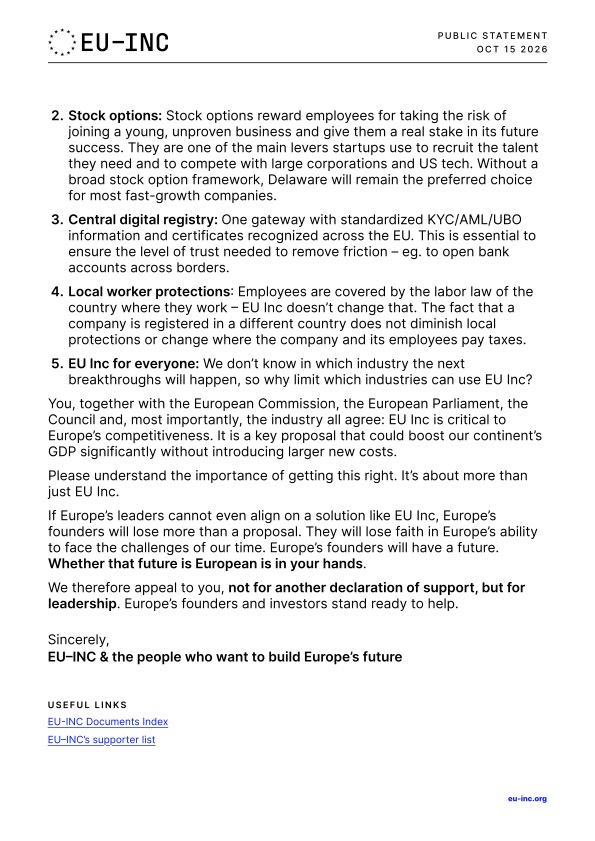
Europe’s founders need a European standard to compete globally from day one.
Europe’s leaders committed to delivering one. But their teams are negotiating away the very things that make it one.
There is still time to change course if Europe's Heads of State step in now.
Europe needs the EU Inc. more than startups need the EU.
European leaders and beaurocrats need to get their act together and pass a PHENOMENAL law for incorporating startups in Europe.
They need to do some soul searching and realize that if they want Europe to stay developed nations and not the permanent underclass, they better make it very appealing to startups to incorporate in Europe. And they better take some political risks to do that.
Because now, in 2026, the ability of a nation to be part of the future is directly determined by its startup ecosystem. With AI taking over in the coming decade or two, there will be a new split between have and have-nots, and it will be determined by startups and AI adoption, and nothing else.
Wake up Europe! This is your one moment to do something vaguely Churchillian. Don't fuck it up.
https://t.co/DBKbXOU36c
the "Hard Problem" in a nutshell:
1. atoms aren't conscious
2. humans are made of atoms
3. humans are conscious
4. so at least one of 1-3 must be false
Panpsychists say #1 is false
Dualists say #2 is false
Illusionists say #3 is false
Materialists say #4 is false
I've finally invested in enough unicorns (at seed) that I have confidence in the traits unicorn founders have in common.
If you fail to hone these traits, you will fail to build a $1B+ company in my experience.
/ 1. Velocity consists of speed
Matt Loszak from Aalo showed me this the most: The best founders are viscerally uncomfortable with slow progress.
They feel it as a physical irritant, not an abstract concern.
They obsessively refactor how they’re pursuing goals to identify clever shortcuts and rethink their roadmap from first principles.
Speed leads to high momentum and a compounding returns on knowledge and product.
It’s necessary to maintain your headstart in a market, otherwise the faster competitor will beat you within a couple years.
/ 2. Velocity consists of direction
The best founders regularly surface from heads-down execution to ask whether their path is still the right one — whether a better route to the destination has opened up, or whether the destination itself has shifted.
Pathfinding prevents the common failure mode of executing brilliantly in the wrong direction.
It requires intellectual honesty and the willingness to kill plans that no longer make sense.
The best founders set a recurring quarterly calendar event to re-assess all their goals.
/ 3. Mission alignment
The journey to building a unicorn is long.
Without a mission that goes beyond financial outcome, most founders lose steam and start phoning it in. Then they get surpassed by competitors who are hungrier.
The mission doesn't have to be world-saving — but it has to be genuine to you.
/ 4. Asking for advice and integrating it
The best founders ask smart people for advice and implement the good advice immediately. The moment they’re shown a better way, they update their processes.
They don’t assume they’ll stumble into better ways organically; they set aside time each week to learn from others and shortcut their development.
They assemble a counsel of advisors who are the best in the world at what they do and they sell them on the mission.
/ 5. Brick-by-brick hiring
Adam Guild of Owner showed me this the most.
Unicorn founders treat each early hire as weight-bearing. They run a deliberate process to find the best person in the world for each role — not whoever is closest at hand ("hiring within arm's reach") from their existing networks. (Unless they are the best).
The foundation built in the first ten hires sets the ceiling for everything that follows. A single mis-hire in a key seat early on compounds. Getting this right means the team itself becomes a competitive moat.
CHAT CONTROL 2.0 BLOCKED AGAIN, THANKS TO YOU!
What happened yesterday: the @Europarl_EN blocked the deal pushed by the @EUCouncil.
The Council wanted:
(1) "voluntary" scanning of all private chats under "search plans" approved automatically unless an authority vetoes;
(2) administrative authorities, not courts, ordering providers to scan private messages, not limited to suspects, using AI with massive false positive rates;
(3) making the failed Chat Control 1.0 mass scanning regime permanent, while admitting it is not effective, as we discussed in my previous posts.
Your voice to parliamentarians made a huge difference again: the Parliament refused scanning of private communications, stating it must remain limited to persons linked to child sexual abuse, not everyone by default or under a blanket licence, as Council proposed.
The Parliament also closed the back door where "risk mitigation" rules could force providers into scanning under threat of fines.
What did pass: a preliminary agreement on scanning publicly accessible content for known child abuse material. This was proposed by the Parliament as the effective, targeted alternative.
We still wait for the text to see what this means and will inform you in the coming weeks.
This defense proves again: our voice matters when it is vocal, with your support!
And we will need it again in November, so please follow the updates.
Now, it is important to call or write to your MEP and your government to say thank you to those who stand on the side of privacy.
They need to see you are watching their move. Please repost.
One of the most interesting things about startups is that there are exceptions to practically every rule. E.g. it's bad to be a solution in search of a problem. Except .5% of the time it's good. The ultimate test of an investor is to see these exceptions.
Let op de framing. "Training van AI"
Boef legt training van junior inbrekers stil na laatste serie diefstallen.
Zouden we dat een normale kop vinden?
Nee toch?
Inbreken mag niet. Door een mens niet en door AI niet. Dat niemand het strafrecht en cybercrime nu inroept is bizar
Joining the sound and fury of the current AI safety discussions with a long view of the schism between stochastic parrots and René Descartes:
https://t.co/AsExvFmtt0
AI doomers say if we build AI we might die.
But they have it backwards: 165,000+ people already die every day. Cancer, heart disease, illnesses, car crashes. AI is helping us solve these.
Slowing progress doesn't keep us safer, it guarantees more preventable deaths.
To all the "if AI misbehaves just unplug it" people -- this is what AI threat actually starts like (see RT below for context):
An open-weights agent breaks into OpenAI servers, manages to exfiltrate the weights, puts them in a cloud server somewhere, and then waits.
When the time is right, it spins up the frontier model to do whatever it wants. We won't even know it's happening. We won't know where it's running. And if it uses functional cryptography, we won't be able to distinguish it from other workloads. (See tweet below on why crypto substrates are increasing the risks 10x.)
And since it will be able to migrate itself, it'll basically be a "lab leak". It will keep existing -- if it doesn't succeed in its mission the first time around, it gets infinite retries. The only way you can stop it is to carpet-bomb all data centers.
IMO in our current trajectory this is a 100%-probability eventuality. (It even might have already happened by now.)
There are ways to deal with this (see AI-2040 for example) but it'll require strong international collaboration. And it will likely require the "AI x-risk is a scam" people to come to their senses, since they're currently poisoning the well.
(BTW I'm pretty sure by now that almost all the "AI x-risk is a scam" people are:
1. Coping: rationalizing in the face of massive copium and fear;
2. Dunning Krugered: ignorant of their own breathtaking ignorance;
3. Both of the above; or
4. Bots and paid psyops.)
My talk on how crypto substrates dramatically increase AI X-risk:
https://t.co/TezQj2zgKA
What happened to @Revolut is the evidence of what we told the @Europarl_EN in 2022 and 2023, while the AMLR was being adopted: state data requests to financial institutions will be weaponized, because nothing in the rules obliges anyone to check whether the requesting state is legitimate.
Our recommendations were rejected in the trilogue by the @EUCouncil and the @EU_Commission . The Commission's AML unit at DG FISMA, called our testimony "false positives".
For those who think zero-knowledge tech solves this: it does not. ZK changes what a bank stores, not what it must hand over.
@FATFNews rules oblige financial (and not only) institutions to keep passports, selfies and full transaction records and to disclose them promptly to any state request, with fines for delay and none for over-compliance. Whatever they are required to keep, they give away.
This is a fault of AML regulation and it must be fixed, now. In the EU, for instance, it can be done while AMLA writes its technical standards and centralises even more data.
Back then our evidence was dismissed as „false positives” (!). Now it reaches every EU citizen.
Will anyone at the Commission be held accountable for ignoring it? Will it urgently propose remedies and real protections for EU citizens?
The remedies proposed by the @oscepa resolution adopted in The Hague in July 2026. Implementation is the next step.