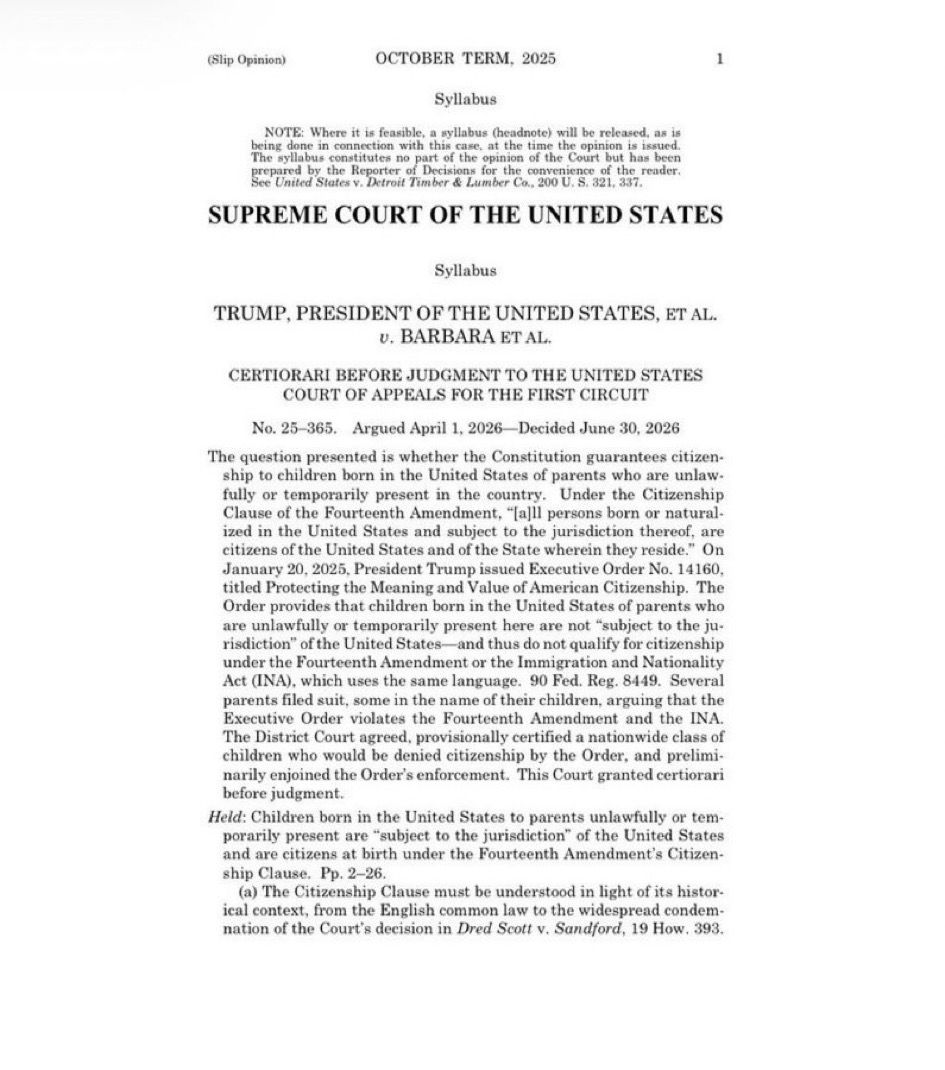
The US Supreme Court struck down President Donald Trump's executive order and upheld birthright citizenship for all children born in the United States.
Ajay Bhutoria, former White House advisor to President Biden and immigration advocate, said, “The Supreme Court’s decision to uphold birthright citizenship is a historic victory for justice, the US Constitution, and the American Dream. By protecting the 14th Amendment, the Court has rejected a harmful attempt to create a tiered system of citizenship and strip rights from children born on U.S. soil. For decades, the South Asian diaspora and millions of immigrant families have contributed to the fabric, economy, and culture of this nation. As we look forward to celebrating 250 years of America, this ruling reaffirms the foundational promise that has made our nation a beacon of freedom and opportunity for two and a half centuries. This ruling ensures that America remains a land of equal opportunity where a child’s future is not determined by their parents’ immigration status."
In the mid-20th century, global academic elites believed a newly independent, rebuilding India lacked the sophisticated intellectual infrastructure to govern its own scientific destiny. Dr. Devendra Nath Mishra responded by storming the highest halls of European mathematics, securing an elite doctorate from the Sorbonne University in Paris & returning to build the absolute backbone of India’s national scientific architecture. He took the reins of the nation's premier research bodies & universities, proving that a sovereign nation could build its own intellectual engine.
This is the story of how Academic Defiance built the Brainweight of a Nation.
In the decades following independence, a subtle but deeply damaging narrative persisted in international circles: India can handle basic administrative work, but advanced scientific policy, complex mathematical research & high-level institutional governance belong to the West. India's brightest minds were expected to migrate to Europe/America to find validation.
The strategic intellectual wealth of the country was constantly leaking away, leaving local universities starved of top-tier visionary administrators. If India wanted to build its scientific future: its rockets, its research labs, its heavy engineering, it had to rely on a curriculum & administrative blueprints designed by foreign minds.
The country was rich in young talent, but that talent was trapped in outdated, post-colonial systems that lacked the confidence to innovate.
D N Mishra was a boy from Lucknow who saw mathematics not just as a subject of numbers, but as the ultimate language of logic & self-reliance. He excelled at the University of Lucknow, but he refused to accept that advanced knowledge was a restricted domain.
He went to the Sorbonne University in Paris, 1 of the oldest & most notoriously rigorous intellectual proving grounds in the world. He conquered their doctoral program, earning a Doctor of Science (DSc) in Mathematics.
When he returned to India, he was armed with a world-class pedigree, but he did not use it to secure a comfortable life abroad. He went straight to the heartland of India, joining Sagar University in Madhya Pradesh to head the department of mathematics.
In the late 1960s, while dominating the mathematics department, he discovered that the university needed a temporary lecturer for French. Instead of waiting for a foreign expert to be flown in, the mathematician simply stepped up & taught advanced French himself, demonstrating a profound defiance against the idea of limited specialization.
Dr. Mishra did not stay confined to the classroom. He realized that a country cannot scale its scientific capability w/o a powerful, top-tier administrative architecture. He began an administrative journey that spanned decades, moving systematically through the gears of the state.
He took up the mantle of Joint Education Advisor in the Ministry of Education, designing the very policies that strengthened STEM disciplines across thousands of Indian colleges. He did not stop there. He stepped into the Council of Scientific & Industrial Research (CSIR) as its Deputy Director, bridging the gap b/w theoretical mathematics & heavy industrial application.
His pitch to the young researchers he managed across India’s labs was unwavering: "Do not look to the West for validation. Your data, your equations & your research must serve the soil you stand on."
In February 1994, Dr. Mishra was called to lead 1 of the most culturally & historically significant institutions in Asia: Banaras Hindu University (BHU), as its 19th Vice-Chancellor.
BHU is not just a university; it is an entire ecosystem of arts, sciences, engineering & medicine founded on nationalistic pride. Dr. Mishra brought his razor-sharp mathematical precision & European administrative rigor to a campus navigating a highly transitional era in modern India.
He restructured governance, protected academic autonomy & ensured that the massive institution ran with the clockwork efficiency of a beautifully balanced eqn. For the 1st time in a generation, administrative policy was not just about bureaucracy; it was about unleashing the pure potential of Indian scholars.
Dr. Mishra’s decades of administrative warfare did not build a single factory; instead, it built the minds that populated every factory, space program & research lab in modern India. By systematically designing policies at the Ministry of Education & CSIR, he ensured that India’s scientific independence was completely institutionalized.
His household itself became a legendary sanctuary for independent thought. He fostered an environment of uncompromising creative & intellectual freedom, so much so that his son, Sudhir Mishra, would go on to become 1 of India’s most acclaimed, fiercely independent parallel cinema filmmakers (the director behind Hazaaron Khwaishein Aisi).
Dr. Devendra Nath Mishra proved that institutional building is the ultimate form of long-term entrepreneurship. He showed that we do not need a balance sheet of profits to build a nation; we need an ironclad system of education.
Dr. Mishra built a Backbone. He proved that an Indian mathematician could engineer the intellectual infra of a multi-billion-dollar nation better than any colonial system ever could.
शुरुआती दिनों में मुझे बिजनेस खड़ा करने का सबसे बड़ा सबक एक बड़ी deal के हाथ से निकल जाने पर मिला, और वो था – delegation (काम सौंपने) का महत्व, और ऐसा न करने का नुकसान।
सरल शब्दों में कहें तो - "खुद सब कुछ करने के बजाय, किसी काम के लिए सही व्यक्ति को चुनकर उसे जिम्मेदारी देना और उसपर भरोसा करना ही डेलिगेशन है।"
मैं शुरुआती दिनों में अपने सारे काम खुद ही संभालता था - एक 'one man army' की तरह।
मेरी सुबह buyers को फोन करने में बीतती थी, दोपहर suppliers के साथ, और शामें बैंक में। मुझे लगता था कि हर काम खुद से करना ही सफलता का एकमात्र रास्ता है, भले ही उसमें दिन का हर एक मिनट लग जाए।
लेकिन फिर एक दिन, सिर्फ एक form समय पर न भर पाने की वजह से एक बहुत बड़ी deal मेरे हाथ से निकल गई। मैं अंदर से टूट गया। तब समझ आया कि भले ही मैं दिन-रात एक कर रहा था, पर मेरा तरीका गलत था।
और फिर मैंने पहली बार एक 'मुंशी' को hire किया।
मुझे लगता है कि हर leader को खुद से एक सवाल जरूर पूछना चाहिए - मेरे एक घंटे की कीमत क्या है? अगर उस एक घंटे का काम कोई और कर सकता है, तो उसे hire कीजिए। और अपना समय वहां लगाइए जहां उसकी असली कीमत है - बड़े सपनों को पूरा करने में।
Carl Sagan explains why a child’s simple question may be deeper than most adults realize.
“Mommy, why is the grass green?”
And very often the child gets an answer like:
“Oh, who knows?”
But that is not a silly question.
It is an extremely profound question.
Because hidden inside it are the fundamentals of biology, light, chemistry, and physics.
How much better it would be to say:
“That’s a good question.”
“Maybe we can look it up.”
“Maybe when you grow up, you can find the answer.”
The tragedy is that many children learn the wrong lesson.
They learn that asking deep questions is somehow bad.
And when that happens, we lose something precious.
We lose intellectual resources.
We lose curiosity.
We lose future thinkers.
Because the complex and subtle problems we face can only be solved by people capable of complex and subtle thoughts.
A child’s question is not an interruption.
Sometimes, it is the beginning of science.
India may launch a funding scheme to develop 5 Regional Medical Hubs with private-sector participation. The hubs will integrate hospitals, medical colleges and research facilities under the FY27 Budget’s medical tourism plan. The programme targets healthcare infrastructure expansion to increase international patient inflows.
Long before famous mathematicians like Pythagoras and Euclid, geometry was not yet a formal science.
Then came Thales of Miletus. He looked at a circle and discovered a rule that no one had ever bothered to prove: If you draw a triangle inside a circle where one side is the straight diameter line, the opposite corner will always form a perfect 90-degree right angle.
This might sound like a minor detail, but it was a massive breakthrough.
History considers this the very first mathematical theorem. Why?
Because instead of just guessing or measuring a few specific examples, Thales used step-by-step logic to prove why this rule must always be true for every single circle in existence.
India has major rare-earth deposits, but it does not yet control the full industrial chain needed to convert them into high-performance magnets.
Much of the precision machinery and know-how is controlled by German, Japanese, and Chinese firms.
Qutbuddin Aibak, the first ruler of the Slave Dynasty in the Delhi Sultanate, died after falling from a galloping horse.
But is it really possible that a general who rode a horse for the first time at the age of 11 and fought countless battles on horseback could die from a galloping horse?
Real History vs. Fabricated Story
When Qutbuddin Aibak plundered Rajputana, he killed the king of Mewar and captured Prince Karan Singh. Along with the looted wealth and the prince, he also took the prince's horse "Shubhrak" to Lahore.
In Lahore, Karan Singh tried to escape and was captured. Qutbuddin ordered his beheading and, to add insult to injury, ordered a polo match played using the dead prince's head as a ball.
On the day of the beheading, Qutbuddin arrived at the venue riding Shubhrak. Upon seeing its master Karan Singh, the horse bolted uncontrollably, causing Qutbuddin to fall from the horse. Shubhrak kicked the fallen Qutbuddin with a powerful kick. The powerful blows to the chest and head proved fatal. Qutbuddin Aibak died instantly in 1210 CE.
Everyone was stunned. Shubhrak ran towards Karan Singh, and taking advantage of the ensuing chaos, the prince jumped onto his valiant horse, which immediately took off running and began the most arduous race of his life.
It was a continuous race for almost more than three days, finally stopping at the gates of the kingdom of Mewar. When the prince dismounted, Shubhrak stood still like a statue. Karan Singh lovingly stroked the horse's head, but was shocked when Shubhrak fell to the ground.
The powerful horse managed to save its master and safely escorted him back to his kingdom before succumbing to his injuries.
We've read about Chetak, but the story of Shubhrak is beyond belief! Facts like this never make it into the curriculum of our modern education system. Most of us haven't even heard of it. Have we?
It is permanently buried in history. It's time to share the glory.
🙏🏻🇮🇳Jai Hind🙏🏻
His name was G. D. Naidu.
He was born in 1893 in a small village near Coimbatore, into a farming family.
He hated school, left after the third standard, and never returned to formal education.
As a teenager, he saw a British officer riding a motorcycle and could not believe a vehicle could move without an animal pulling it.
Determined to own one, he left his village, worked for nearly three years as a waiter in a hotel, and saved every coin until he could buy a motorcycle.
Then he did something unusual.
He took the entire machine apart, piece by piece, simply to understand how it worked.
By putting it back together again, he taught himself to be a mechanic.
That curiosity changed his life.
He began with a single bus that he drove himself and eventually built one of the finest bus services in the country.
In 1937, at his workshop in Coimbatore, he built India’s first indigenous electric motor.
That invention played a major role in transforming Coimbatore into one of India’s leading industrial cities.
He did not stop there.
Over his lifetime, he developed more than a hundred inventions, including an electric razor that won international recognition, ultra thin shaving blades, a tamper proof voting machine, a fruit juice extractor, an affordable radio for ordinary homes, and even a small two seater car, though he was denied a licence to manufacture it.
People began calling him the Edison of India.
Nobel laureate C. V. Raman described him as a man in a million.
A boy who walked away from school after the third standard spent the rest of his life teaching a nation how to build.
Follow for stories India deserves to remember.
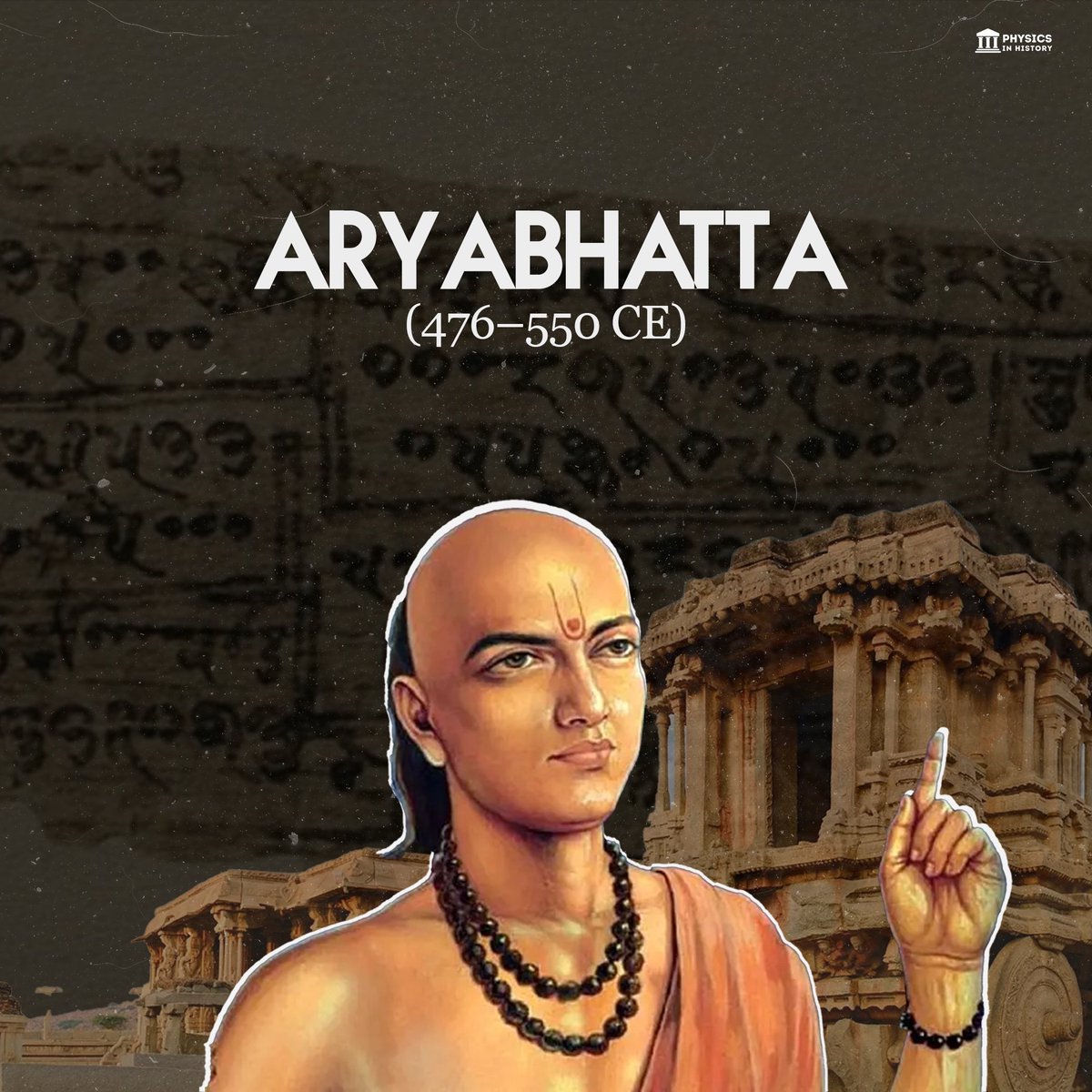
Aryabhatta, a remarkable Indian mathematician and astronomer, wrote his most famous treatise, Aryabhatiya, when he was only 23 years old. It contains 121 verses on various topics of mathematics and astronomy, such as the value of pi, the solution of quadratic equations, the calculation of eclipses, and the motion of planets.
Cabinet approves Thailand-Japan study on low-Earth orbit satellites
The Cabinet has approved a cooperation agreement between Thailand and Japan to jointly study low-Earth orbit (LEO) satellite constellations and assess opportunities for future space projects.
The study will examine how Japanese LEO satellite technology can be applied in Thailand to support public services, industry and national security. The project will be carried out with support from GISTDA and JAXA and will also explore cooperation in space industry development and emerging space projects in Thailand.
The memorandum will remain in effect for three years and can be extended. It does not create any legal or financial obligations.
#Thailand #Satellites
Voyager's Eternal Voyage
Launched in 1977, Voyager 1 is now traveling through interstellar space. In about 40,000 years, it will pass near another star and could continue circling the Milky Way for billions of years.
Airbus satellites capture the tower that crowned Gaudí’s masterpiece 📸 🏰✨
After 144 years of construction, one of the world's most extraordinary architectural masterpieces is now complete. Barcelona's Sagrada Familia has been shaped by Antoni Gaudi's vision for more than a century. Inspired by nature, geometry and faith, his design transformed the basilica into one of the world's most iconic landmarks.
On 10 June 2026, the Tower of Jesus Christ was inaugurated. Rising 172.5 metres above the city and crowned by a monumental cross, it completes the basilica’s highest architectural element and makes Sagrada Família the tallest church in the world.
This image was acquired by the Pléiades Neo constellation at 30cm resolution and enhanced using HD15 processing. Designed to improve the visual rendering of Pléiades Neo imagery, HD15 brightens colours and sharpens details, enabling easier interpretation of the basilica’s intricate architecture and its urban surroundings. ✨
Explore the full-resolution imagery in our Image Gallery ➡️ https://t.co/fY5WQdDEmj
A bronze statue of Maharishi Sushruta, widely regarded as the Father of Surgery, has been unveiled at the Royal College of Surgeons of Edinburgh, honouring India's ancient medical legacy and its historic ties with Scotland. With @danielaureltv
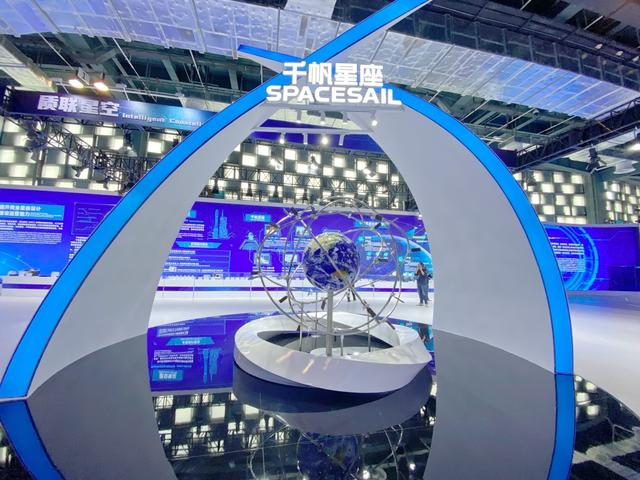
A Chinese satellite internet company has successfully completed direct-to-satellite voice calls using standard, unmodified commercial smartphones, marking China's first trial of its kind, with the entire communication link remaining smooth and stable throughout, while delivering excellent voice quality.
The direct-to-cell technology requires no hardware or software modifications to standard commercial smartphones, and the field test showed full signal strength and voice quality on par with terrestrial 5G.