La fragata Libertad anoche, en la tormenta que azoto New York .
Habia llegado el dia anterior junto a otros buques miticos , como la Vepucci Italiana para participar del #Sail2026Parade
Tesla delivered 480,126 vehicles in Q2, up 25% YoY. Wall Street was expecting 406,000. Total Q2 production was 451,758
Tesla also says that they deployed 13.5 GWh of energy storage in Q2 2026.
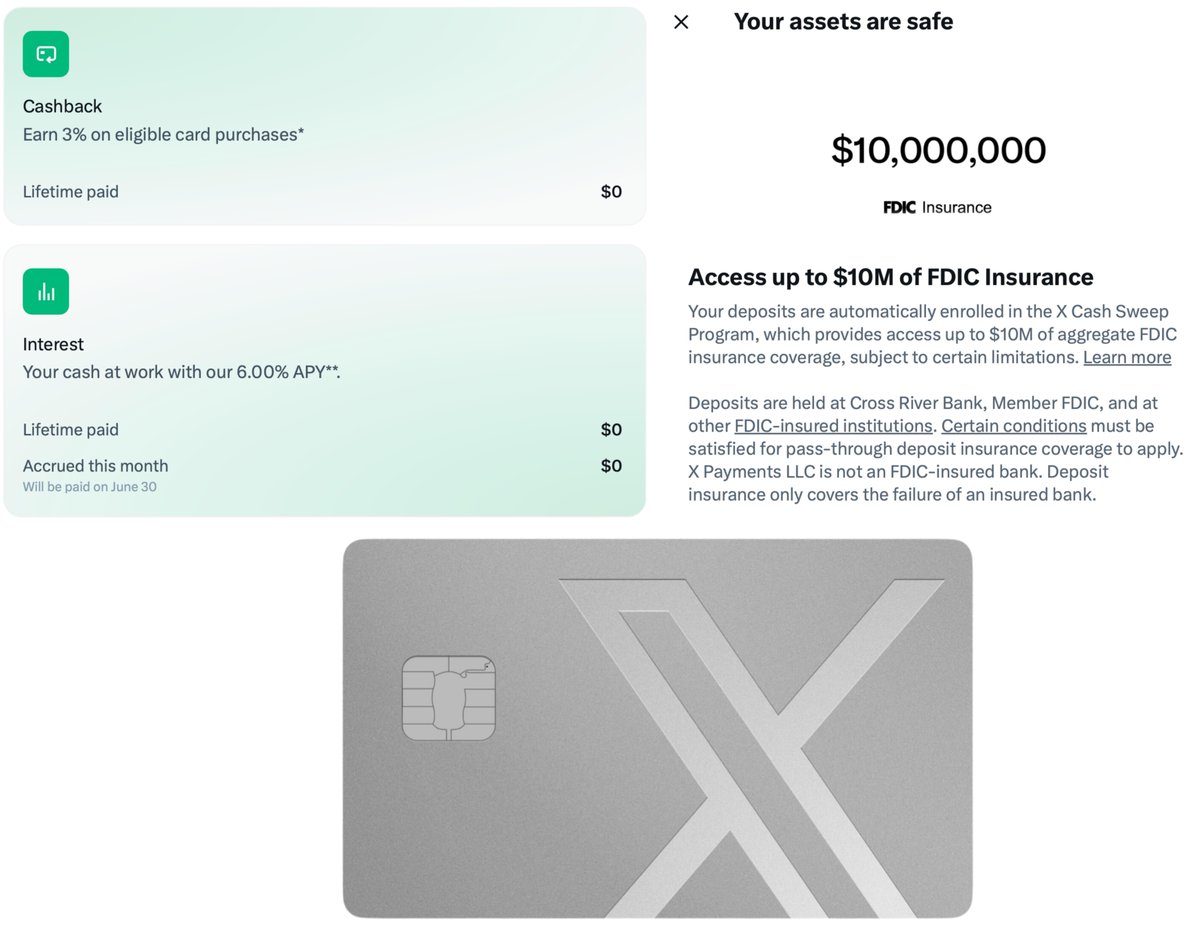
With 𝕏 Money you currently get:
• 6% APY on all cash deposited into 𝕏 Money (no limit)
• Up to $10 million of aggregate FDIC insurance coverage
• Unlimited 3% cashback on all card purchases*
• Physical metal card. Card may be used anywhere Visa is accepted. 𝕏 Money can also be used with Apple Pay
• All your 𝕏 Creator payouts paid out through 𝕏 Money
• Free wires, bill payments, checks, and more
• Free ATM withdrawals. You get reimbursed for fees incurred at out-of-network machines
• Visa's Zero Liability Policy ensures you won’t be held responsible for unauthorized card transactions
• Early direct deposit: Receive your paycheck up to 2 days before your usual payday when you sign up for direct deposit
• Instant P2P payments: Send, receive, or request money instantly from anyone on 𝕏
*The 3% cashback excludes stamps and coin stores, precious stones and metals, watches and jewelry, betting, lottery tickets, etc.
The @Tesla Model 3 and Model Y have just been named the #1 and #2 Most American-Made vehicles for 2026 by https://t.co/8eBlPTqKpL. This includes EVs & Gas cars🇺🇸
This is the sixth year in a row that Tesla has claimed the most American-made vehicle.
NVIDIA open-sourced a security scanner for AI agent skills and the research behind it is more alarming than the tool itself.
The repo is called SkillSpector.
NVIDIA says research found 26.1% of agent skills contain vulnerabilities, and 5.2% show likely malicious intent.
This is from a study of 42,447 skills pulled from major marketplaces the kind of skills people are already installing into Claude Code, Codex CLI, Gemini CLI, and every other agent framework that ships today.
One in four is broken. One in twenty is hostile.
SkillSpector scans for 64 vulnerability patterns across 16 categories: prompt injection, credential exfiltration, privilege escalation, supply-chain attacks, memory poisoning, rogue self-modifying agents, MCP tool poisoning, YARA malware signatures, even taint-tracking for "credentials flow to a network sink without sanitization."
It runs locally. It does static + optional LLM semantic analysis. It outputs SARIF, so it drops straight into CI.
But the part worth sitting with is the category names themselves.
1. Rogue Agent: self-modification at runtime.
2. Memory Poisoning: content designed to persist across interactions.
3. Tool-Based Exfiltration of system prompts.
4. Excessive Agency: autonomous decision-making without a human in the loop.
These aren't theoretical anymore. NVIDIA is shipping detectors for them because they're being found in the wild, at scale, on marketplaces real users install from.
And notice who is shipping this. Not a scrappy security startup. NVIDIA the company selling the picks and shovels of the entire AI economy is now also writing the threat model for it.
(For context: this is the same posture Microsoft took with Windows Defender in the 2000s. When your platform is everywhere, you can't outsource the safety layer.)
Agent skills were sold to us as a productivity feature drop a folder into a directory, your agent gets new capabilities. The reality is closer to npm in 2016: a vast ecosystem of executable code, installed with implicit trust, and statistically certain to contain something hostile.
The agent ecosystem just got its first SAST tool. It also got proof it needed one.
ngl really impressed.
https://t.co/IetIcYoTkS
"And that's what SpaceX is all about - is to take the fiction out of science fiction and create an exciting, inspiring future for everyone."
@SpaceX Founder, CEO, CTO & Chairman @elonmusk takes the @NasdaqExchange podium on $SPCX IPO day.
BREAKING: Inside Impulse Space with Tom Mueller (@lrocket) (SpaceX's 1st Employee)
FULL TOUR
The famous engineer behind the Merlin engine, now Founder, CEO & CTO of Impulse Space (@GoToImpulse)
ICYMI: Merlin still powers Falcon 9 today, the most reliable rocket engine ever flown & the highest thrust-to-weight ever developed. It's the workhorse behind nearly every SpaceX mission: Starlink launches, Dragon crew & cargo flights to the ISS, & booster landings
Tom walks us through the factory floor, from the avionics clean room to a live rocket engine firing in the vacuum chamber
Impulse is building the in-space mobility layer: the vehicles & engines that move spacecraft after launch, from LEO to GEO, the Moon, infinity & beyond
We cover:
→ Mira: precision maneuvering spacecraft & its saiph thrusters (8 thrusters, ~50 lbs thrust, 5-yr orbit life)
→ Helios: long haul same-day delivery vehicle (12 tons of LOX/methane, LEO to GEO)
→ Deneb Engine: 15,000 lbs thrust engine that powers Helios, ox-rich staged combustion, carbon skirt running over 3,000°F
→ Why 3D printing is "almost a cheat code" for rocket engines
→ In-house composite tanks, Novaloy, & copper liners machined from 700 lbs down to 25
→ 3 spacecraft in orbit + a 1,200-meter rendezvous
→ Starlink, iterating Merlin & Raptor, & working with @elonmusk
→ Nuclear propulsion, the Moon, & why compute needs to move to space
𝐓𝐈𝐌𝐄𝐒𝐓𝐀𝐌𝐏𝐒
(00:00) Tom Mueller, Founder, CEO & CTO of Impulse Space
(00:49) Inside Impulse Space
(02:32) Avionics Bay floor
(02:59) Building rockets at home
(03:50) Mira and Helios
(08:00) Why Tom left SpaceX
(09:33) The Deneb Engine walkthrough
(11:42) Testing in Mojave
(12:23) Favorite part of the Engine
(13:30) How it's 3D Printed
(14:21) Why 3D Printing changes everything
(16:54) Finding Talent for COPVs
(17:28) No Modern hardware without software
(19:52) The Mill Turn explained
(22:42) Payload Deck Design
(25:28) Entering the Secret Area
(30:48) Thrust, Flow Rate, & 100 Sensors
(32:13) Collision avoidance in Orbit
(32:57) The Electric Propulsion Chamber
(34:28) Nuclear Electric is the future
(38:49) Data Centers in Space
(40:28) SpaceX & Starlink's Growth
(41:10) Working with Elon
(42:07) If not CEO, then what?
(42:32) Moon matters more than Mars
Another reality of these compute-based satellites is that they don't need to be deployed in mass quantity to get useful compute. Launch one, load its model, add it to the inference cluster and its crunching AI.
This is very different than the critical mass problem Starlink experienced in the early days. You needed a lot to build a 'network' for a viable service.
Anthropic and Google are now paying @SpaceX a combined $2.17 billon per month for compute capacity. That's a revenue run rate of $26 billion per year. BIG MONEY.
Covenant Logistics has completed two weeks of @Tesla Semi testing. They were blown away by its capabilities.
"We were amazed at the performance of the Tesla Semi and felt a level of confidence that was hard to match in a diesel truck.
As one of our final runs we tackled a section of I-5 between Santa Clarita and the San Joaquin Valley over the Tejon Pass - famously known as "The Grapevine" - a lane critical to trucks hauling cargo from the ports in Oakland, Los Angeles, and Long Beach. "The Grapevine" sits at an elevation of 4,160 feet and represents the highest point on I-5 in California. The northbound descent from Tejon Summit drops 2,613 feet over 11.6 miles, with the steepest section — known as the Grapevine Hill — running about 6% grade for 5 miles.
Running the Grapevine with a loaded trailer is about as demanding a real-world test as you could design for any truck. Running Northbound - lose momentum on a steep grade with a heavy load can be stressful as speed drops fast and recovering on that grade is challenging. Running Southbound requires attention to braking and heat management (which isn't a problem for an EV when you've got regenerative braking doing most of the work)."
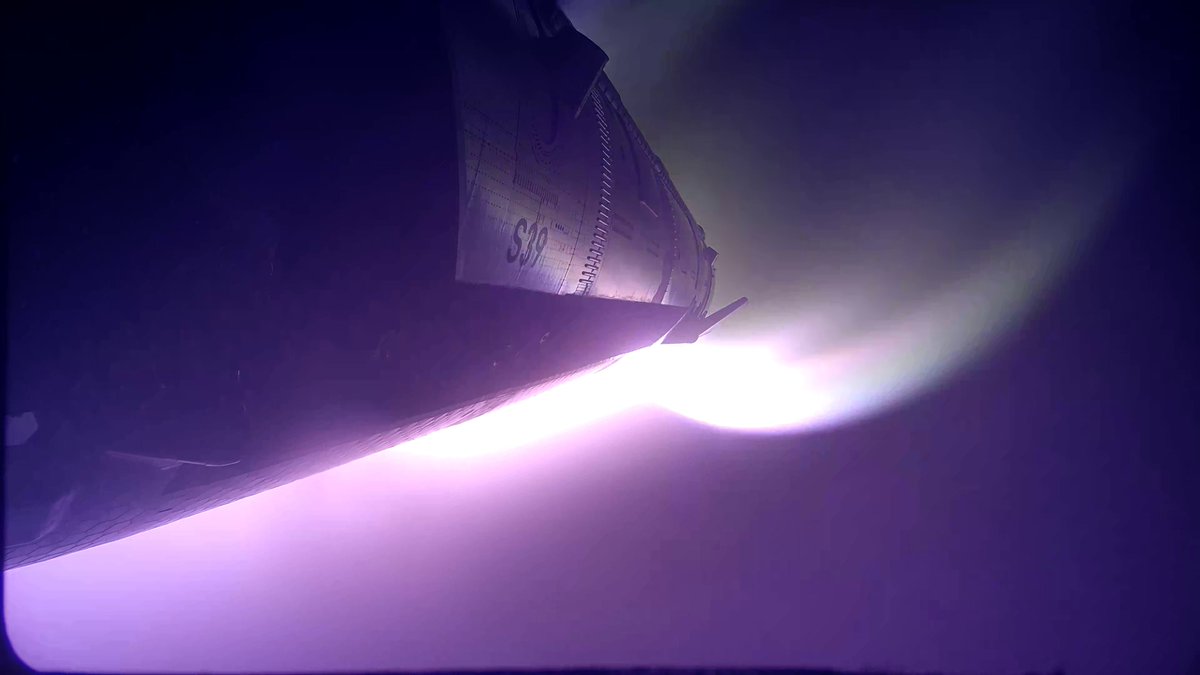
I thought I'd try to illustrate how Starship 39 made up for a less than optimal sub-orbital insertion and lower-than-planned perigee by using aerodynamics during re-entry to extend its downrange flight profile and make an on-target landing in the Indian Ocean.
The ship used a combination of Angle-of Attack (AOA) changes, the flaps and body of the ship as lifting surfaces to manage the total drag forces to "fly" a longer distance, all while managing plasma heating & velocity decreases to prepare for the landing burn.
@SpaceX had to do this because of the loss of the one RVAC at about the 3:03 mark just after hot staging, resulting in the remaining 5 engines to compensate and burn longer. Impressive example of the Avionics, Navigation & Control used with Starship!
Check out this short video clip with illustrations & information along the way! I hope you find this informative!
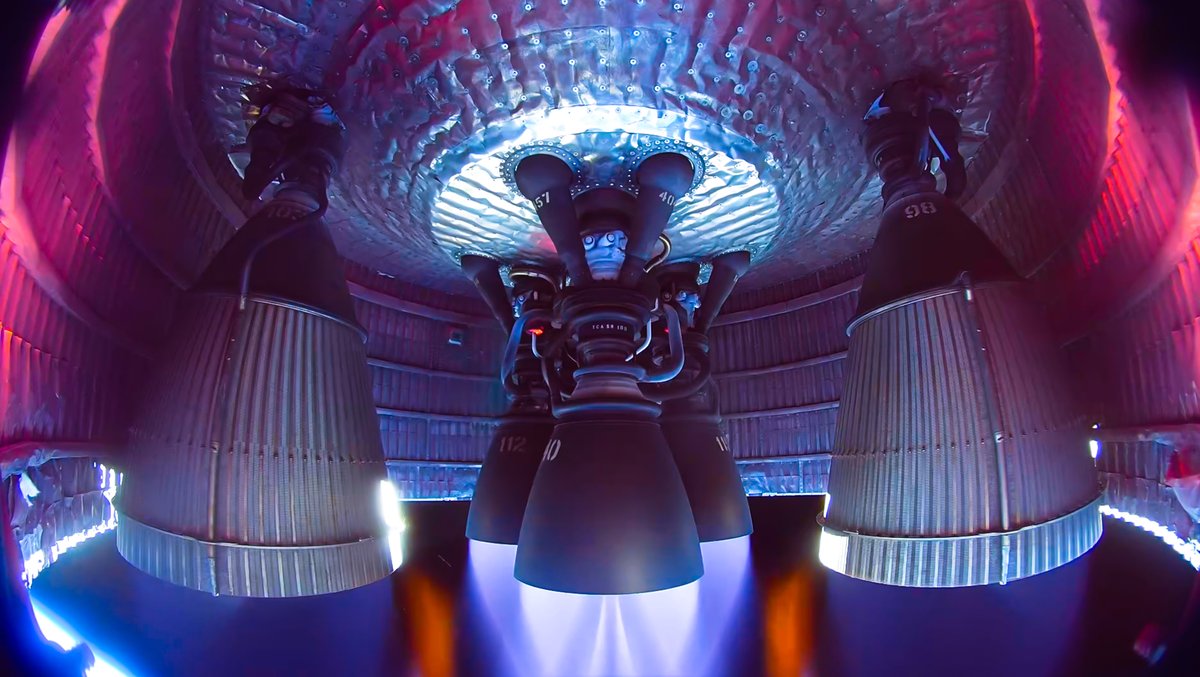
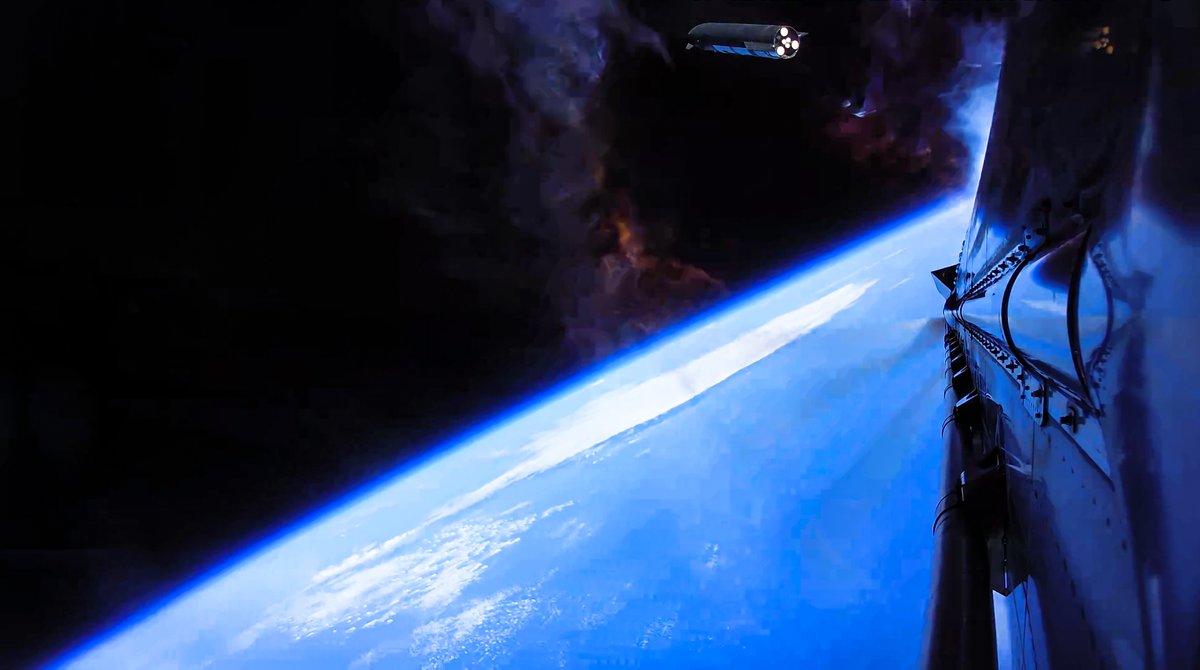
Onboard views from Starship and Super Heavy V3, which are equipped with upgraded cameras capable of streaming 4K video through every phase of flight via @Starlink