Can someone explain to me why the Eastern Herzegovinian dialect became the standard for every serbo-croatian language when it isn't native to the biggest cities of the region? Genuinely asking am I missing something? Was it a compromise or was it actually just the elite dialect?
There’s a reason most of the westerners who fetishize IQ online tend to cluster around academia, research, policy analysis and think tanks. Their world rewards abstraction and credentialism and is a relatively closed system with Gaussian outcomes. Many of them have never created anything in genuinely chaotic environments or places where outcomes are mediated by other people, institutions, timing, incentives and sheer contingency. They mistake their local optimum for a universal one.
So when they say IQ is “highly predictive of success,” what they really mean is success as they understand it which is success in linear, test-aligned, institutionally curated niches. Which is why things like educational attainment, job complexity an the like are always their set of examples, because these are in domains that are explicitly designed to reward the cognitive traits IQ tests measure.
Although they may not admit it, many of them would be uncomfortable with the reality that a random online streamer who has accumulated leverage outside credentialed systems is more objectively successful than they are by the standards most people actually care about. When confronted with this, they either contest the word “objectively” or redefine success altogether retroactively reshaping the goalposts so their own position remains central and dignified.
But for the majority of people, success is very simple lol. It is basically financial and social security, some optionality and leverage. It is the ability to absorb shocks and still remain standing. By those measures, being a highly intelligent but economically and socially fragile physics professor is not an obvious win.
People who have actually built things especially people who grew up in environments where plans routinely collapse under political, economic, or social instability understand this instinctively. They know that real world success is non-linear, path-dependent, and deeply social. It involves many other people, many moving parts, and a great deal of effort applied over time. Crucially, they also understand something the IQ wankers hardly ever consider which is that effort is endogenously suppressed. People work hard when something matters to them. A lack of visible effort is not necessarily a lack of capacity any more than it is a lack of incentive, meaning, or perceived payoff. And effort plays a far greater role on mileage which compounds into success.
The narrow, niched definition of success that IQ wankers cling to exists largely to preserve a clean 1 to 1 mapping between their test scores and their life outcomes. Interrogate their definitions very well and you’ll find an ego-soothing fiction somewhere there. But it is not how most people experience the world, and it is not the kind of success most people are trying to achieve.
SPIRITUALITY VS PERFORMATIVE PIETY
[THREAD]
While spirituality can be regarded as the distilled essence of religion, performative piety is nothing more than the ostentatious, narcissistic, hollow, crass and disingenuous manifestation of religiosity*.
The motto of the Russian GRU:
"Only the stars are above us"
Выше нас только звёзды
The Ukrainian GUR:
"The wise will rule the stars"
Sapiens Dominabitur Astris
Even the motto is a well spoken troll.
bacaan pagi: topik Xenolinguistic
Jika makhluk asing boleh berbicara, apakah rupa bahasanya? Makalah pendek ini menyinggung kecenderungan manusia secara umum yang gemar menempek sifat² manusiawi ke atas kewujudan berbeza
https://t.co/ncqUE3g4It
Credit card ini byk kelebihan but kita selalu fikir ia berkaitan dgn hutang. Trust me if korang pandai guna, ia blh menjadi satu financial instrument yang paling function korg pernah ada 🫶🏻
One of the rewards yg saya suka about Credit Card is Cashback yang lumayan
— a thread
Hutang kad kredit terlalu tinggi antara punca golongan muda berusia bawah 30 tahun di Malaysia.
Kad kredit ibarat pisau, kalau salah guna memang akan parah. Harini saya nak kongsikan cara guna kad kredit tanpa sebarang caj
👇
Banyak mathematician sangat "zuhud" dan benci dunia ni
Grothendieck in particular, pada penghujung fasa hidup dia
dia lari daripada dunia pergi menyorok hidup sorang² di pergunungan Pyrenees
taknak cakap dengan sesiapa, taknak orang publish apa² pasal dia.
Many mathematicians are rather childlike, unworldly in some sense, but Grothendieck more than most. He just seemed like an innocent—not very sophisticated, no pretense, no sham. He thought very clearly and explained things very patiently, without any sense of superiority. He wasn��t contaminated by civilization or power or one-up-manship.
-- John Tate on Alexander Grothendieck
#CrustaceansInTheNews - 𝐺𝑒𝑜𝑠𝑒𝑠𝑎𝑟𝑚𝑎 𝑏𝑢𝑛𝑖𝑎𝑛. On a new species of vampire crab from the 𝐺𝑒𝑜𝑠𝑒𝑠𝑎𝑟𝑚𝑎 𝑓𝑜𝑥𝑖 species-group (Crustacea: Brachyura: Sesarmidae) in northern Peninsular Malaysia. #NewSpeciesAlert
🔓 (direct PDF) - https://t.co/CImc0igNSG
Sabine Hossenfelder coined 'Lost in Math' for physicists who (allegedly) get so enamoured of the mathematical beauty of their theories that they believe they must be true.
There is a related but separate phenomenon, which I call 'Lost in Philosophy' where physicists (scientists more generally) fall in love with their ideals of how nature should be. They invent theories that start from their own philosophical ideals and try to fit nature into it.
The classic example is Einstein, who refused to accept quantum theory as fundamental because he believed "God does not play dice"--i.e nature should follow the principle now called 'realism'. He tried to invent a new theory which could explain nature while satisfying realism, which incidentally led him to also get Lost in Math and failed.
This approach usually fails. Nature does not care about what principles you think it should follow.
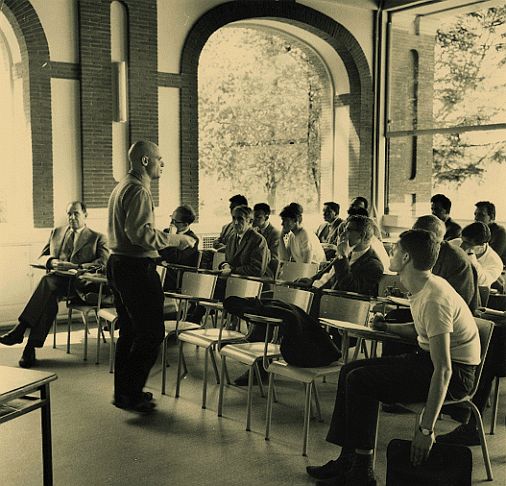
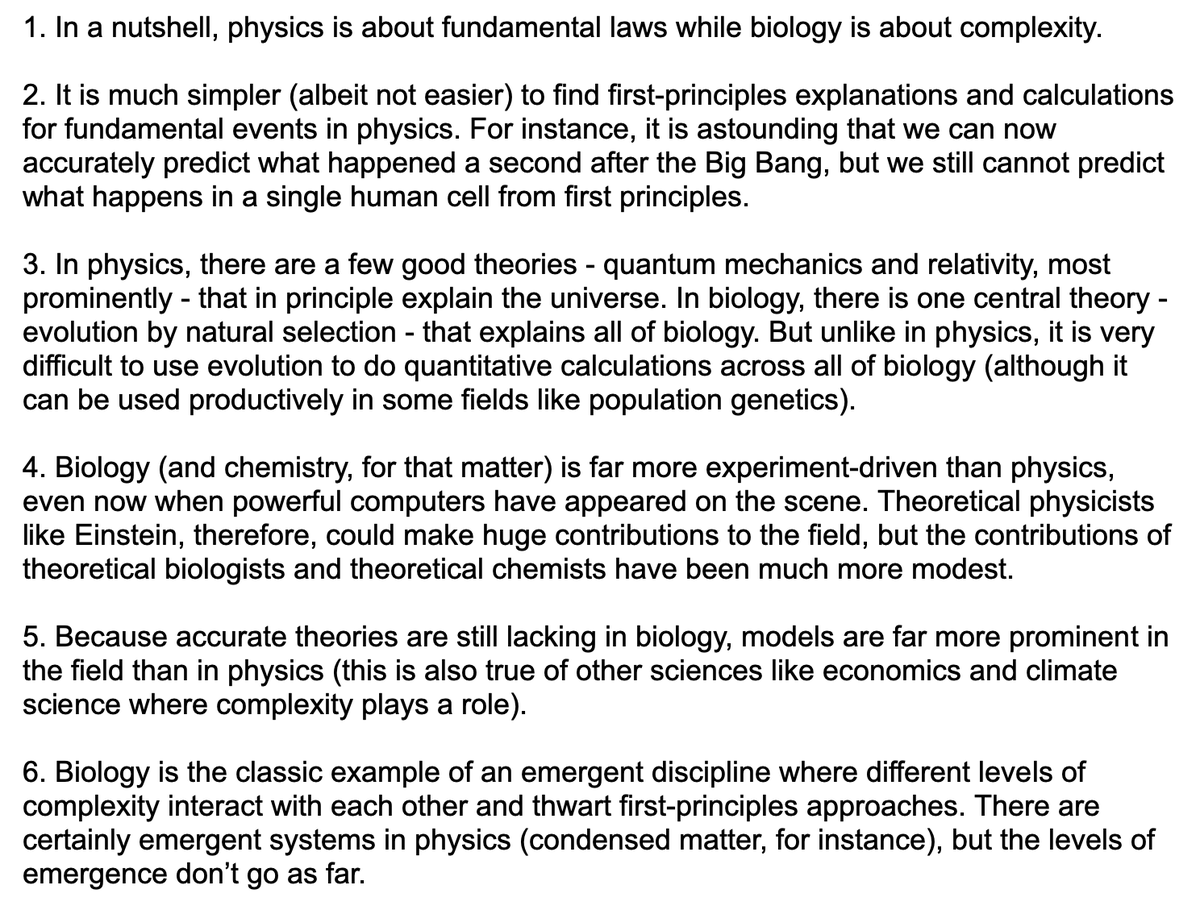
A friend of mine is writing an article about physicists who turned to biology (Leo Szilard, Francis Crick, Walter Gilbert and others) and asked me what I thought were the differences between the two fields. Here's what I said in my reply:
Consider applying for The Carbon Fellowship if you embrace scientific contemplation— combining STEM and the humanities to grasp Divine Nature.
Applications are on a rolling basis!
https://t.co/bWDhIOpdMW
Perkataan "Viande" dalam perancis bermaksud daging, tetapi dalam bahasa perancis lama perkataan ini juga bermakna "makanan" secara umum. Malah dalam bahasa inggeris, sehingga kini "Viand" itu bermaksud makanan/hidangan secara umum yang tidak semestinya khusus untuk daging sahaja.
Genesis chapter 1 ayat 30 (KJV 1611):
"And to euery beast of the earth, and to euery foule of the aire, and to euery thing that creepeth vpon the earth, wherein there is life, I haue giuen euery greene herbe for meat: and it was so."
Meat membawa maksud makanan secara umum
Penyempitan makna daripada istilah umum untuk makanan kepada daging tidak unik dalam kes Lechem/Laham ini sahaja. Dalam bahasa eropah seperti inggeris dan perancis juga berlaku. Misalnya "Meat" dalam bahasa Inggeris lama bermakna "makanan" secara umum.
beit/baitul (בית/بيت) bermaksud rumah, sama maknanya dalam bahasa arab dan juga yahudi. Tetapi laham لَحَم dalam bahasa arab membawa maksud daging manakala lechem לחם dalam bahasa hebrew bermaksud roti.
Nampak macam makna yang berbeza, tetapi secara etymology, laham dan lechem berkongsi asal yang sama, daripada sebuah istilah semitik lama yang bermakna "makanan/roti". Dalam kes bahasa arab, لَحَم mengalami penyempitan makna yang membawa kepada penukaran "makanan" kepada "daging"