Work @Google. I post things and snippets in the startup world, tech, AI, science, and business that I’m interested in. Follow me if you like my content ☄️
We'll be spending a lot more time trying to understand the outputs of language models. A few thoughts, tips & tricks:
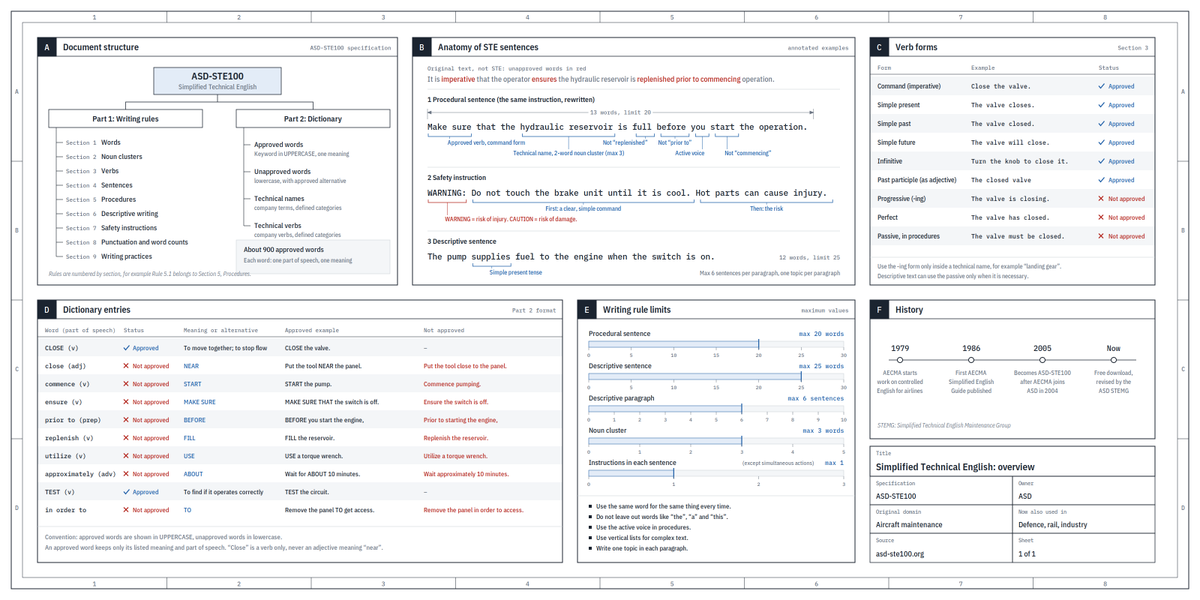
Writing. Something I've had success with: Ask your LLM to explain something in ASD-STE100, it's a controlled language specification originally developed for aerospace maintenance documentation. LLMs well-versed in this language and it comes with heavy constraints on clean writing style that I often find a lot more readable. Sometimes I've tried to soften it a bit e.g. ask for "80% of the way to ASD-STE100" because the spec is quite stringent. But even better:
Diagrams / images. Instead of writing, ask your LLM to create a diagram. These can be a lot easier to process, parse, and understand. But even better:
Web pages. Ask for output "in HTML" to get a beautiful, interactive webpage. LLMs are getting really good at frontend and can create beautiful experiences, animations, etc. But even better:
Explainer videos. The output format I am most bullish on is fully custom / bespoke explainer videos generated on any arbitrary topic. Experiment with things like "Create a 3b1b style video explainer on X. Use my ElevenLabs API key for audio narration". (you'd need an API key for the latter or you can ask your LLM to find you decent free alternatives that use your local compute). This is actually starting to work!
In summary:
- As LLMs get better, they will do more and more of the legwork autonomously, and a lot more of our work will rise up the abstractions into oversight and understanding.
- Luckily, LLMs can help here too because as intelligence and code are increasingly abundant, you can ask for large, custom, discardable software artifacts (e.g. web apps, video explainers) that would have never made sense to create before. Push the boundaries here and you'll be surprised.
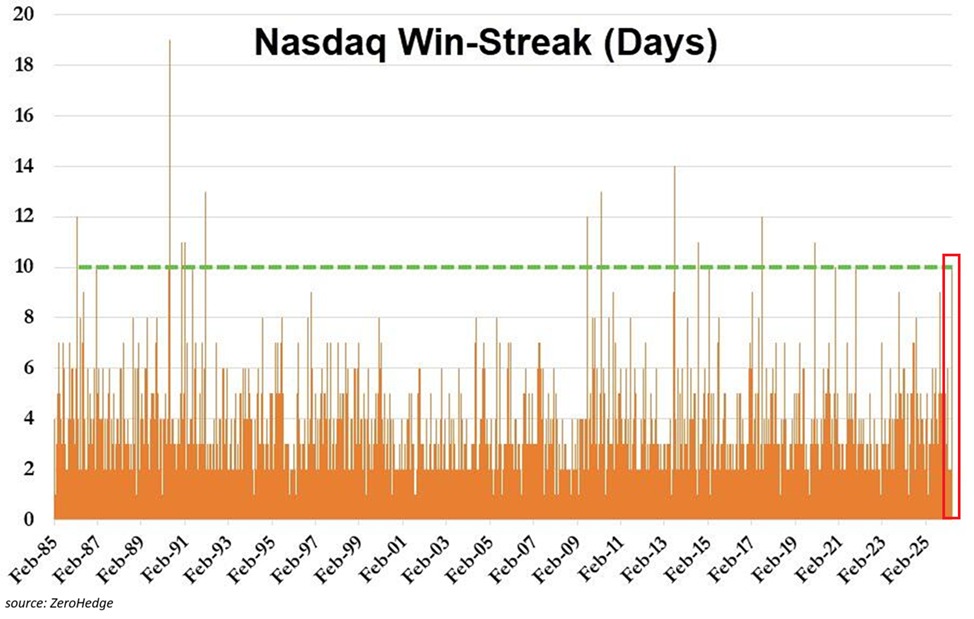
We are witnessing a historic rally:
The Nasdaq Composite has finished green for 10 consecutive trading sessions, the longest streak since November 2021.
The index has rallied +13.7% over this time span, the biggest recovery since 2022 and the third-largest since 2009.
If the streak extends to 11 days, this would mark the longest streak since 2019.
The S&P 500 has also been positive in 9 out of the last 10 trading sessions.
The market is experiencing one of its best recoveries this century.
AGENTS dot md files don't scale beyond modest codebases.
Lots of discussions on this lately.
If you're building serious software with Claude Code or any agentic tool, a single AGENTS dot md will eventually fail you. This paper shows what comes next.
A 1,000-line prototype can be fully described in a single prompt. A 100,000-line system cannot. The AI must be told, repeatedly and reliably, how the project works, what patterns to follow, and what mistakes to avoid.
Single-file manifests hit a ceiling fast.
This new paper, Codified Context, documents a three-tier infrastructure built during real development of a 108,000-line C# distributed system across 283 sessions over 70 days.
The system uses a three-tier memory architecture: a hot-memory constitution (660 lines, always loaded), 19 specialized domain-expert agents (9,300 lines total) invoked per task, and a cold-memory knowledge base of 34 specification documents (~16,250 lines) queried on demand via an MCP retrieval server.
Across 283 sessions, this produced 2,801 human prompts, 1,197 agent invocations, and 16,522 autonomous agent turns, roughly 6 autonomous turns per human prompt, with a knowledge-to-code ratio of 24.2%.
Crucially, none of it was designed upfront: each new agent and specification emerged from a real failure, a recurring bug, an architectural mistake, a convention forgotten, and was codified so it could never require re-explanation again, turning documentation into load-bearing infrastructure that agents depend on as memory, not reference.
Paper: https://t.co/ZXBzhhkzsq
Learn to build effective AI agents in our academy: https://t.co/1e8RZKs4uX
"You have to put in the time, but the judgment is more important. The direction you’re heading in matters more than how fast you move, especially with leverage."
From the @navalmanack
https://t.co/NkyQePRFEV
A startup is either gaining momentum or standing still.
Marc Andreessen says the best founders pick up power early by compounding credibility into resources, and resources into results.
“A top tier VC is a bridge loan of credibility at a point in time when the startup maybe deserves it, but just doesn’t have it yet.”
Source: @pmarca on Cheeky Pint with @collision and Charlie Songhurst
Crypto is…
Desperate gamblers chasing their first bag.
Investors funding the buildout of the global casino.
Bankers hypnotizing the masses to collect their vig.
…all meaningless and ephemeral without the cypherpunks, who defend the dream of encrypted and unstoppable cash.
This powerful quote from the Shaolin Monk Master Shi Heng Yi @ShiHengYi hit me:
“Discipline your thoughts, stop thinking too much. Don’t go into the past, don’t go into the future, be in the present. Why? Because only then it’s possible that the mind is free, the CAPACITY is free, now you can completely immerse into whatever you are doing, and this means you have ARRIVED.”
I have the tendency to overthink and I believe a lot of you are the same as me especially during time of life uncertainties. Close your eyes, and read this quote in your mind, and then release your mental capacity to just be in the present. Then start doing whatever you are doing. Focused.
After studying high-performing PMs for years, I noticed something strange:
The most impactful product managers often do LESS than their peers.
They write shorter docs. Hold fewer meetings. Create simpler processes.
They've mastered making impact look effortless.
Here's how:
Junior PM: Our DAU is terrible. Users log in once a month.
Senior PM: How often should they log in?
Junior PM: Daily. Like Slack or Notion.
Senior PM: Does their job require daily interaction with your product?
Junior PM: ...no. They run monthly reports.
Senior PM: Then why chase daily usage?
Junior PM: Because investors want high engagement metrics.
Senior PM: Investors want sustainable business. Not vanity metrics.
Junior PM: But all successful products have daily users.
Senior PM: Successful products match frequency to user needs.
Junior PM: So monthly usage is fine?
Senior PM: Monthly usage is perfect if each visit delivers massive value.
Junior PM: Our users spend 5 minutes per visit.
Senior PM: That's the problem. Not the frequency.
Junior PM: How do we fix 5-minute sessions?
Senior PM: Make those 5 minutes worth scheduling their month around.
Junior PM: That seems backwards.
Senior PM: Most PMs optimize for the wrong thing.
Junior PM: Which is?
Senior PM: Forcing behavior change instead of amplifying natural patterns.
Junior PM: But we need growth.
Senior PM: Then make monthly users successful first.
Junior PM: How?
Senior PM: The stepping stone strategy.
Junior PM: Never heard of it.
Senior PM: Because everyone's copying consumer apps.
Junior PM: Explain.
Senior PM: Monthly user runs their report. Takes 5 minutes.
Junior PM: Right.
Senior PM: What happens with that report?
Junior PM: They... share it with their team?
Senior PM: Keep going.
Junior PM: Team asks questions. They dig deeper.
Senior PM: Where do they dig?
Junior PM: Excel. They export and analyze offline.
Senior PM: There's your opportunity.
Junior PM: Build analytics features?
Senior PM: No. Make their existing workflow 10x better.
Junior PM: By doing what?
Senior PM: Auto-generate the insights they manually find in Excel.
Junior PM: But that's still monthly.
Senior PM: Until they see an insight worth investigating.
Junior PM: Then they come back?
Senior PM: Now you've earned a second visit.
Junior PM: Still not daily.
Senior PM: Yet. Watch what happens next.
Junior PM: They investigate the insight?
Senior PM: They share it. Their boss asks questions.
Junior PM: So they come back again.
Senior PM: Now it's weekly. Naturally.
Junior PM: Without forcing it.
Senior PM: The pattern becomes: Report → Insight → Investigation → Action
Junior PM: Each step increases frequency.
Senior PM: Because each step delivers value.
Junior PM: Not because we added gamification.
Senior PM: Exactly. Natural progression beats forced habits.
Junior PM: But this takes longer.
Senior PM: Sustainable growth always does.
Junior PM: What if users don't progress?
Senior PM: Then you haven't solved the right problem.
Junior PM: Harsh.
Senior PM: Most "engagement features" mask product-market fit issues.
Junior PM: Like what?
Senior PM: Notifications. Streaks. Points. All band-aids.
Junior PM: But every product has those.
Senior PM: Every failing product needs those.
Junior PM: So we should remove our notifications?
Senior PM: Make them unnecessary first.
Junior PM: How?
Senior PM: Create pull, not push.
Junior PM: Meaning?
Senior PM: Users check because they want to, not because you pinged them.
Junior PM: That's idealistic.
Senior PM: That's product-market fit.
Junior PM: Give me a concrete example.
Senior PM: GitHub. No streaks. No points.
Junior PM: But developers check it constantly.
Senior PM: Because their work lives there.
Junior PM: We're not GitHub.
Senior PM: You're not listening.
Junior PM: What am I missing?
Senior PM: GitHub earned the right to daily usage.
Junior PM: By being essential.
Senior PM: By solving one problem so well, it created ten more.
Junior PM: Each problem increases usage.
Senior PM: Now you're getting it.
Junior PM: So start with our core problem.
Senior PM: Make monthly reports insanely valuable.
Junior PM: Then let usage naturally increase.
Senior PM: Through value delivery, not engagement hacks.
Junior PM: This changes our entire roadmap.
Senior PM: Good. Your roadmap was solving the wrong problem.
Junior PM: We were building features for daily users who don't exist.
Senior PM: While ignoring monthly users who do.
Junior PM: Classic mistake.
Senior PM: The most common PM failure pattern.
Junior PM: Optimizing for who we want users to be.
Senior PM: Instead of who they actually are.
Junior PM: Power users aren't born. They're developed.
Senior PM: Through value, not manipulation.
Junior PM: One successful interaction at a time.
Senior PM: Until daily usage becomes inevitable.
Junior PM: Not forced.
Senior PM: That's the difference between products that last and products that don't.
A lesson I learned early in my career: It's hard to motivate people, but easy to demotivate them.
Sometimes, our good intentions have the exact oppositive effect (and easy ways to avoid them):
The number 1 mistake ex-engineers make in PM roles:
Prioritizing possibility over value.
Let's uncover this fallacy and reverse it in just 3 minutes. 🧵
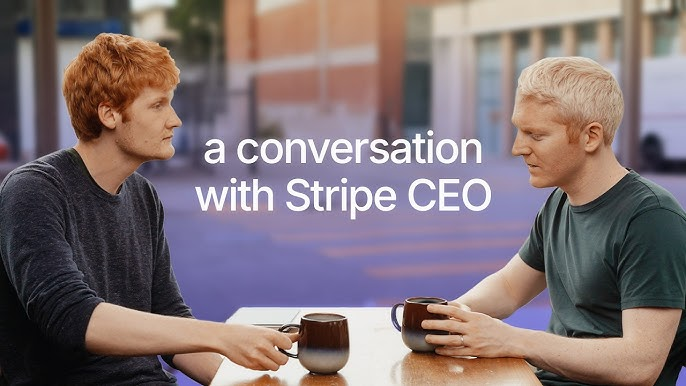
Just watched an incredible interview between Cursor CEO Michael Truell and Stripe CEO Patrick Collison and I'm buzzing with ideas! We're talking the future of software, AI's real impact, and how to build systems that last—so many lessons for builders & creators.
Here's the breakdown 👇
The Next Frontier: Programming Human Biology 🔬
This is where it gets mind-bending. Patrick is incredibly excited about using foundation models to "program biology" and finally tackle complex diseases like cancer and autoimmune disorders.
We've never cured a complex disease because we've lacked the tools to understand its intricate systems. With new tech in gene sequencing and AI, we're on the verge of a new era in medicine.