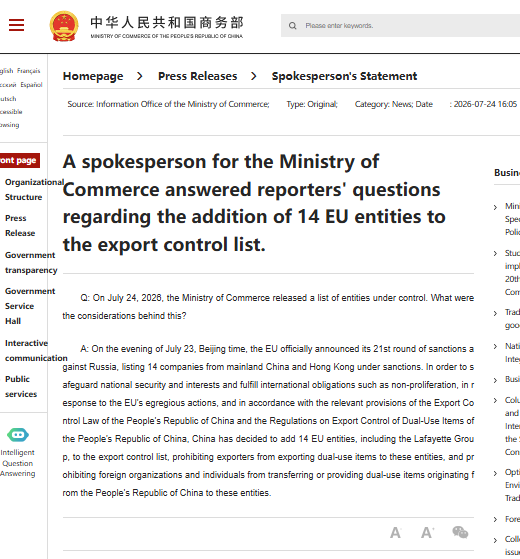
Breaking: China has added 14 EU entities to its export control list a day after the EU added 14 Chinese / HK companies to its 21st package of sanctions
Moonshot should release the K3 open weights and details about what infrastructure K3 trained on.
The debate about PRC models and distillation is breaking brains throughout Silicon Valley and the AI community, with many arguing the US government is at risk of regulatory capture by Anthropic and OpenAI, and instead should just focus on competing, and anyway the US frontier labs are all built on the distillation of human knowledge so who are they to whinge about being distilled.
If the US officials are making the argument to President Trump that the Chinese labs are ripping America off and risk crashing the stock market by undermining investor confidence in the AI boom that is driving the stock market, the odds of US government actions against some of these labs are high, no matter what other Silicon Valley leaders, and even Nvidia’s Jensen Huang, try to argue.
In my long read on the Kimi K3 situation, I focus on the big picture for where we going next.
0. Chinese labs have 3 of top 8 most intelligent models, and have been climbing the ranking.
1. China’s recommits to open-source AI – showing a different (lower) read on near-term risks
2. Open models as the economic Achilles heel of frontier labs (as @deanwball said), and why this can be good for the ecosystem
3. China’s efficiency advantage is letting them make the best models for less, pointing to them staying competitive
4. A growing ecosystem of frontier, open models is coming soon
5. We are at the very beginning of a long story of frontier open-weight policy, which is extremely complex and something we are not handling well
Kimi K3 is really the beginning, or the reset, of all these stories. I expect to continue to unpack them regularly.
America Is About to Hand Its Best Founders to Its Rivals -
by Josh Wolfe (cofounder + partner, Lux Capital) + Deepak Hegde (Professor NYU Stern)
On June 17, the White House cleared the final regulatory checkpoint for a Department of Homeland Security rule that would cap F-1 student visas at four years, shorten the post-graduation grace period from 60 days to 30, and replace 30 years of “duration of status” admission with discretionary federal review. Federal Register publication is imminent. The effective date will follow 60 days later — putting the rule on track for early fall.
The press has framed it as a question about students. It is not. It is a question about whether the federal government should override one of the most productive talent markets the world has ever known — and hand a competitive edge it took 50 years to build to Beijing, Ottawa, and Brussels.
Consider Jan Koum, a Ukrainian immigrant who arrived in the United States at 16 and worked as a janitor while attending San Jose State. He applied for jobs at Twitter and Facebook; both rejected him. A résumé without a degree did not impress recruiters. So he started his own company. Five years later, Facebook bought it — WhatsApp — for $19 billion.
The labor market made a $19 billion mistake. The entrepreneurship market corrected it. That correction — quietly, across decades, without subsidy or industrial policy — has been America’s quiet competitive advantage. It is what the new rule would unwind.
Consider who the F-1 cohort actually is. Roughly three-quarters of foreign nationals who earn STEM PhDs at American universities stay; for Chinese and Indian graduates, the rate exceeds 80 percent. They are the population from which one in four U.S. unicorns draws a founder; counting all immigrant pathways, more than half of America’s billion-dollar startups have at least one. Without immigrants, that herd would be cut in half.
The cap does not fit the work. The median U.S. STEM PhD takes 5.7 years; physics PhDs average six. The rule is not long enough to finish the degree it regulates. Every foreign physicist, computer scientist, and materials engineer in serious graduate work will need an immigration officer’s permission to keep going. Sometimes she will not get it.
Andrew Ng arrived on an F-1 at Carnegie Mellon in 1993, spent five more years on his Berkeley PhD, and co-founded Coursera, Google Brain, and DeepLearning AI. Jensen Huang, founder of Nvidia, spread his Stanford master’s over eight years while working at LSI Logic. Fei-Fei Li, the “godmother of AI” now running World Labs, took six years to finish her Caltech PhD. Charles Zuker, grandson of Eastern European Jews who fled to Chile during the Holocaust, came to MIT at 20 and co-founded the biotech Kallyope. None of them moved at the four-year pace. Each one’s continuation past year four would have been an officer’s coin flip.
There is a name for this pattern in economics. Labor markets cannot observe ability directly; they read signals — degrees, schools, prior employers, accents. When the signal underrates the worker, she rejects the wage and becomes the residual claimant of her own talent. She starts a company. Entrepreneurs, the data show, score higher on cognitive tests than equally credentialed employees, and lower on credentials than equally able ones. America’s edge has never been about polishing the resumes the world’s HR systems approve. It is about absorbing the people those systems miss.
This is happening now, in artificial intelligence. A March 2026 NBER paper linking Census records to 42,000 AI researchers finds the share working in industry rose from 48 to 68 percent between 2001 and 2019 — and the decline in the U.S.-born share is “almost entirely accounted for” by Chinese- and Indian-born researchers stepping in. The American AI revolution is being built, in significant part, by exactly the foreign STEM PhDs the rule would turn away.
The rule converts what was an arbitrageable labor-market mistake — talent the market underrated, corrected by entrepreneurship — into an irreversible immigration decision. An officer reviewing an extension at year four cannot see a future founder. He sees a delay, a discretionary file, one of hundreds on his desk, and optimizes against the application that becomes tomorrow’s headline.
The talent is already moving. A March 2025 Nature survey found 75 percent of U.S.-based scientists who responded considering leaving. Fall 2025 brought a 17 percent drop in new international student enrollments. The European Research Council saw a 31 percent jump in applications for its flagship grants, with “particular growth” from U.S.-based researchers, and doubled its relocation top-up to €2 million. Canada committed $1.2 billion to attracting foreign talent. China launched a visa for international STEM graduates.
And the F-1 rule does not stand alone. The wage-weighted H-1B lottery just ran for the first time, the $100,000 H-1B fee comes up for renewal in September, and a new USCIS policy now pushes green-card applicants to leave the country and apply abroad — so even a founder who beats the four-year cap may have to leave the United States to secure the right to stay.
The reform that would actually serve American workers — a startup visa, a stapled green card for STEM PhDs, an exemption from country caps that trap Indian and Chinese graduates in decade-long queues — is the one Congress keeps refusing to pass. At a minimum, the administration should not be using regulatory authority to make the problem worse.
America has spent 50 years operating one of the most efficient talent markets on earth: a system that quietly absorbed the people the world’s labor markets underrated and let them reprice themselves through entrepreneurship. No subsidy built it. No industrial policy created it. The F-1 rule replaces that market with the discretion of an immigration officer. Let it take effect, and the United States loses not just the founders it never identified, but the mechanism that found them — and the rest of the world picks up the difference.
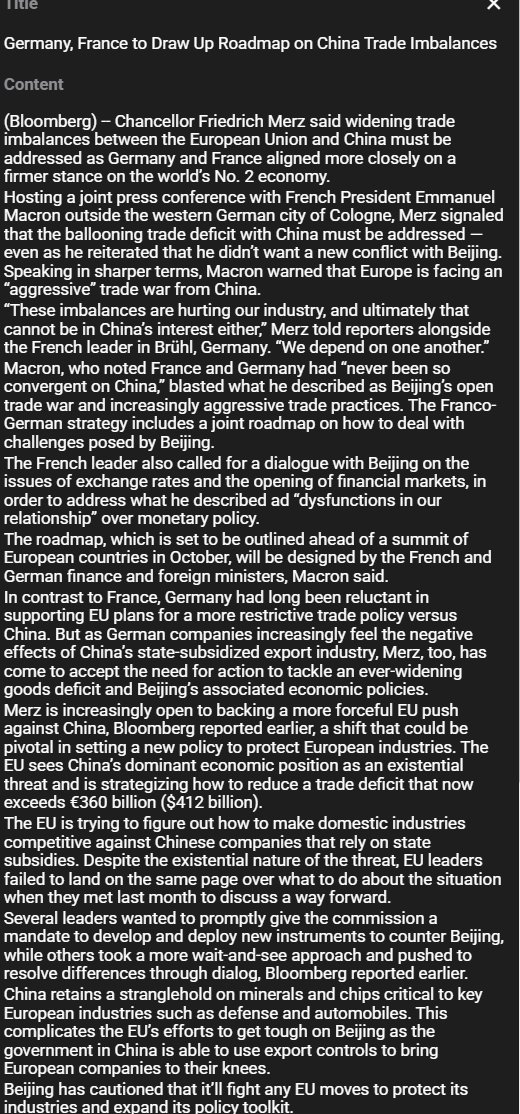
Trade war update: France & Germany to draw up roadmap on China shock before Oct European Council
"Macron, who noted France and Germany had “never been so convergent on China,” blasted what he described as Beijing’s open trade war and increasingly aggressive trade practices."
Super excited to hear that Center for China Analysis at @AsiaPolicy has encouraged me to write more on Substack, perhaps housed in my own (now dormant!) Substack space with cross-posting on CCA’s Substack. The specifics are still TBD, but I’d love your thoughts: what should I post about, on China econ and tech?
- quick takes on new policies + tips / intels / predictions about what to watch next?
- AMA chats?
- close readings of Chinese language documents?
- podcasts?
- something in Chinese?
- boba chain reviews?
The China watching space on Substack is evolving quickly, and people are already doing excellent content e.g., newsletters, translations, policy analyses. Wanted to contribute where I can add some marginal value without duplicating work others are already doing, and probably doing better tbh...
Drop me a reply or DM with suggestions!
This is one of the benchmarks I am watching, from the UK's governmental AI security agency. They will test Kimi K3 when the weights are out in a couple of weeks.
It will tell us both whether Kimi has caught up with the public frontier & also kick off a TON of cyber discussions.
My mental model for how the model layer will shake out in the long-term resembles how the mobile operating layer turned out:
- OpenAI/Anthropic will be the most profitable, capture a devoted set of customers, locked-in but largely don't mind, like like iOS ecosystem
- a long tail of open models will enable a long tail of enterprises, devices, brands, use cases. Each not as profitable as OAI/A\ individually, but all will do fine and find their reasons to exist, just like Android ecosystem
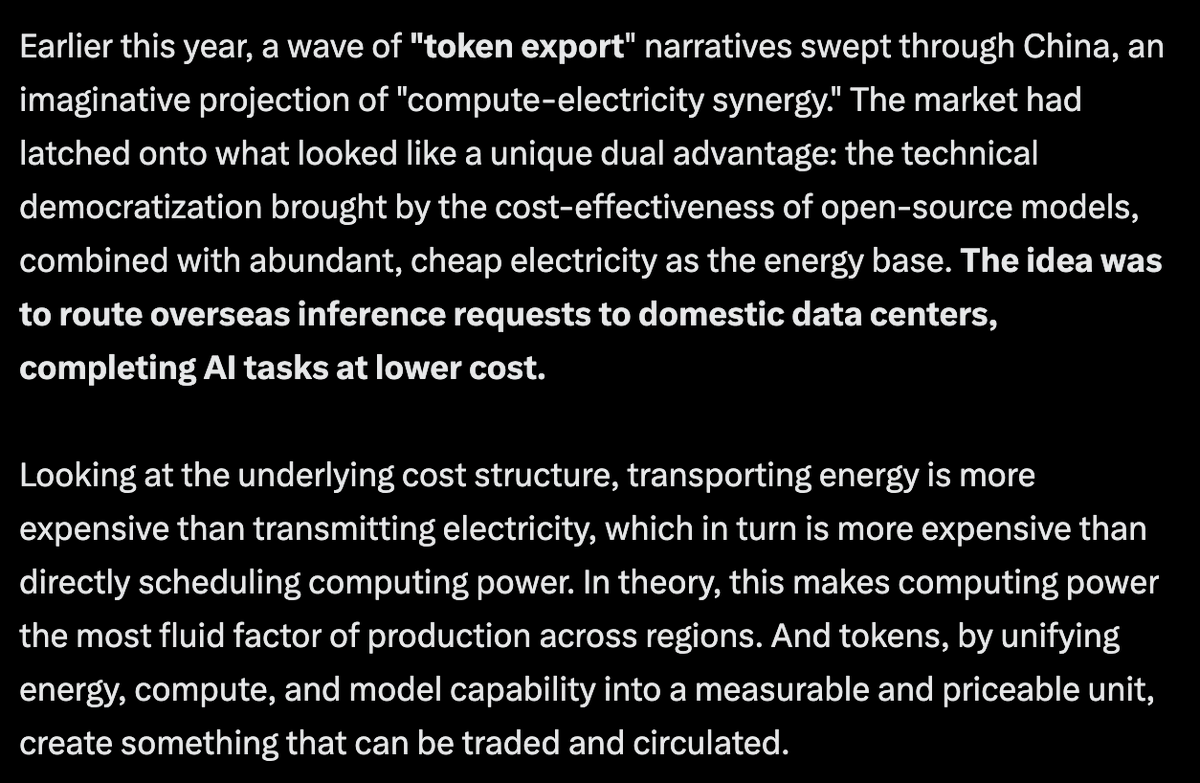
For those who are just waking up to the
China has cheaper electricity +
maybe eventually cheaper inference hardware stack +
open & cheaper models
could mean China will be "exporting tokens!"
This was a popular narrative at the beginning of the year in China and our friends at @WeijinResearch wrote about it in April.
TLDR, it's not that easy obviously, and faces many obstacles, some of which -- ahem, geopolitical -- we are seeing today
In a new @CEIPStatecraft paper, I take a "big picture" look at American economic power. Takeaways:
1. Trump has the most ambitious agenda for American economic hegemony of any president in decades. But he has also triggered a backlash that may undermine US economic power. 🧵
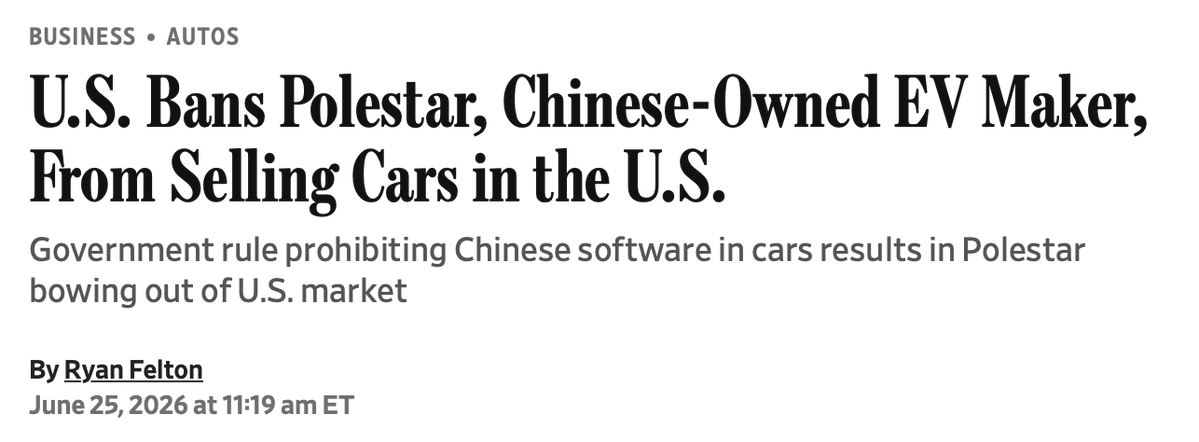
@CommerceGov ban on Polestar under the "connected cars" rule signals continued managed decoupling in strategic sectors even against more stable overall US-China relations.
Also signals the continued role of tech controls, not just tariffs, in managing the econ relationship.
It's hard to imagine calls for a new Plaza accord to push up the RMB are going to go anywhere. In my view the diplomatic effort would be better spent arguing for better domestic macro policy in China to boost inflation. That is more of a win-win argument, as it would help China deal with high youth unemployment, depressed wage expectations, etc etc, while also reversing some of the ~20% depreciation in the real effective exchange rate. Might not work either, but chances are better than US/G7 trying to force a revaluation
The rush of capital into China’s tech start-up world hit a speed bump this month.
Within hours of each other last Friday, a Chinese city government ordered companies to disclose their financial ties to robot vacuum maker Dreame Technology, and China’s State Council issued sweeping rules to tighten oversight of the country’s 23 trillion yuan ($3.4 trillion) private fund industry.
Click here to read more: https://t.co/uYbUqaF7sQ
🚨🇨🇳🏭📈🚨
New @RANDCorporation report on China's techno-industrial policies under Xi! With @JonathonPSine and Benjamin Lenain. We detail the evolution, goals, and instruments. Lots of charts and summary tables! Please enjoy.
https://t.co/dev9o5Nn0v
Good work has been done by @Brad_Setser and others on the hit to the EU from China's auto export surge. I've seen less focus on Korea and Japan, even though both have big auto sectors. So here are a few charts.
Like the EU, Korea now has a deficit with China in cars
1/8