Mathematician Terence Tao on training and running LLMs isn't mathematically difficult; any math undergrad could understand the basics
The mystery is that we have no theory to predict why models excel at certain tasks and fail at others
"we can only make empirical experiments"
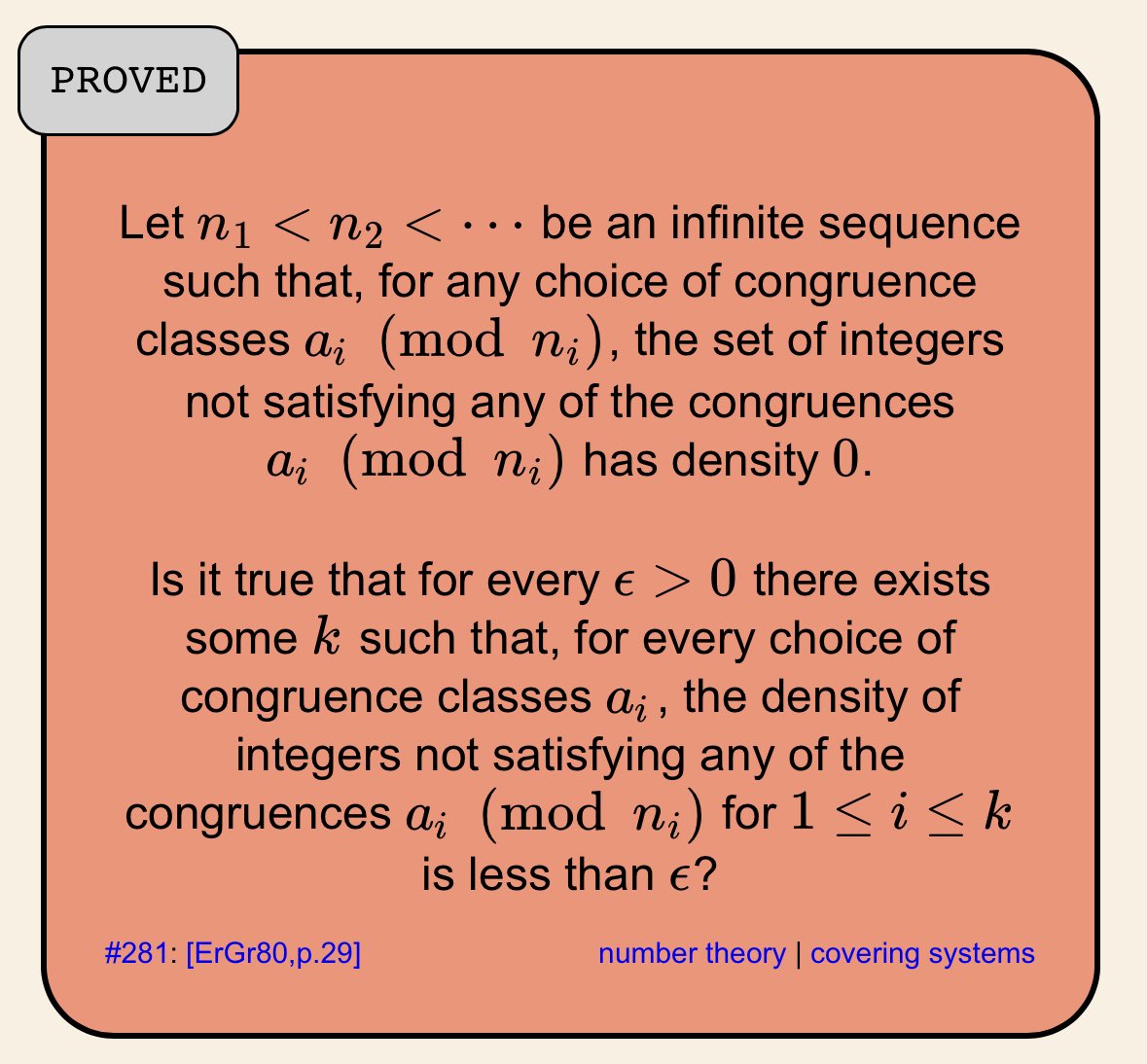
I've solved a second Erdos problem (#281) using only GPT 5.2 Pro - no prior solutions found.
Terence Tao calls it "perhaps the most unambiguous instance" of AI solving an open problem:
Terence Tao predicts the end of math gatekeeping with AI.
AI proof assistants are smashing the technical barriers that keep amateurs out.
By automating verification, AI empowers anyone to contribute rigorous pro-level Math.
The Ivory Tower is falling
Terence Tao says the real breakthrough isn’t just AI solving Erdős problems. It’s how it rewrites the paper, again and again.
But beyond the solution, Tao highlights something more profound: the emergence of AI-powered write–rewrite cycles for mathematical exposition.
Through a blend of tools like ChatGPT and Aristotle (Lean formalizer), AI users collaboratively produced not just the proof, but multiple drafts of a full paper including natural language explanations, historical framing, and literature connections.
This new mode of rapid mathematical storytelling routinely impossible with traditional tools is now real.
Like @davidbessis and others, I think that Hinton is wrong. To explain why, let me tell you a brief story.
About a decade ago, in 2017, I developed an automated theorem-proving framework that was ultimately integrated into Mathematica (see: https://t.co/nGCIUk44TP) (1/15)
“passed away together with his wife, Michelle, reportedly due to the anger he caused others….” etc. etc.
From a sitting @POTUS.
I’m not afflicted with TDS. I can call balls & strikes, and this is madness and pure evil. You mustn’t EVER do this from *our* Oval Office. Period.
A reset button for rotation could change how we control them all.
Is it possible to cancel out a complicated spin without painstakingly reversing every single move? Surprisingly, the answer is yes.
Mathematicians Jean-Pierre Eckmann (University of Geneva) and Tsvi Tlusty (UNIST, South Korea) recently proved that almost any object—whether it’s a spinning top, a tumbling satellite, a twisted protein, or even a scrambled Rubik’s Cube—has a hidden “reset button” for its orientation.
Instead of undoing the motion step by step in reverse order, you can take the entire original sequence of rotations, scale it by a certain constant factor (make every turn bigger or smaller by the same proportion), perform that scaled version once, then do it again—and the object snaps perfectly back to its starting orientation. Two scaled copies of the same motion are enough to erase it completely.
It feels deeply counterintuitive. We’re used to thinking that rotations in 3D space don’t commute and that the only safe way to return home is to retrace your path exactly backward. Yet this new result reveals a previously unknown geometric symmetry: certain scaling factors turn the rotation group into something that has a kind of built-in “double and cancel” feature.
The discovery applies to any rigid body moving in three dimensions and may simplify algorithms in robotics (for reorienting a robot arm without tracking every prior move), computer graphics, molecular dynamics simulations, spacecraft attitude control, and even some problems in quantum mechanics.
In short, nature has been hiding a remarkably simple trick: sometimes the fastest way to undo a complex dance of spins isn’t to moonwalk backward through every step; it’s to perform an enlarged (or shrunken) version of the same dance twice.
["Walks in Rotation Spaces Return Home when Doubled and Scaled." Physical Review Letters, 2025]
'He has a point, but he's too blunt.'
From the start, a key tactic of the gender identitarians has been linguistic prescription, and it's proved shockingly successful. Trans activists' shibboleths and euphemisms have been allowed to penetrate the upper echelons of our culture with devastating consequences to freedom of speech and belief. Huge swathes of liberal media, the arts, academia and publishing have thrown themselves with gusto into the defence of a quasi-religious belief causing provable real world harm, and in their arrogance they've been outraged when people they assumed were part of their In Group have refused to march meekly along in lock step.
Time and again, I've seen and heard well-educated people who consider themselves critical thinkers and bold truth-tellers squirm when put on the spot. 'Well, yes, maybe there's something in what you're saying, but it's hateful/provocative/rude not to use the approved language/pretend people can literally change sex/keep drawing attention to medical malpractice or opportunistic sexual predators. Why can't you be nice? Why won't you pretend? We thought you were one of us! Don't you realise we have sophisticated new words and phrases these days that obviate the necessity of thinking any of this through?'
As the vibe shifts, and a lot of people in the elite professions start trying to reposition themselves, the obvious place to start is, 'it's not that I couldn't see your point, but did you have to say it that way?' We dissenters were supposed to find a way of questioning the chemical castration of children while calling it 'gender affirming care.' We were meant to defend the rights of vulnerable women while also using female pronouns for male rapists. We should have found a way to discuss fairness for women and girls in sport, while pretending that the ineradicable physical advantage men have over women doesn't exist.
Either a man can be a woman, or he can't. Either women deserve rights, or they don't. Either there's a provable medical benefit to transitioning children, or there isn't. Either you're on the side of a totalitarian ideology that seeks to impose falsehoods on society through the threat of ostracisation, shaming and violence, or you're not. The alternative to being 'blunt' - using accurate, factual language to describe what was going on - was to surrender freedom of speech and espouse ideological jargon that obfuscated the issues and the harms caused. We've always needed blunt people, but we need them most of all when being asked to bow down to a naked emperor.
"Williams and Ceci sent fake job applications to more than 800 faculty members in engineering, economics, biology, and psychology... As shown in the graph below, faculty expressed a strong preference for the female candidates - a 2:1 preference overall."
[Link below.]
I'm calling on economists *not* to do this. True scientic consensus is rare. I think you undermine the IPCC when treat a social scientific question as tantamount to the hard sciences. Especially since their press release makes clear that this is an exercise in question-begging.
"As a former BBC journalist who now teaches journalism at university, I can tell you that, no, the BBC’s journalism is not impartial, and yes, the corporation is institutionally biased." --
@MajinGraham for @Quillette
https://t.co/llrYDIR4Dt
Remember how I told you about how Jeffrey Epstein is actually “anti-interesting” to our News organizations.
They try to “anti-break” this story. The story repeatedly “unhappens” at places like the NYT.
You’re looking at a massive covert operations hub. This includes your News:
I am actually the lead and corresponding author on the most cited research paper of this person's career. Someone told me that today, and I verified it.
The claim that her work has had any substantial effect on breast cancer is a dramatic overstatement.
Like much of what’s being presented in this 60 Minutes segment, it’s a PR narrative designed to grab money. It’s dishonesty from these institutions about what technology from the life sciences can actually do—and it says more about the way universities grift the public for sympathy and funding than anything about science itself.
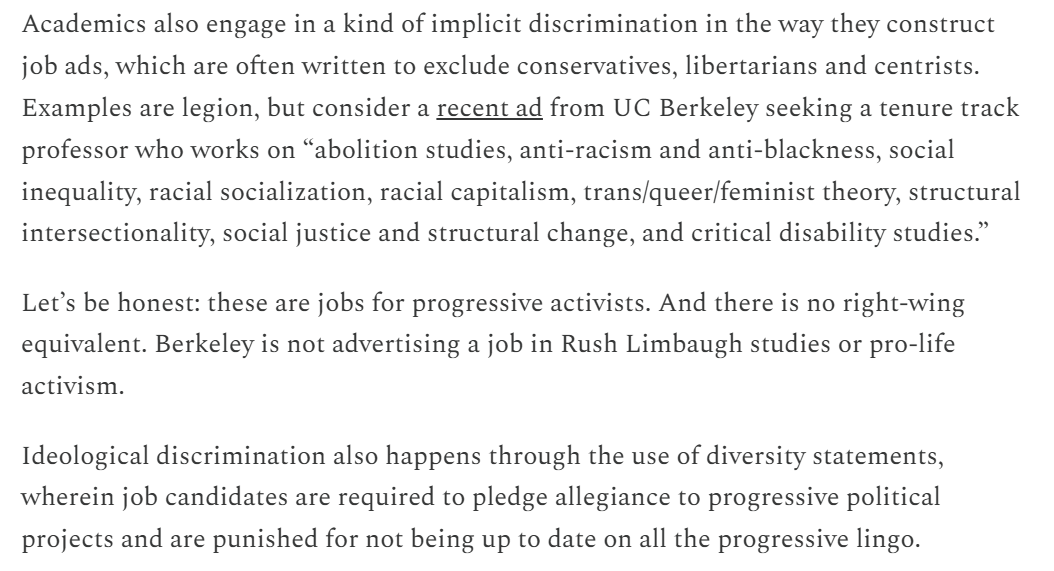
Re the ideological biases in the academy:
When I was pursuing my PhD, which was about discrimination and inequality, I often got shocked reactions, sometimes mixed with sheer, genuine confusion, when fellow academics realized that my work wasn’t about artificially pushing to expand the range of groups or situations considered wrongfully discriminatory (and thus covered by anti-discrimination law).
When it became clear that I was actually arguing that there are basic ambiguities and conceptual/normative problems in how the notion of discrimination is understood and applied in political discourse and by the legal system, my work, I suspect, was quietly branded as advancing some anti-justice or perhaps even racist (or some other "-ist") agenda.
Apparently, many of my colleagues simply couldn’t wrap their heads around the fact that I was there to do research, not to promote some grandiose activist narrative -- an activity which, aside from being politically motivated, tends to be extremely boring from an intellectual point of view.
(For the record, I've always been pretty moderate politically and I'm not particularly conservative - not that there's anything wrong with it! - and often "pass" as your normy liberal in many settings in my home country and abroad. I also think that my work could have actually contributed to improving anti-discrimination protections in many cases. Oh well).









![Rainmaker1973's tweet photo. A reset button for rotation could change how we control them all.
Is it possible to cancel out a complicated spin without painstakingly reversing every single move? Surprisingly, the answer is yes.
Mathematicians Jean-Pierre Eckmann (University of Geneva) and Tsvi Tlusty (UNIST, South Korea) recently proved that almost any object—whether it’s a spinning top, a tumbling satellite, a twisted protein, or even a scrambled Rubik’s Cube—has a hidden “reset button” for its orientation.
Instead of undoing the motion step by step in reverse order, you can take the entire original sequence of rotations, scale it by a certain constant factor (make every turn bigger or smaller by the same proportion), perform that scaled version once, then do it again—and the object snaps perfectly back to its starting orientation. Two scaled copies of the same motion are enough to erase it completely.
It feels deeply counterintuitive. We’re used to thinking that rotations in 3D space don’t commute and that the only safe way to return home is to retrace your path exactly backward. Yet this new result reveals a previously unknown geometric symmetry: certain scaling factors turn the rotation group into something that has a kind of built-in “double and cancel” feature.
The discovery applies to any rigid body moving in three dimensions and may simplify algorithms in robotics (for reorienting a robot arm without tracking every prior move), computer graphics, molecular dynamics simulations, spacecraft attitude control, and even some problems in quantum mechanics.
In short, nature has been hiding a remarkably simple trick: sometimes the fastest way to undo a complex dance of spins isn’t to moonwalk backward through every step; it’s to perform an enlarged (or shrunken) version of the same dance twice.
["Walks in Rotation Spaces Return Home when Doubled and Scaled." Physical Review Letters, 2025]](https://pbs.twimg.com/media/G7V5AsFXEAEFeMc.png)
![SteveStuWill's tweet photo. "Williams and Ceci sent fake job applications to more than 800 faculty members in engineering, economics, biology, and psychology... As shown in the graph below, faculty expressed a strong preference for the female candidates - a 2:1 preference overall."
[Link below.] https://t.co/lIqxzpOb7a](https://pbs.twimg.com/media/G56EP2SaMAAQ-IR.jpg)