I am honored to be presenting at the annual conference of the American Society of Preventive Oncology in Chicago.
The Emergency Patient Support Network currently operates in two cities (Philadelphia and Camden NJ), and the program is receiving national attention. We anticipate @LegacyOfHopePHL expanding to several other cities in the next year.
Today information on @LegacyOfHopePHL's Emergency Patient Support Network was well received at a Roundtable discussion on Food Insecurity and Cancer Outcomes. Tomorrow I'll have the opportunity to present during the Best of ASPO: Social Determinants of Health.
We're grateful to share the unique work that Legacy of Hope is doing in Philadelphia and proud to be a part of the important research in collaboration with the team at @KimmelCancerCtr and @TJUHospital.
Elon Musk says when hiring, evidence of exceptional ability matters more than any other credential.
"Did they face really difficult problems and overcome them? You wanna make sure that if there was some significant accomplishment, were they really responsible, or was somebody else more responsible?"
"Usually the person who's had to struggle with the problem, they really understand it. And they don't forget, if it was very difficult."
"There's no need even to have a college degree. At all. Or even high school."
"If somebody graduated from a great university, that may be an indication that they will be capable of great things, but it's not necessarily the case."
"If you look at people like Bill Gates or Larry Ellison, Steve Jobs, these guys didn't graduate from college. But if you had a chance to hire them, of course, that would be a good idea."
"If there's a track record of exceptional achievement, then it's likely that that will continue into the future."
@elonmusk (2014)
I am automating investigative journalism at https://t.co/XkM9jqV49c
We're breaking five stories today based on verifiable financial data which everyone missed for years.
This is what I’ve been working on. 🧵
METR is ideologically homogenous, largely foreign-born or foreign-educated, and intellectually
incestuous. They are an outgrowth of a particular EA subculture at Oxford and Cambridge with a niche and unusual set of values.
There is an unseen hand pushing AI safety as a political ideology.
Effective Altruists believe a tiny group of technocrats should decide how much technological progress the rest of us are allowed to have…. and how many shrimp your life is worth.
You are witnessing their attempted coup.
https://t.co/8Bi4Dvjklh
JENSEN HUANG: “We don't welcome political discourse inside our company. Take it home … We're bipartisan. We want America to succeed … The discourse about race and religion and politics and all of that stuff, we tell people do it outside the company. It's not for us.”
One of the greatest viruses of the modern man is looking at Instagram Stories. You will melt your brain looking at a barrage of outcomes—like vacations, parties, cars—with no visibility of the process that got them there.
1) AI will not eradicate humanity. Humans survived an ice age, the Black Death, two world wars, and (so far) the advent of nuclear weapons. Anyone who is loudly warning of AI-caused human extinction should not be taken seriously.
2) If you worked in a company where you anticipated a 10% chance that your product would kill ten people, let alone all people, the correct response would be horror, ceasing all operations, and likely contacting the police or other criminal authorities. I am obviously no Coxon booster but at least his behavior is in line with his stated beliefs. Any current AI company employees saying "yes, me too, the thing we are building and about to IPO may kill all humans" should, again, not be taken seriously. Their actions betray their actual beliefs.
3) Antitrust law does not prevent AI companies from coordinating to make sure AI does not hurt people. It does not prevent companies working together to make sure it doesn't hack people; the DOJ and FTC made this clear a decade ago when they issued a policy statement saying that the agencies "do not believe that antitrust is – or should be – a roadblock to legitimate cybersecurity information sharing." The same principles apply here. See: https://t.co/aQsqGn1xjX
4) Antitrust law does absolutely prevent AI companies from organizing to prevent the entry of cheaper, upstart rivals because the bigger companies are burning cash and failing to achieve sufficient profitability. The panic of individual employees may be sincere if misguided, but the moves by their CEOs to achieve some kind of broad "antitrust waiver" or "exemption" should be meet with deep skepticism in light of the economics of the industry and the threat they face from open models.
This is what Dario and Sama fear -
- the cost of fine tuned open source models trained on custom data was 95% less than the frontier models
- And they performed better than the frontier models
- And they could train them in less than 48 hours
The big AI labs have no moat..
Even at the enterprise level..
Any sane company would prefer a custom trained open source model instead of paying API pricing to Anthropic and Open AI
If open source keeps growing at the pace it is, frontier labs' business collapses..
only way out is oldest trick in manipulation - FUD -> Fear, Uncertainty, Death
Step 1 - Seed the psyop
- Test a swarm of agents trained to "hack"
- The swarm does what its supposed to do - hack
- Publish a report - AI is too dangerous
Step 2 - weed out the doubters
- Get an employee to quit your company
- Go viral saying both companies are not doing enough to self regulate AI
- AI is dangerous - will kill humanity by the end of the decade
Step 3 - Prepare for fruition
- write an "essay" to "pace the frontier"
- Advocate regulation
- Only a few holier than though companies get to build AI
- Scare the world into agreeing with AI Doom
- Effectively turn your competitors into criminals (genius business strategy)
Endgame -
- Become a cartel that controls AI (and the world)
- Raise prices (coz business is unsustainable... ofc)
- IPO (offload liability of said unsustainable business to the public)
Laugh all the way to the bank 🤑
Win!
If you have your OpenClaw working 24/7 using frontier models like Opus, you're easily burning $300 a day.
That's $100,000 a year.
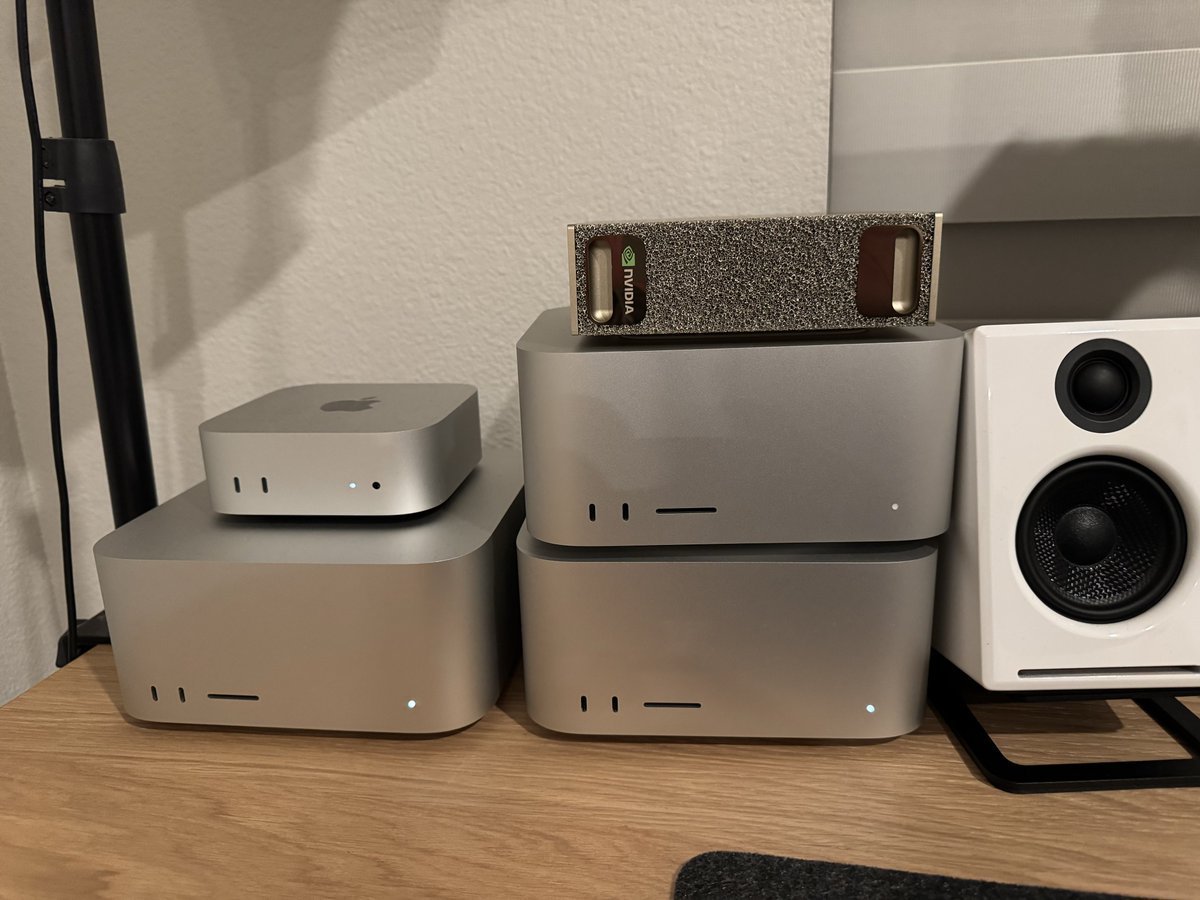
I have 3 Mac Studios and a DGX Spark running 4 high end local models (Nemotron 3, Qwen 3.5, Kimi K2.5, MiniMax2.5). They're chugging 24/7/365. I spent a third of that yearly cost to buy these computers
I'll be able to use them for years for free
On top of that they're completely private, secure, and personalized.
Not a single prompt goes to a cloud server that can be read by an employee or used to train another model
I hope this makes it painfully obvious why local is the future for AI agents. And why America needs to enter the local AI race.