Today, the House Foreign Affairs Committee marks up the MATCH Act - the most consequential semiconductor export control legislation in years. @janet_e_egan and I wrote about why it matters in a new @CNASdc Insights piece. 🧵
1/ China is systematically extracting the capabilities of U.S. frontier AI.
With @danielremler, a comprehensive analysis of Adversarial Distillation: the evidence, the supply chain, and what to do about it. 🧵
Due to regulatory confusion, it had become an open secret that large-scale shipments of cutting-edge US AI chips were resuming to Chinese-headquartered firms outside China without a US export license.
This, in effect, was a total cancellation of US AI chip controls.
The new BIS guidance clarifies that a license is still required for these shipments.
But while the guidance solved one problem, it failed to fix, and even exacerbated another.
Namely, by failing to say that BIS is also enforcing license requirements on foundries like TSMC to perform due diligence on their customers, the guidance has opened the door to a redux of Huawei illicitly using front companies to manufacture millions of chips at US and allied foundries.
BIS needs to issue a clarification immediately that these due diligence requirements are being enforced.
The old national security playbook no longer applies. America must embrace New Rules to win the 21st century.
I argue that, as we see vividly in 2026, geographic chokepoints are back. Iran and the Strait of Hormuz are emblematic, but there are others.
Even for AI companies, AI progress is faster than expected
If they expected models to be this useful and in demand, they could have locked in contracts at lower prices. But most didn't, and are now getting burned by higher prices
.@RepBrianMast at @CNASdc: The MATCH Act, AI OVERWATCH Act, and Chip Security Act were introduced to prevent China from stealing our tech lead and winning the AI arms race. This is a dire national security issue, which is why it is vital to get these bills across the finish line.
Was great speaking with @CatieEdmondson for her excellent piece on China's AI labor anxieties
"[AI diffusion] aspirations have run headlong into a growing political problem: anxiety over the workers who could be displaced by the realization of Beijing's technological drive"
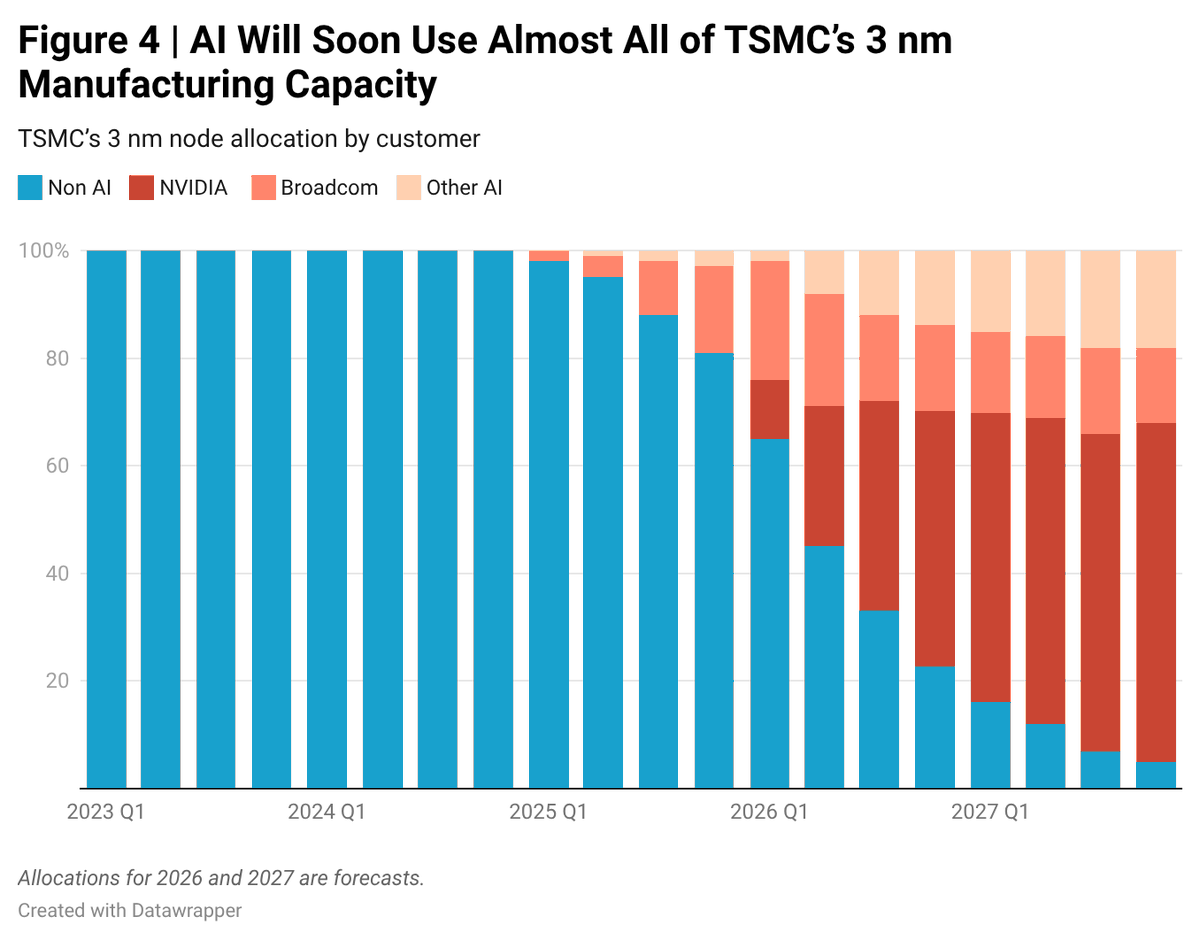
AI companies are pushing TSMC’s current production capacity to its limit—and planned capacity is fully reserved before it has even broken ground.
@james_s48, @janet_e_egan, and Rory Madigan demonstrate what this means for U.S. policy.
Following President Trump's visit to Beijing, we're hosting House Foreign Affairs Committee Chairman @RepBrianMast next Tuesday at 2pm ET for a discussion on the US-China AI competition. Tune in!
I made it to Times Square! My friend @communidiyi uploaded a silly Halloween photo of me and my partner for her company’s IPO today.
Congrats @cerebras!
While mandated industry-government partnership is certainly a step in the right direction, I would have liked to see mandated testing pre-deployment too, and appropriate funding of CAISI to fill that vital role
Voluntary testing of models is pretty much the status quo.
Scoop: The White House is preparing an executive order on AI security that omits mandatory model testing and emphasizes voluntary participation by AI companies for cyber defense efforts.
W/ @cmsub for @business
https://t.co/RR5u2D9sSM
The term sovereign AI is everywhere now, but what does it mean in practice?
My colleagues and I launched the Sovereign AI Index to find out (!)
It tracks 130+ sovereign AI projects with insights on hardware contracts, commonly used base models, spending trends & more
The AI buildout is bottlenecked by chip manufacturing capacity
This means AI chips become even more valuable, exports are zero-sum, and America has greater leverage
We lay out how we got here, tightest supply chain constraints, & policy implications in a paper w/ @janet_e_egan🧵
While Sen. Warren is right about the immense energy and infrastructure cost to keep up with data centers, it's a bit inaccurate to say that all the companies are passing the costs onto consumers.
A lot of these companies have signed voluntary commitments to pay for energy and grid upgrades. They've also signed onto the White House Ratepayer Protection Pledge.
But the real question is whether these voluntary frameworks are sufficient - or whether laws need to be put in place. Concerns from local communities are real, and policymakers need to come up with a real solution.
Big tech companies are building massive, energy-guzzling data centers to power their AI models.
And rather than paying for the cost of new infrastructure to accommodate those data centers, some of the richest companies are passing those costs onto you.
You shouldn't be subsidizing AI data centers.
Super important issue that is not being talked about enough imo.
The ongoing legality of remote access undermines a strong export control regime - and no, selling chips to China doesn’t make remote access less appealing when labs can access more advanced chips via the cloud.
Cloud providers could collect information about their customers (and to some extent probably already have information for large amounts of compute) but currently have no incentive to do this in a systematic way or share with the govt.
Congress must pass the Remote Access Security Act to close this loophole.
Congress is trying to close a longstanding loophole that allows Chinese customers to remotely access restricted U.S. chips.
In a new article for @CarnegieEndow, I discuss the logic behind these "cloud controls" and why they're more complicated than they seem.
My takeaways below:
Two Chinese courts (in Beijing + Hangzhou) recently ruled that companies cannot use AI as a pretext for layoffs
This cuts against how most people in the US assume China is approaching AI, and points to a significant constraint on Beijing's AI diffusion ambitions


![rubyscanlon's tweet photo. Was great speaking with @CatieEdmondson for her excellent piece on China's AI labor anxieties
"[AI diffusion] aspirations have run headlong into a growing political problem: anxiety over the workers who could be displaced by the realization of Beijing's technological drive" https://t.co/b4tcwJZ95m](https://pbs.twimg.com/media/HIxLziTWwAEpan2.png)