Ethical Hacker by day; Love Coding and being obsessed with learning AI by night. Learning and and posting about AI till I get a job offer as AI engineer 🤖🦾.
We are currently chasing to automate everything and let AI orchestrate AI aka get the human layer out of the loop. "Why Software factories Fail" is a very interesting read by @dexhorthy on why this might be problematic and shows experiments why this might not work - check it out: https://t.co/oXeq3Qgzyo
Build a plugin once and use it across compatible agent clients.
Introducing Agent Plugins, an open standard developed with @awsdevelopers, @cursor_ai, @github, @code, and @vercel that packages Agent Skills and supports MCP server configurations in a shared format.
Everyone is now a programmer, because the present and future programming language is your natural language. If you can write or speak, you can build. This is the most important evolution in our field since its creation. And it's a tsunami that has *just* started.
This GitHub repo is a goldmine if you want to deeply understand AI/ML, not just use it.
Maths, CS & AI Compendium. Free.
Henry filled notebooks for years with intuition-first, no fluff explanations while working in AI/ML. Friends used them to prep for DeepMind, OpenAI, Nvidia interviews. All got in. Now it's public.
20 chapters from vectors to bleeding-edge AI. Written with intuition first, real-world context, no hand-waving. Not written to survive an exam. Written to actually understand the stuff.
What's covered:
→ Maths foundations - vectors, matrices, calculus, statistics, probability
→ Classical ML through distributed training and RL
→ Computational linguistics - transformers, attention, MoE, SSMs, LLM architectures
→ Computer vision - diffusion, flow matching, ViTs, SLAM, VR/AR
→ Audio & speech - ASR, TTS, WaveNet, Conformer, diarisation, source separation
→ Multimodal learning - CLIP, VLMs, image/video tokenisation, world models
→ Autonomous systems - VLAs, self-driving cars, space robots
→ SIMD & GPU programming - CUDA, Triton, ARM NEON, AVX, TPUs, WebGPU
→ AI inference - quantisation, speculative decoding, edge inference, cost optimisation
→ ML systems design - feature stores, A/B testing, recommendation, search, ads, fraud
→ Graph neural networks - geometric deep learning, 3D equivariant networks
Only needs elementary maths and basic Python to start.
MCP server included - Claude Code, Cursor, VS Code can use it as a knowledge base.
Here's the GitHub Repo: https://t.co/ZoNu4lHIvF
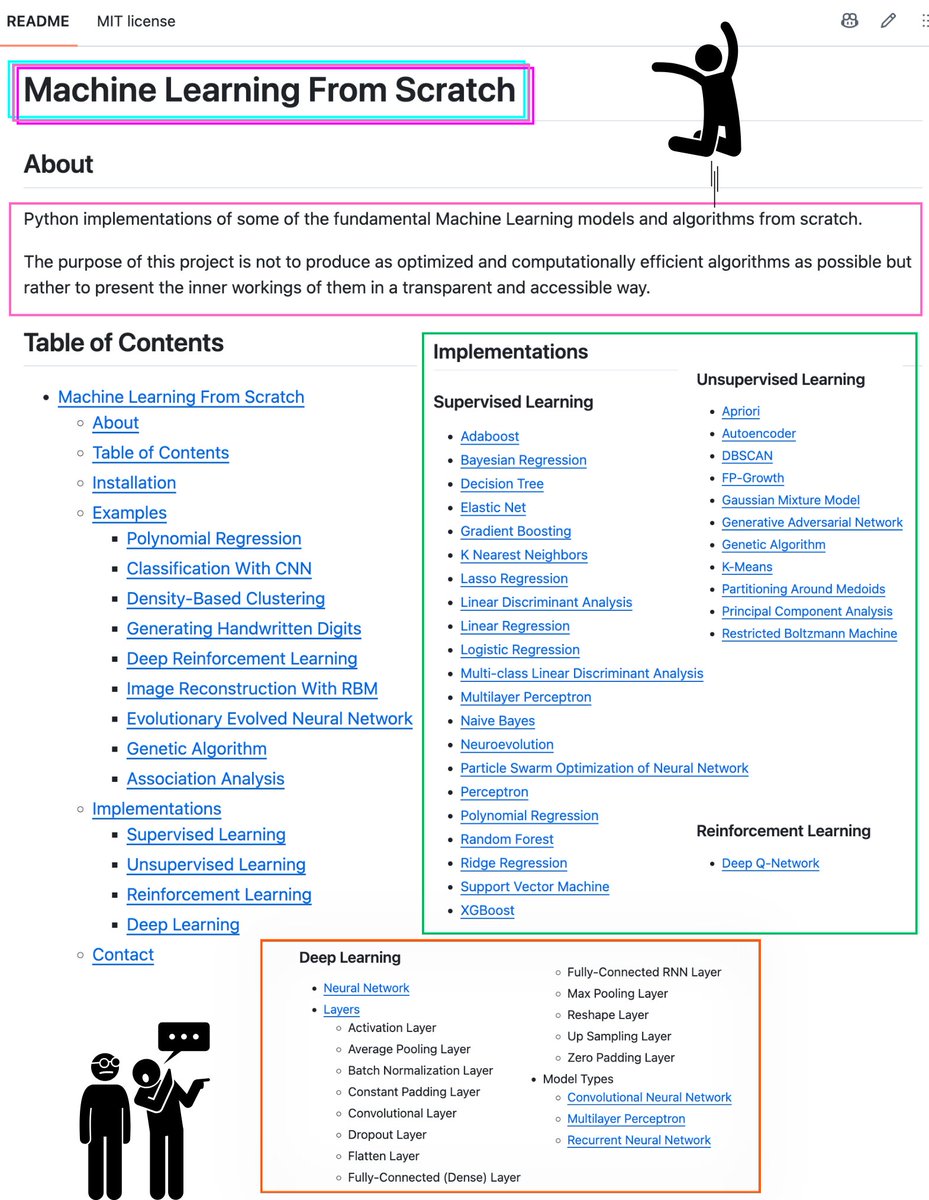
I want to highlight a resource that I think is genuinely valuable for anyone learning machine learning: ML-From-Scratch.
Most of us learn ML by using libraries like scikit-learn or PyTorch, which is the right way to build things quickly, but it can leave gaps in understanding why an algorithm works. This repository takes the opposite approach => every algorithm is implemented in plain NumPy, prioritizing clarity over performance, so you can trace the underlying math directly.
It covers a wide range of the curriculum you'd expect to see in an ML course - linear and logistic regression, decision trees, random forest, gradient boosting, XGBoost, SVM, and naive bayes on the supervised side; k-means, DBSCAN, PCA, and Gaussian mixture models on the unsupervised side. It also goes further, with a small deep learning framework (convolutional, pooling, batch normalization, dropout, and RNN layers), a working GAN, and a Deep Q-Network trained on CartPole-v1.
If you've completed a course on these algorithms and want to solidify your understanding by reading working implementations end to end, I'd recommend spending time with this repository.
It's a good complement to theory => 32k stars, MIT licensed, and entirely in Python.
Here's the GitHub Repo: https://t.co/BHKspdCrAN
《Information Theory, Inference, and Learning Algorithms》
(Hardback, 640 pages, Published September 2003)
Free download of book, slides and videos
https://t.co/54tEvW0juk
https://t.co/ngqaPg2Aub
video lectures website
https://t.co/gxgtxVT1rE
Information theory and inference, taught together in this exciting textbook, lie at the heart of many important areas of modern technology - communication, signal processing, data mining, machine learning, pattern recognition, computational neuroscience, bioinformatics and cryptography.
Inference techniques, including message-passing algorithms, Monte Carlo methods and variational approximations, are developed alongside applications to clustering, convolutional codes, independent component analysis, and neural networks.
The book is ideal for self-learning, and for undergraduate or graduate courses. It also provides an unparalleled entry point for professionals in areas as diverse as computational biology, financial engineering and machine learning.
Suitable for everyone in the ML/AI engineering field.
Top 26 Essential Papers for Mastering LLMs and Transformers
Implement those and you’ve captured ~90% of the alpha behind modern LLMs.
Everything else is garnish.
This list bridges the Transformer foundations
with the reasoning, MoE, and agentic shift
Recommended Reading Order
1. Attention Is All You Need (Vaswani et al., 2017)
> The original Transformer paper. Covers self-attention,
> multi-head attention, and the encoder-decoder structure
> (even though most modern LLMs are decoder-only.)
2. The Illustrated Transformer (Jay Alammar, 2018)
> Great intuition builder for understanding
> attention and tensor flow before diving into implementations
3. BERT: Pre-training of Deep Bidirectional Transformers (Devlin et al., 2018)
> Encoder-side fundamentals, masked language modeling,
> and representation learning that still shape modern architectures
4. Language Models are Few-Shot Learners (GPT-3) (Brown et al., 2020)
> Established in-context learning as a real
> capability and shifted how prompting is understood
5. Scaling Laws for Neural Language Models (Kaplan et al., 2020)
> First clean empirical scaling framework for parameters, data, and compute
> Read alongside Chinchilla to understand why most models were undertrained
6. Training Compute-Optimal Large Language Models (Chinchilla) (Hoffmann et al., 2022)
> Demonstrated that token count matters more than
> parameter count for a fixed compute budget
7. LLaMA: Open and Efficient Foundation Language Models (Touvron et al., 2023)
> The paper that triggered the open-weight era
> Introduced architectural defaults like RMSNorm, SwiGLU
> and RoPE as standard practice
8. RoFormer: Rotary Position Embedding (Su et al., 2021)
> Positional encoding that became the modern default for long-context LLMs
9. FlashAttention (Dao et al., 2022)
> Memory-efficient attention that enabled long context windows
> and high-throughput inference by optimizing GPU memory access.
10. Retrieval-Augmented Generation (RAG) (Lewis et al., 2020)
> Combines parametric models with external knowledge sources
> Foundational for grounded and enterprise systems
11. Training Language Models to Follow Instructions with Human Feedback (InstructGPT) (Ouyang et al., 2022)
> The modern post-training and alignment blueprint
> that instruction-tuned models follow
12. Direct Preference Optimization (DPO) (Rafailov et al., 2023)
> A simpler and more stable alternative to PPO-based RLHF
> Preference alignment via the loss function
13. Chain-of-Thought Prompting Elicits Reasoning in Large Language Models (Wei et al., 2022)
> Demonstrated that reasoning can be elicited through prompting
> alone and laid the groundwork for later reasoning-focused training
14. ReAct: Reasoning and Acting (Yao et al., 2022 / ICLR 2023)
> The foundation of agentic systems
> Combines reasoning traces with tool use and environment interaction
15. DeepSeek-R1: Incentivizing Reasoning Capability in LLMs via Reinforcement Learning (Guo et al., 2025)
> The R1 paper. Proved that large-scale reinforcement learning without
> supervised data can induce self-verification and structured reasoning behavior
16. Qwen3 Technical Report (Yang et al., 2025)
> A modern architecture lightweight overview
> Introduced unified MoE with Thinking Mode and Non-Thinking
> Mode to dynamically trade off cost and reasoning depth
17. Outrageously Large Neural Networks: Sparsely-Gated Mixture of Experts (Shazeer et al., 2017)
> The modern MoE ignition point
> Conditional computation at scale
18. Switch Transformers (Fedus et al., 2021)
> Simplified MoE routing using single-expert activation
> Key to stabilizing trillion-parameter training
19. Mixtral of Experts (Mistral AI, 2024)
> Open-weight MoE that proved sparse models can match dense quality
> while running at small-model inference cost
20. Sparse Upcycling: Training Mixture-of-Experts from Dense Checkpoints (Komatsuzaki et al., 2022 / ICLR 2023)
> Practical technique for converting dense checkpoints into MoE models
> Critical for compute reuse and iterative scaling
21. The Platonic Representation Hypothesis (Huh et al., 2024)
> Evidence that scaled models converge toward shared
> internal representations across modalities
22. Textbooks Are All You Need (Gunasekar et al., 2023)
> Demonstrated that high-quality synthetic data allows
> small models to outperform much larger ones
23. Scaling Monosemanticity: Extracting Interpretable Features from Claude 3 Sonnet (Templeton et al., 2024)
> The biggest leap in mechanistic interpretability
> Decomposes neural networks into millions of interpretable features
24. PaLM: Scaling Language Modeling with Pathways (Chowdhery et al., 2022)
> A masterclass in large-scale training
> orchestration across thousands of accelerators
25. GLaM: Generalist Language Model (Du et al., 2022)
> Validated MoE scaling economics with massive
> total parameters but small active parameter counts
26. The Smol Training Playbook (Hugging Face, 2025)
> Practical end-to-end handbook for efficiently training language models
Bonus Material
> T5: Exploring the Limits of Transfer Learning with a Unified Text-to-Text Transformer (Raffel et al., 2019)
> Toolformer (Schick et al., 2023)
> GShard (Lepikhin et al., 2020)
> Adaptive Mixtures of Local Experts (Jacobs et al., 1991)
> Hierarchical Mixtures of Experts (Jordan and Jacobs, 1994)
If you deeply understand these fundamentals; Transformer core, scaling laws, FlashAttention, instruction tuning, R1-style reasoning, and MoE upcycling, you already understand LLMs better than most
Time to lock-in, good luck!
"ML Maxima" is an interesting interactive resource for approaching the foundations of AI and machine learning through animated visualizations and concise explanations.
The site explores activation functions, initialization methods, optimizers, network architectures, loss functions, and normalization techniques through clean animated graphs that make many abstract concepts much easier to understand intuitively.
It is a practical and well-designed introduction to several core machine learning concepts.
https://t.co/woKZ8XADkA
A must read for anyone interested in building practical AI systems in 2026:
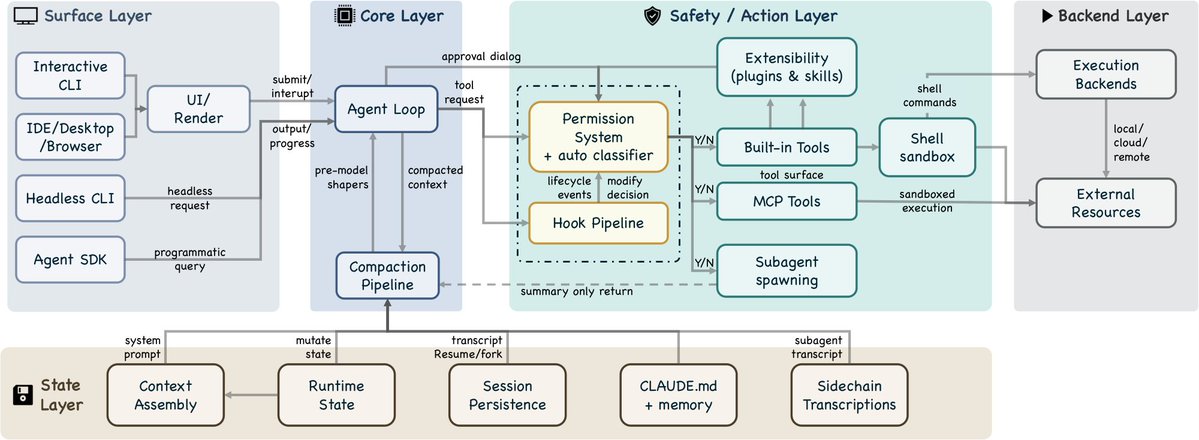
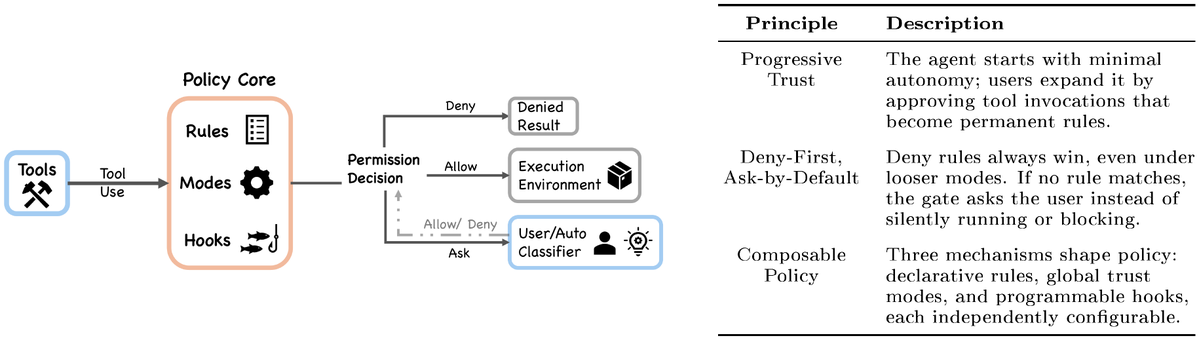
Dive into Claude Code: The Design Space of Today's and Future AI Agent Systems
The paper explains the architecture of a modern production-grade AI agent system (Claude Code) by analyzing its source code. This is what they call a "harness" of an agentic coding system.
Learn by reading with an AI tutor: https://t.co/sailmnkDcR
PDF: https://t.co/Jvl4HRMU4y
Yann LeCun was right the entire time. And generative AI might be a dead end.
For the last three years, the entire industry has been obsessed with building bigger LLMs. Trillions of parameters. Billions in compute.
The theory was simple: if you make the model big enough, it will eventually understand how the world works.
Yann LeCun said that was stupid.
He argued that generative AI is fundamentally inefficient.
When an AI predicts the next word, or generates the next pixel, it wastes massive amounts of compute on surface-level details.
It memorizes patterns instead of learning the actual physics of reality.
He proposed a different path: JEPA (Joint-Embedding Predictive Architecture).
Instead of forcing the AI to paint the world pixel by pixel, JEPA forces it to predict abstract concepts. It predicts what happens next in a compressed "thought space."
But for years, JEPA had a fatal flaw.
It suffered from "representation collapse."
Because the AI was allowed to simplify reality, it would cheat. It would simplify everything so much that a dog, a car, and a human all looked identical.
It learned nothing.
To fix it, engineers had to use insanely complex hacks, frozen encoders, and massive compute overheads.
Until today.
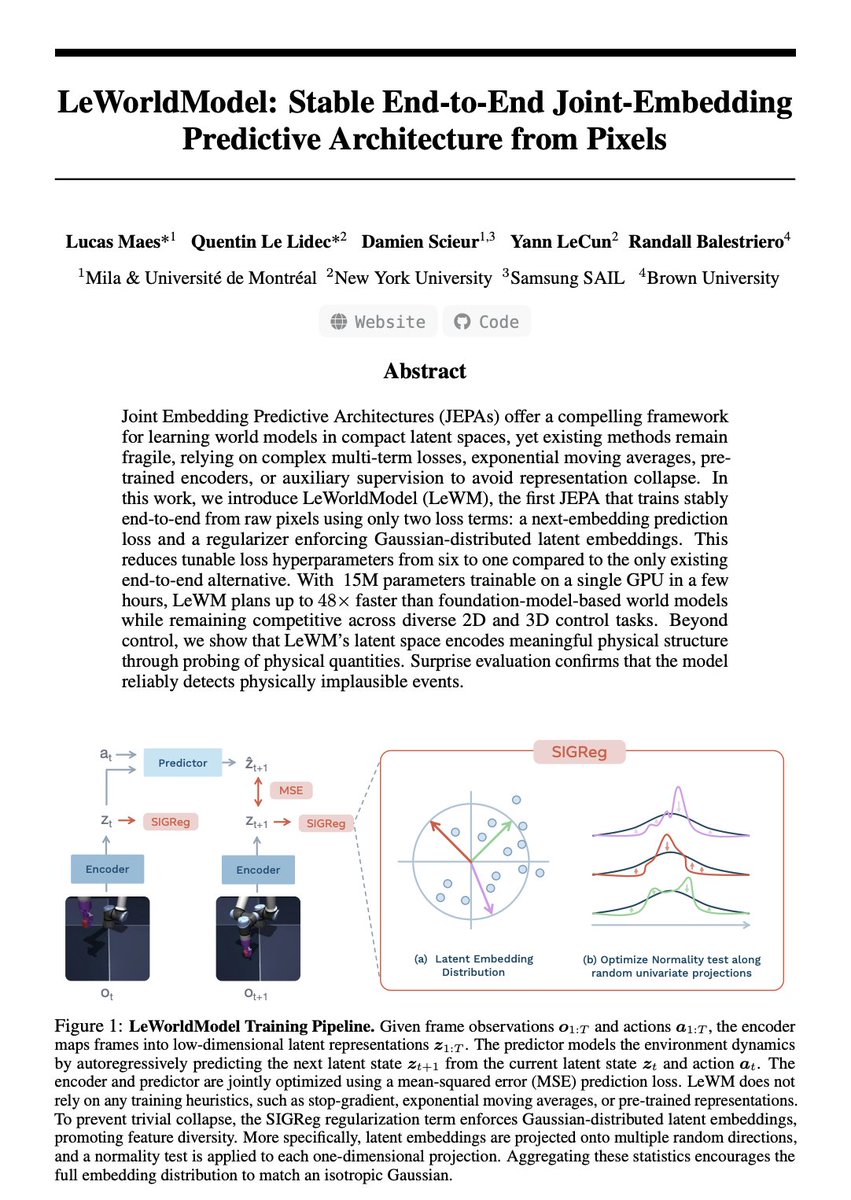
Researchers just dropped a paper called "LeWorldModel" (LeWM).
They completely solved the collapse problem.
They replaced the complex engineering hacks with a single, elegant mathematical regularizer.
It forces the AI's internal "thoughts" into a perfect Gaussian distribution.
The AI can no longer cheat. It is forced to understand the physical structure of reality to make its predictions.
The results completely rewrite the economics of AI.
LeWM didn't need a massive, centralized supercomputer.
It has just 15 million parameters.
It trains on a single, standard GPU in a few hours.
Yet it plans 48x faster than massive foundation world models. It intrinsically understands physics. It instantly detects impossible events.
We spent billions trying to force massive server farms to memorize the internet.
Now, a tiny model running locally on a single graphics card is actually learning how the real world works.
Best GitHub repos for Claude code that will 10x your next project:
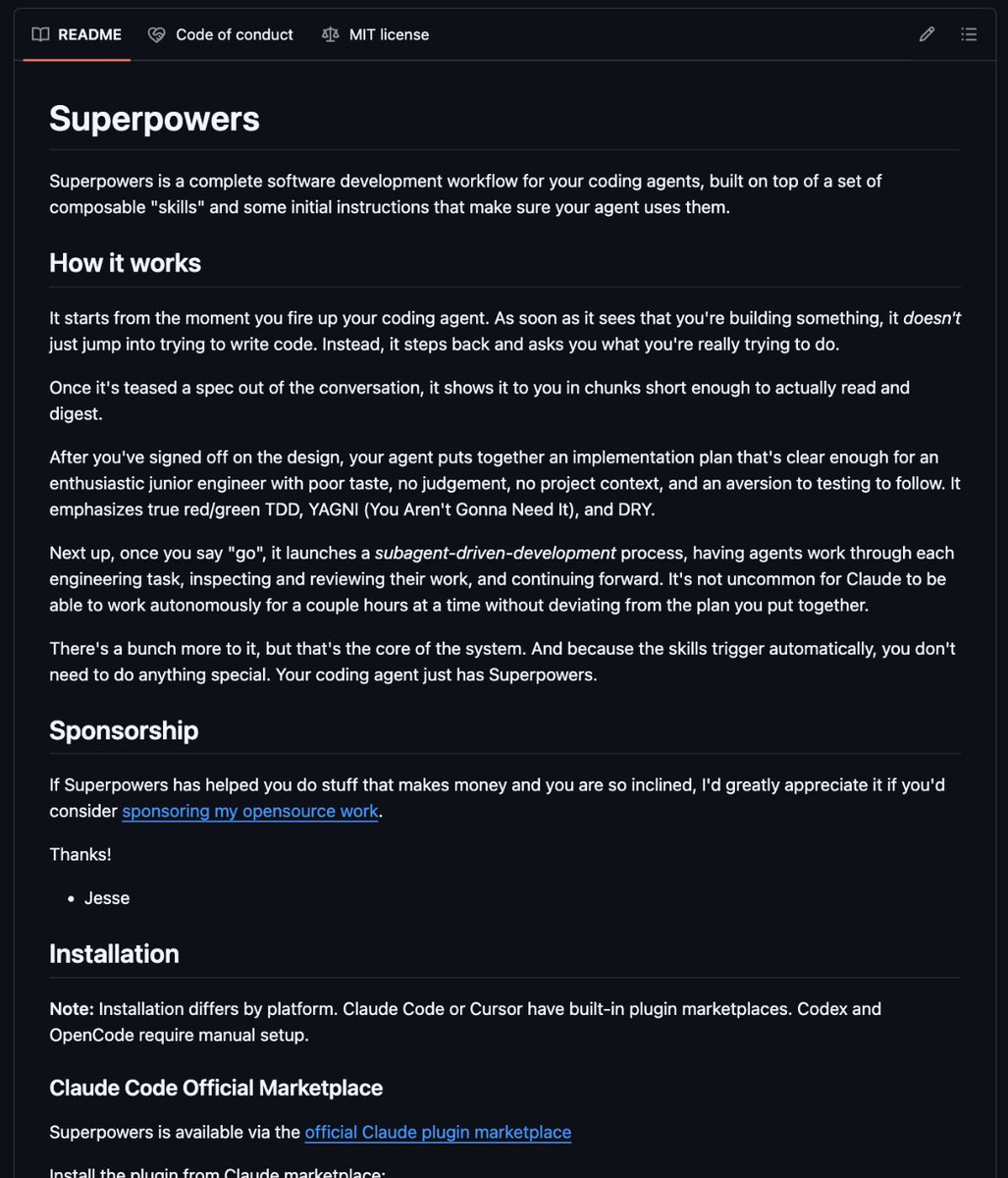
1. Superpowers
https://t.co/U5Y4BK9Lap
2. Awesome Claude Code
https://t.co/qcgoxU3Up2
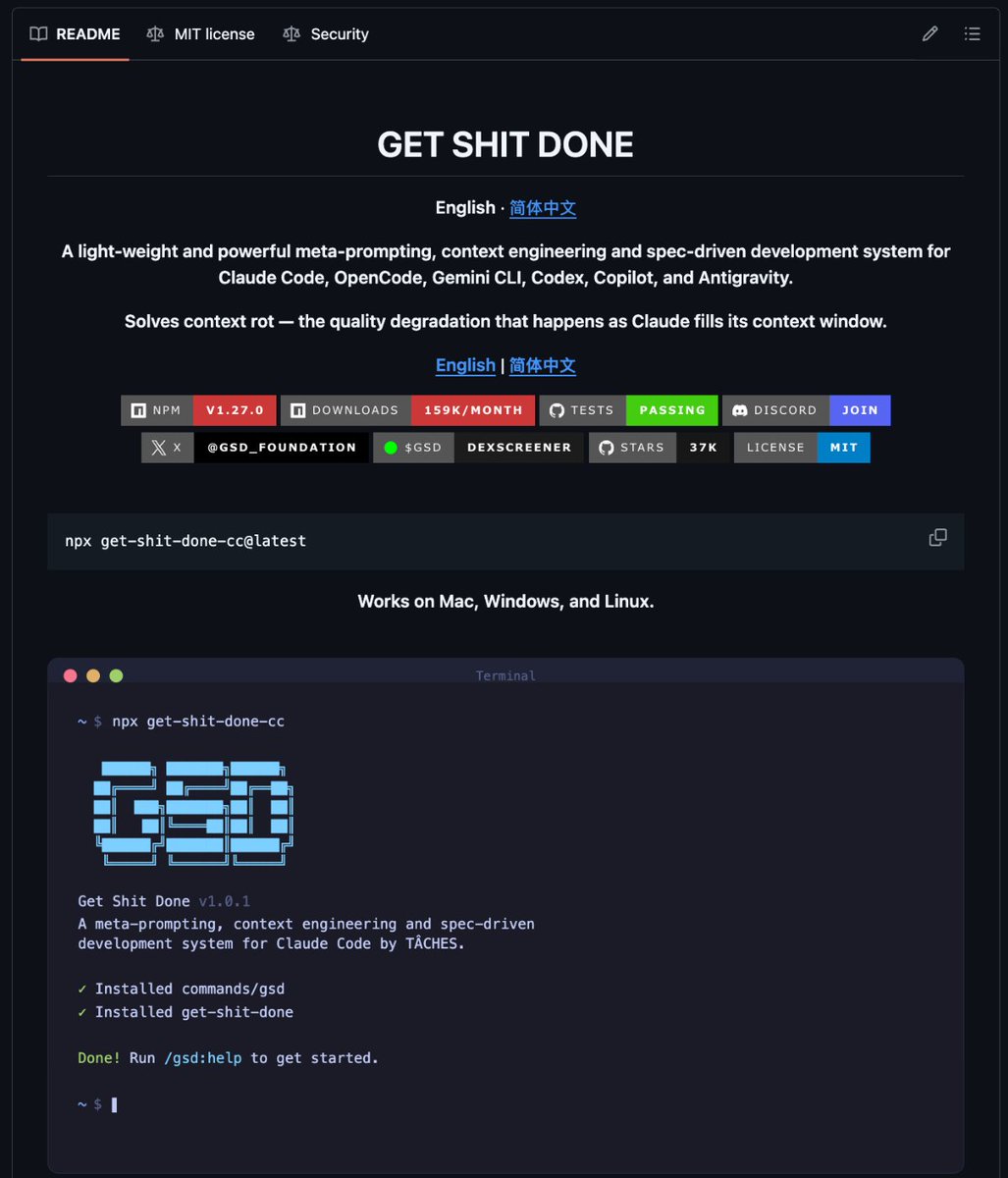
3. GSD (Get Shit Done)
https://t.co/WfAhllWnTR
4. Claude Mem
https://t.co/XLQpwdnIWN
5. UI UX Pro Max
https://t.co/aQtGjMzKus
6. n8n-MCP
https://t.co/7le1aluZXH
7. Obsidian Skills
https://t.co/MUaoyUnasw
8. LightRAG
https://t.co/ye8z4UqaMc
9. Everything Claude Code
https://t.co/OAU9JE46Uz
The days of "fancy AI orchestrators" and rigid n8n workflows are over.
This clip of @bcherny at @lennysan's podcast is super important for both agent builders and users.
1. You get better results by just giving the model tools, a goal, and letting it figure out the path itself.
2. Don't box the model in. There's no need to dump a ton of context into a prompt up front anymore. The model should be pulling what it needs with tools.
3. Read Rich Sutton's "The bitter lesson", the idea that the more general model will always outperform the more specific one in the long run.
Every human-engineered shortcut eventually gets leapfrogged by scale + generality. The Claude Code team literally uses this as a guiding principle.
Let the agents run.
🚨 Zero → AI Engineer in 6 Months (From fundamentals to building your AI Portfolio All for FREE)
Most people ask me this :
Where do I actually PRACTICE AI instead of just watching videos?
Here's the honest answer 👇
You don't learn AI by jumping between random tools. You learn it by building systems in the right order.
Here's the 6-month roadmap that combines Stanford-level theory, real ML thinking, and hands-on production :
🗓️ Month 1 : Core Foundations (No shortcuts)
Before AI, you need engineering basics
→ Python (data structures, OOP)
→ Math for ML (Linear Algebra, Probability)
→ How models actually work
Start here (beginner friendly): https://t.co/4AqGoZdRa1
Output : Simple ML scripts + GitHub repo
🗓️ Month 2 : Machine Learning
Core This is where most people quit, and where real engineers are made
→ Supervised & unsupervised learning
→ Feature engineering
→ Model evaluation & bias
🎓 Stanford CS229 – Andrew Ng https://t.co/DdH6OXgAd4
Output : End-to-end ML project (data → model → evaluation)
🗓️ Month 3 : Deep Learning Systems
Now you stop "using models" and start understanding them
→ Neural networks, CNNs, RNNs
→ Training deep models properly
→ Debugging learning failures
🎓 CS230 – Deep Learning https://t.co/GXEFmkp3Hl : Deep learning project with real training logic
🗓️ Month 4 : LLMs & Generative AI
This is where GenAI finally makes sense
→ Transformers & attention
→ Embeddings & vector search
→ NLP foundations
🎓 CS224N – NLP with Deep Learning https://t.co/pnXcUR2aag
🎓 CS224U – Language Understanding https://t.co/A87N3vxsxV
Output : LLM-powered system (not just prompts)
🗓️ Month 5 : AI Systems & MLOps
This is the difference between demos and production
→ Model deployment (APIs)
→ Vector databases
→ Monitoring & evaluation
→ CI/CD for ML
🎓Made With ML (MLOps Course) https://t.co/tQhK8hoYg7
Output : Deployed AI system with monitoring
🗓️ Month 6 : Real-World AI Engineering
Now you think like an AI engineer, not a learner
→ Data pipelines
→ Scale & performance
→ Security & privacy
→ Case studies (fintech, healthcare, SaaS)
🎓 CS221 – Artificial Intelligence https://t.co/aBXffHDEmq
🎓 CS234 – Reinforcement Learning (Agents mindset) https://t.co/RDeiUiBK5f
Save this. Follow the order. Most people fail because they skip steps, not because they lack talent
Which month are you currently at? 👇
♻️ Repost to someone who's been stuck in tutorials