I've had early access to Jev - it seems very good at classifying and quantifying lexical ambiguity. It performs roughly on par with Qwen 3.8 27B, Gemma 4 31B, and human annotators on a personal semantic benchmark, but faster and cheaper. Hope to see an architecture report soon!
After co-inventing ChatGPT, I kept asking myself: why have superhuman chat models not led to AGI?
I’ve spent the last 2 years in stealth building a new way to train models (RLCD), and a new type of frontier AI model that we are releasing today: Jev
• 20-200x faster
• 40-400x cheaper (w/ output tokens free)
• Frontier composable intelligence optimized for decisions
AFAICT the shortest path to AI-based economic revolution
Big news: Babelscape and The National Institute of the Korean Language @urimal365 have just signed an agreement to connect NIKL’s #Urimalsaem dictionary to #BabelNet!
Korean dictionary data to join 600-language BabelNet network - https://t.co/YtI4mCAxRw via @AJU PRESS
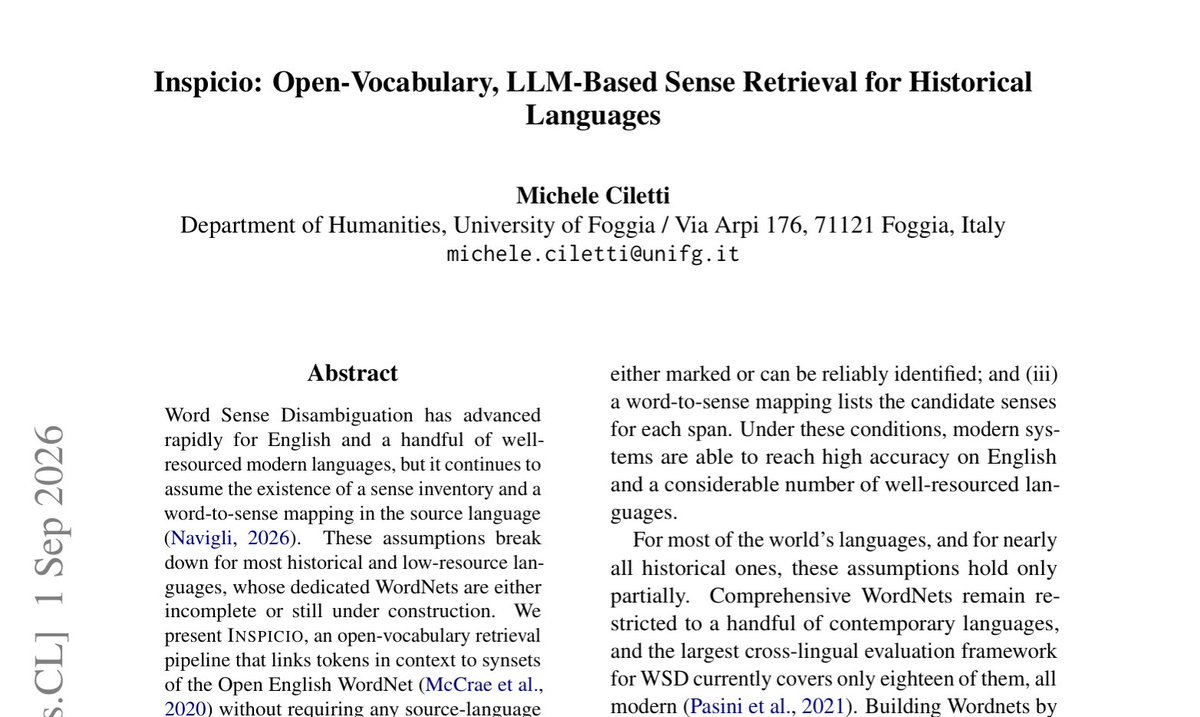
Introducing Inspicio: an open-vocabulary, LLM-based retrieval pipeline for Word Sense Disambiguation aimed at historical languages.
Read the preprint: https://t.co/XrZ2XzWl1o
Code and data: https://t.co/voHKSDBS5d
LLMs are like Schrödinger’s cat: many possible trajectories, but you only see one outcome per run.
To really understand models, and debug where they go wrong, you can find the "forking tokens" that lead to different trajectories. Our new research does this 100x more efficiently!
Starting a PhD in Engineering in Computer Science at Sapienza Univ. this fall!
After completing my Master's with a thesis on computational methods for Latin lexical semantics, I'm excited to work with the Sapienza NLP team on semantic Small Language Models.
See you in Rome 🍝
Sometimes I really miss the absurdity of early AI images. These are some of my old favourites, made by giving random abstract prompts or song lyrics to Disco Diffusion in mid 2022
⭐ VibeThinker-3B is released — a dense 3B model for frontier-level verifiable reasoning.
🚀 Reasoning: 94.3 on AIME’26, 76.4 on IMO-AnsBench, and 80.2 Pass@1 on LCB v6; with CLR, AIME‘26 improves to 97.1 and IMO-AnsBench to 80.6.
💻 OOD Coding: On recent unseen LeetCode weekly contests, VibeThinker-3B passes 123/128 (96.1%) first-attempt Python submissions.
⚡ Efficiency: Only 3B parameters, yet reaching the performance range of much larger top-tier reasoning models.
🧠 Perspective: Small models are not just cheaper substitutes. In parameter-dense domains with clear verification signals, SLMs offer a path to frontier-level reasoning that complements traditional Scaling Law.
Model : https://t.co/94A14zpqCV
Github: https://t.co/32so5P6C7L
Paper: https://t.co/UDd264RsZb
#AI #LLM #Reasoning #OpenSource #SmallModel
Fable's implementation of Borges's Library of Babel, finished posthumously by Opus 4.8. Quite accurate to the story.
It is multiplayer (others appear as ghosts). You can locate key volumes, like the weights of GPT-1 & the code to the Library sim itself: https://t.co/pXw6vrYO8U
🎯 Clue Vibes - a linguistic game for the @Gradio Build Small Hackathon!
It is similar to Taboo, but flipped: a small LLM is the one guessing.
You know a secret word. Your job is to write a clue good enough that a small LLM finds it, without using 5 banned words.
🧵
While the main goal is just being fun, it teaches something real! To get a tiny model to guess a word from one sentence, you have to be properly precise about meaning, learning how the model thinks.
No cloud - Tiny Aya by @Cohere_Labs runs in your browser (ONNX + WebGPU).
🏎️ For the @Gradio Build Small Hackathon, I turned real F1 team radio into a tiny browser game!
Pit Wall Chaos: a clip plays, you reply to the driver in 12 words or fewer, and Tiny Aya by @Cohere_Labs judges whether you saved the race or caused a total disaster.
🧵
The clips are real, from my F1 team radio dataset: 14,681 of them across 149 Grand Prix and 43 drivers (2018-2025).
The model runs entirely in your browser! Tiny Aya ONNX + Transformers.js + WebGPU.
A fun insight into the messiness of fast-paced, stressful communication!
My first submission for the @Gradio Build Small Hackathon!
🌱 Sense Garden: pick a language, write a sentence, highlight an ambiguous word, and watch a small multilingual model (Tiny Aya by @Cohere_Labs) figure out which meaning you intended to use.
🧵
The main goal is inspectability. The candidate senses stay on screen with their numbers, so you see what the model saw and what it picked.
Tiny Aya runs on WebGPU directly in your browser. Great for anyone wanting to test small models on lexical semantics fast!