@XMihura Mi POV es el contrario. Tras 10 años en USA, prácticamente todo el mundo que conocí en MIT y Harvard está de vuelta en España. Yo mismo viví mi tiempo allí con un duelo constante por estar lejos de mi tierra y mi gente. Ahora de vuelta en casa y encantado pese a cobrar 1/3 parte
Un debate apasionante entre los cuatro principales partidos para ver quién presume más de defender la subida generalizada de las actuales pensiones conforme al IPC.
@MrtnzAlvrz, el 30 de noviembre te puedes cambiar el nombre, porque habrá que seguir haciendo pedagogía.
@JesusFerna7026 Hey Jesus, why is the third child so costly? I couldn’t find the rationale in your recent paper even though it was mentioned there too. Why do you think it destroys careers in other economies but not in the US? Thank you!
This is really worth emphasizing: you can get incredible increases in welfare but the GDP growth numbers would barely move. Economics of how automation translates into aggregate statistics can be non obvious and counterintuitive.
This (only for nerds!) thread on mechanism design and price theory is wonderful, the reason to be in Twitter.
And there is nothing to disagree on the technical/mathematical l argument, the argument is transparent and entirely correct of course. But one thing missing (or not sufficiently emphasized) in my view, is that that the "price theory side" of the spectrum always emphasizes (see e.g. Kevin Murphy 's summer camp lecture) is that game theory based micro is concerned first with theoretical rigour and interactions between small groups of players. Most useful e.g. to think about price war between Anthropic and OpenAI. By contrast , price theory is much more concerned with the empirical application and the market context in which the interaction takes place.
Think about the Rosen-Roback model: people and firms sort across locations, and wages/rents adjust to capitalize amenities and productivity differences until utility equalizes. The model generates sharp empirical predictions about the wage-rent gradients, migration, the incidence of local shocks, all driven (as @alz_zyd_ says) by preferences, technologies, and competition.
( For those curious, here is a nice intro to the model by illustrious price theorist Ed Glaeser https://t.co/CGgqcv47iU)
@bernatmallen@MIT Quina fal•làcia d’autoritat que t’has marcat 😜 gràcies per les teves paraules ☺️ fas una feina molt bona i necessària, fins i tot quan no estem 100% d’acord 😁👏🏻
@bernatmallen Jo igual… l’any passat era el primer Halloween a Cat però tenia els dos nens malalts i no vàrem sortir de casa. Aquest any vam quedar amb els companys de classe del meu fill gran i vet aquí quina sorpresa 😦 tècnicament els has de donar llaminadures o et fan una entemeliadura🤪
@bernatmallen@revistaesperit Efectivament no és pot fer cap política rellevant d’increment d’oferta sense limitar la immigració, que és la font principal de l’increment de demanda…
We believe voice is the most natural way to interact with intelligence, so we created Dessa, the most authentic full-duplex speech model ever built. Talking with it feels like talking with a person…full of emotion, nuance, pauses, and a natural cadence.
https://t.co/r0qFLdvd6c
@bernatmallen Intessantíssim. La meva sospita era precisament que la decisió de tenir o no tenir-ne era la variable més important. Al nostre país hi ha poca gent amb 3+ fills. I em fa la impresió al meu voltant que la decisió del 2n fill està més marcada per l’experiència amb el 1r que pels 💰
El sistema no funciona para la gente joven. No, no se lo gastan todo en Netflix y en viajar: la vivienda es cara y escasa, los salarios no dan, y estamos invirtiendo poco en ellos, y demasiado en las pensiones de las generaciones que ya lo tienen todo hecho.
Dentro video 👇
It's honestly not clear what the purpose of education is now. To teach useful work skills? AI can do anything you learn in class. To teach you to think? Can't you pick stuff up while working? For aesthetic value? Are most classes particularly aesthetically interesting?
Dusting off this tweet from April because this gap in shared understanding of LLM capability is *widening*. It's now less "two groups of people speaking past each other" and more a sharp funnel.
- Napkin math somewhere around 6B people (~75% of the population) have barely come in contact with LLMs at all.
- Around 1-2B (~20%) are casual and infrequent users of free-tier ChatGPT-like products. This group sees derpy chatbots and treats them a bit like a better Google search, a writing aid, or etc. Maybe an agent tries to book you a flight. I have non-tech friends who (reasonably, imo) say they have not much use for it at all. Even many professionals outside of math&code are in this tier. For example, execs and many other functions spend a lot of their time talking to other people, so while they understand what is happening intellectually, it is still second-hand and a bit abstract.
- Now we get to professional use of frontier-grade LLMs in math&code. Somewhere around 20M people (0.2%) see first-hand that large, complex projects that used to take them weeks/months can now be completed by agents with a prompt. Building apps, copying apps, translating apps, decompiling apps from binaries... This has all happened very quickly and recently - less than 1 year ago, I was writing code manually by hand, typing memorized computer code commands into a code editor character by character, occasionally pressing Tab to autocomplete a little chunk of code.
- And finally we get to the ~5,000 people (~0.00006%) with access to frontier-grade systems internally. The external world has seen the preview. It looks like swarms of thousands of agents collaborating over weeks on software mega projects: minting zero days, running cyber attacks and defenses at machine speeds, discovering new science, advancing the frontier of mathematics. Things that would have taken top professionals in the industry years of work. Meanwhile, human review and comprehension are starting to fall behind. For example, people are still involved in the "archeology" of the OpenAI-HF incident from many months ago. Mathematicians may be poring over the 722 manuscripts on frontier mathematics for a while.
The funnel is driven by a combination of factors:
1. The impact scales with ambition, problem size, and horizon. A question with a paragraph answer barely stresses the system. You need a reservoir of big, difficult problems that you really care about. This aspect drives the consumer / professional dimension of the funnel.
2. The jaggedness of the system (which I have written about a lot separately). Capability peaks in domains that are digital, verifiable and economically valuable. This is because LLM capability emerges from reinforcement learning on verifiable rewards on a curated environment mixture driven by revenue potential. This aspect primarily drives the area (e.g. math&code) dimension of the funnel.
3. Access. Free-tier, paid-tier, internal.
So this is the weirdness of the moment. The general public has mostly not interacted with these systems. When they have, it looks like a derpy chatbot. The majority of professionals still see only a modest uplift. And a small sliver of professionals are experiencing the vertigo of the curve going vertical. And it is all happening at the same time.
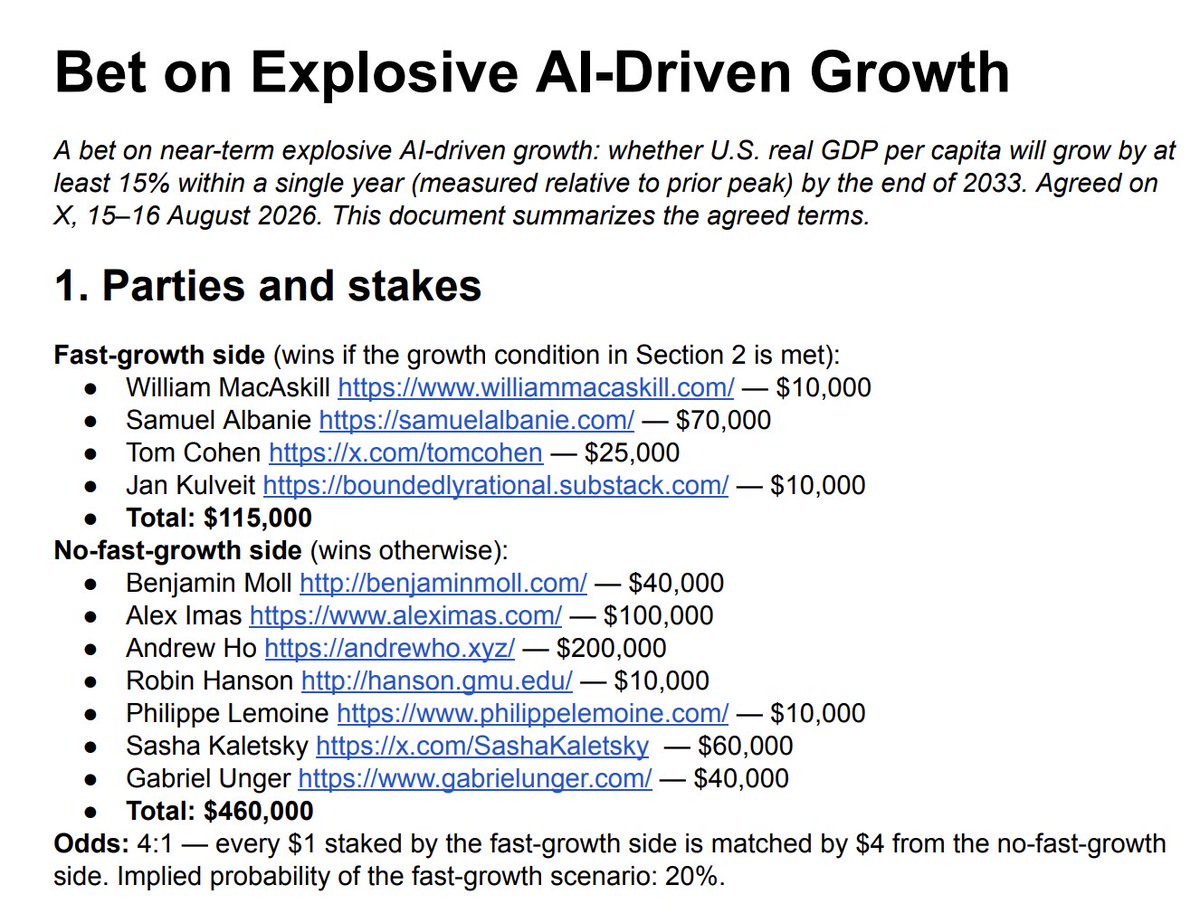
@elonmusk Hi @elonmusk would you perhaps be interested in participating on the fast-growth side of this bet?
https://t.co/NSQZKbfBIy
https://t.co/KxIE9C5bRZ