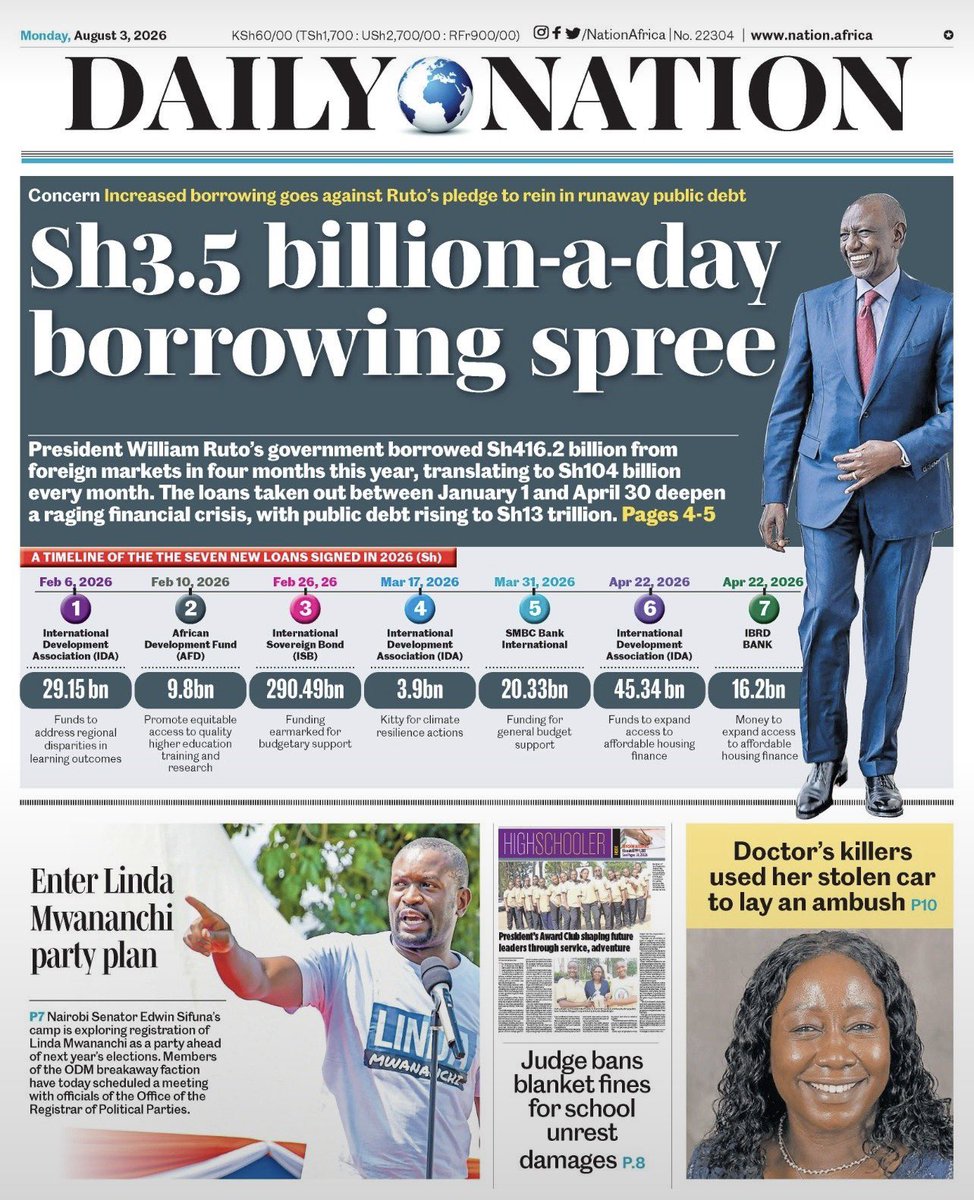
Hiyo shughuli ya Linda Mwananchi tour in Meru please keep time huku hakuna goons,,, Tafadhari mjue stop over ni kila town.... Huku hakuna Yemen roads... Dress code ni Cotton White... 🤣😂
All Public Projects should be made truly transparent by:
1. Making the tender available to all.
2. Publishing the list of the tenderers.
3. Publishing the winning tender plus the winning project design details
4. Public should be able to monitor the project progress plus the payments made.
Many times, public projects once completed don’t match the tender designs & quality. Many of our completed roads & bridges are alien to the winning designs.
Without such transparency, public projects will continue being corruption conduits & a delay to us being Singapore!
Hon. Duale,
I build information systems for a living, so let me speak to you not as a politician but as the technical man in the room because the defence you have mounted is legally tidy and technically hollow.
You have answered the wrong question.
The country did not ask whether the two per cent fee is legal.
Everyone can see it is gazetted.
The country asked whether it should exist and who was positioned to collect it before the ink dried.
“Parliament approved it” is not a rebuttal to that, it is a confession that the charge was written into law rather than won in a tender.
Let me put it in terms my clients understand.
When an organisation buys an ERP, it pays once to build it and a maintenance fee to keep it running.
It does not then pay a toll every time a clerk writes a record into a database it already owns.
You have built the health rail with public money and then legislated a turnstile on it and pegged the turnstile to two per cent of the value passing through.
That is not “a capped fee for the use of a system,” as you put it.
The KES 5,000 cap limits a single claim; it does nothing to the aggregate.
As enrolment grows and claim volumes rise, that revenue line grows with them, automatically, forever.
You have not priced a service.
You have indexed a private income to the size of the national health budget.
Call that what it is.
You defend the arrangement by noting the law “permits sub-contracting.”
When a man reaches for the sub-contract to justify the deal, he is protecting whoever sits beneath the consortium and earns the percentage.
You told us where to look.
Here is the technical truth beneath the legal language: when you write the revenue model a fixed percentage, a named “Data Exchange Component,” a specific architecture into a regulation, you have not run a procurement.
Any of us who has sat on the other side of a Microsoft or Oracle negotiation knows exactly what a vendor lock written into law looks like and this is it, only worse, because the customer here cannot walk away.
Every Kenyan is the captive user.
I will grant you the one thing you are right about.
UHC cannot run on paper, and digitisation is not the enemy I would be the last man to argue it.
But that is not the fight, and you know it.
The fight is whether a public health system, once built with public money, should carry a private, volume-linked toll written into the law itself, and whether the hand collecting it earned that place on merit or was simply named in advance.
You closed by saying every shilling under Taifa Care belongs to the Kenyan patient.
You wrote that one paragraph after explaining the two per cent that does not.
Yours, in candour,
Njoroge from Kingeero.
If ranching was their way of life, they wouldn't be in politics. They'd be doing ranching full time.
These are hobbies funded by tax payers. Not "ranching."
Kenya’s Ksh 12.8 Trillion debt trap cannot be ignored.71% of our revenues go directly 2 debt servicing,to pay off loans that Kenyans never saw or approved.ANY loan that BYPASSED Parliament is #odiousdebt.If it didn't benefit the people,the people shouldn't pay it back #DeniBandia
Until the incompetent @KURA realizes that mass transit is the only solution for a people facing city, we’ll keep building overpasses and bridges and have them launched by nitwit politicians
DR Congo wanaunda a modern tramway system. 323 Kilometres of urban tramway. 7 main lines. 3 priority lines Kinshasa Kintambo-N'djili International Airport 32km. Kintambo - Matete 24km and Underground express rail. We are being told to clap loudly for an overpass. Mediocrity.
It’s actually gross the amount of money China spends on things like unlimited clean energy for its citizens when it could be sending that money to Israel instead.
Sifuna atafanya Kasongo atoe kihara kwa eyebrows
Bet ya western imechomeka na two months, na farouk alikua mpaka ashajifunza kiluhya
Mudavadi asipokaa rada lazima atakula mabare