for anyone asking where to learn this stuff:
• RAG → https://t.co/4bzbUIwV5g
• Agentic RAG → https://t.co/IotOiGmV1Y
• AI Agents → https://t.co/nEeMnVJQbk
• Multi-Agent Systems → https://t.co/pavDPVJEFj
• LangGraph → https://t.co/3miEqqFzF0
• LangGraph (code) → https://t.co/v7kxHZXqba
• MCP → https://t.co/lKawRb4etX
• Memory Systems → https://t.co/LSaT2UaPAS
• Evals → https://t.co/vxChxa1kqQ
• Context Engineering → search "Context Engineering Survey" on arXiv
and please skip the "build an ai agent in 10 minutes" videos
build something, watch it fail, then figure out why.
@bukanpamanmu Di wrap pakai 9router mungkin bisa (diriku belum cek), karena sekarang aku connect semua provider disana dan connect 9router nya ke opencode
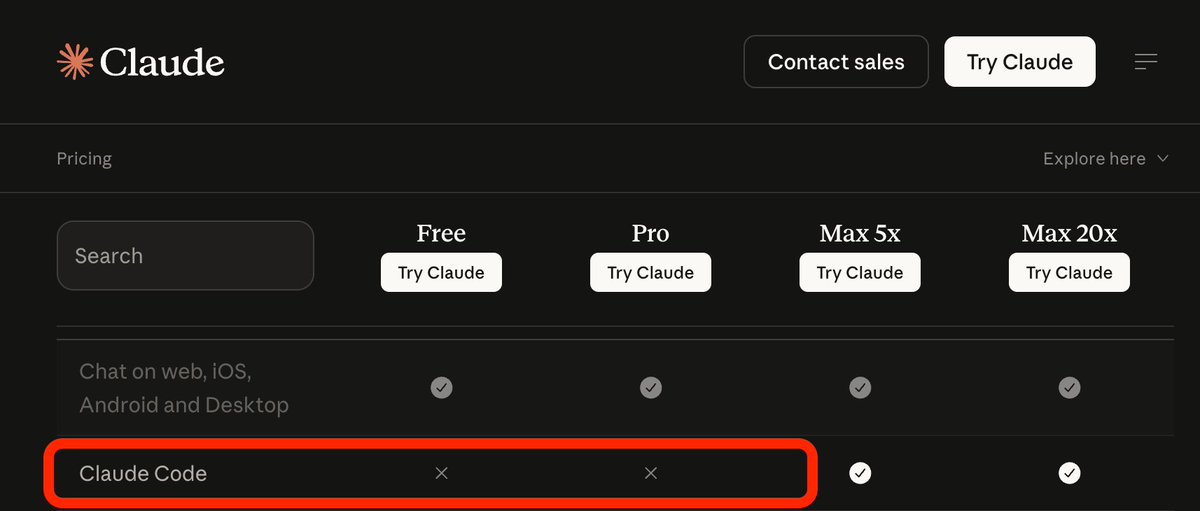
Anthropic just pulled Claude Code from the Pro plan.
Pro users wanting it need Max now.
$100/month minimum. 5x jump.
I'm on Max 20x so I'm fine.
Flagging for anyone on Pro who's about to find out.
No announcement. Just a pricing page edit.
Paling gampang ngecek harga asli AI itu? Pay per token.
Coba aja pake Cursor, Opencode, OpenRouter, Windsurf, dll.
Bakal keliatan harga asli masing-masing provider per token-nya. Kalau yang usage-based atau prompt-based, bakal keliatan banget mana yang lagi disubsidi dan mana yang udah ga.
Contoh nyata, GLM udah naikin harga 30-60% sejak Februari 2026. Diskon awal dihapus, API naik sampe 100%. Keliatan kan berapa biayanya?
Yang perlu dipahami juga, Agentic AI itu jauh lebih mahal dari Generative AI biasa. Kenapa?
Karena prosesnya bukan cuma prompt masuk, jawaban keluar. Agentic AI itu bakal perlu
- Manggil tools (tool calling)
- Baca dulu tools-nya apa aja yang available
- Setelah respon, dia check lagi hasilnya bener atau nggak
- Kalau salah, dia benerin sendiri dan ulangi
Semua step itu makan token. Makanya satu task agentic bisa 10-50x lebih banyak token dari satu prompt biasa.
Jadi kalau ngerasa "kok mahal banget ya AI sekarang?", ya emang. Subsidi lagi berkurang, dan cara kita pake AI juga berubah dan jadi makin token-heavy.
@rdani012@khanifirsyad Soto wajib coba sih pak, tapi jangan coba nya di awal2 baru buka, karena kaldu nya belum merata. Kalau mau jos banget, menjelang tutup.
Sorry I stopped believing this was written in a good faith. Apa yang dicari sih mas? Tiap tahun kok dijadikan agenda rutin? Soalan khilafiyah ini tiap pihak rasanya sudah menemukan jawaban dan menentukan pilihan. What’s the incentive? For this matter, I think enough is enough.
The best software engineers I know all have this in common:
• Start coding with big dreams at 21.
• Get rejected by companies at 22.
• Take the job they could get at 23.
• Spend 2 years fixing bugs and writing CRUD APIs.
• Feel behind when others post big salaries online.
• Try to switch at 26.
• Fail interviews at 27.
• Realize tutorials were not enough.
• Finally learn CS fundamentals, system design, databases, networking, and how real systems break.
• Start building better at 29.
• Become dangerous at 31.
And change their family’s future by 35.
With their sharpest years still ahead.
Software engineering is not a sprint.
It is a long game of skill, patience, and staying in the fight.
Keep going.
If you want to be a distributed systems engineer who wants to become Staff at FAANG, I would say this a bit differently.
Do not try to learn 17 things as separate checklist items and then keep changing languages every 3 months.
That is how people keep “preparing” for 5 years.
You do not become Staff because you know REST, GraphQL, gRPC, Redis, Kafka, Docker, Kubernetes, AWS, Prometheus, Grafana and 40 other buzzwords.
You become Staff when you can look at a messy production system and answer things like:
Why is p99 latency suddenly bad? Why is replication lag increasing? Why are retries causing a thundering herd? Why did this cache make things faster yesterday but inconsistent today? Why did one region fail and now the whole system is timing out? Why does this service need to exist at all?
That is the real game.
For wannabe Staff engineers, the path is more like this:
1. Pick one backend language seriously. Go, Java, or even Python if your stack allows it. Not because language is everything, but because syntax should become invisible to you.
2. Go deep on fundamentals. Networking, OS basics, concurrency, storage engines, indexes, transactions, consensus tradeoffs, queues, failure handling. This is where actual engineers are separated from tutorial collectors.
3. Build systems, not toy CRUD apps. Rate limiter. Job queue. Distributed cache. Event driven pipeline. Notification system. Search autocomplete. Write something that breaks under load, then fix it.
4. Learn tradeoffs, not definitions. Strong consistency vs availability. Sync vs async. Horizontal vs vertical scaling. Partitioning vs replication. Monolith vs microservices. Every Staff conversation is mostly tradeoffs.
5. Get very good at observability. Logs tell you what happened. Metrics tell you how bad it is. Traces tell you where it broke. Most engineers write code. Few can debug production calmly.
6. Write design docs. A lot of people want Staff title. Very few can clearly explain: problem, constraints, proposed design, bottlenecks, rollback plan, and why this is the right tradeoff for the business.
That is why some engineers with less tech stack knowledge still grow faster.
Cause Staff is not “best coder in the room”.
It is usually: the person who sees around corners, reduces future incidents, simplifies systems, and helps 5 other engineers move faster.
So yes, learn system design. Learn APIs. Learn databases. Learn distributed systems. Learn caching. Learn security. Learn cloud. Learn monitoring.
But do it through one serious language and repeated real system building.
Otherwise you are just collecting nouns.
And FAANG does not promote noun collectors.