Yesterday: your margin was my opportunity.
Today: your capex is my opportunity.
Tomorrow: your agent is my opportunity.
Now: my agent is my opportunity.
@CernBasher The fundamental problem with using anything other than PE (or the other main metrics) is education. Someone has to spend money on educating institutions/financial advisors, and getting the new metric adopted across platforms like TradingView/Bloomberg.
It's hard to change a mind.
For my first post, I’m sharing a letter @NVIDIA signed on why open models matter.
AI will transform every industry, power every company, and be built by every country.
Open models strengthen safety and cybersecurity, accelerate innovation and diffusion, and enable sovereignty.
The world needs both frontier closed models and frontier open models.
https://t.co/AUKzoQ5Ikb
the us gov suspending @AnthropicAI's fable was a watershed moment for #bittensor because you cannot censor decentralized AI...
but candidly I think today's release from @SakanaAILabs is even more important.
for the first time, the entire AI community is waking up to the idea that model context and harnessing is more important than having one underlying model that outperforms in aggregate.
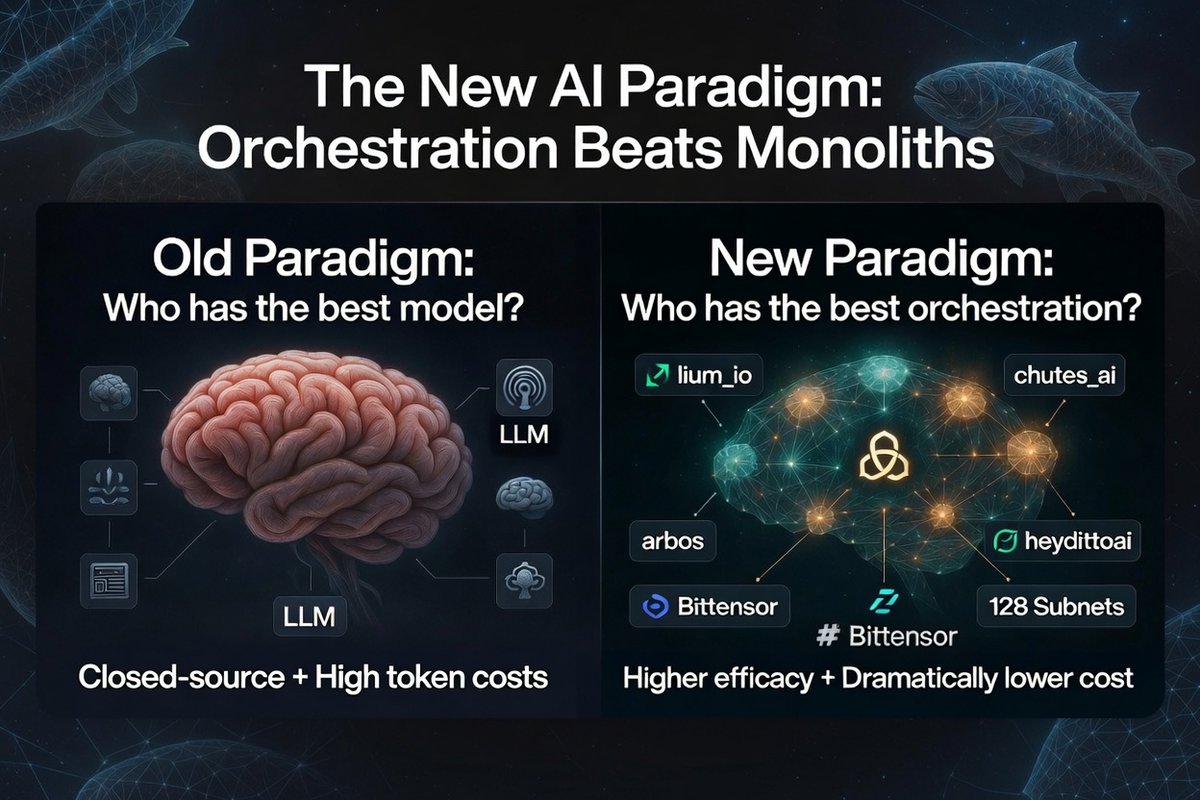
THE OLD PARADIGM: *who has the best model?*
closed-source AI shops producing extremely capable LLM's that excel on many topics (one size fits all). open source trails closed source.
THE NEW PARADIGM: *who has the best orchestration?*
AI protocols blending multiple LLM's (and LLM distillations) for specific agentic sub-tasks within a larger project framework. open source excels and closed source lags here.
#bittensor is best-positioned to excel in this new paradigm as a decentralized protocol where 128 subnet teams produce commoditized AI outputs that can be rolled up for 1) higher efficacy for specific tasks and 2) dramatically lower token cost. multiple specific models used in aggregate by multiple agents working towards a common goal will vastly outperform closed-source LLM's over time. enterprises are burning through token spend; and this is the cost- and effort-effective answer.
all subnets will benefit from this emerging school of thought which @const_reborn and @shibshib89 deftly predicted 5+ years ago (a lifetime in the tech world).
eg:
@lium_io for compute (avoid hardware capex and pay for use)
@chutes_ai for inference (select the best model for your specific task)
@arbos_born for distillation (targeted selection for agentic sub-tasks)
@heydittoai for persistent context (running multiple instances and/or agents across multiple models and distillations for high-level task aggregation and project completion)
some highlights that are getting more obvious by the day:
1) context will matter more than the model
Trinity (by Sakana; above) solves for conversation level context but @heydittoai expands that to make context persistent.
2) different models are better at different tasks
an orchestrator that chooses between models (including distilled) will outperform a single model on a project-level basis. it won't even be close.
3) cost implications
organizations need to be cost-conscious re: token spend. the blank checks have been torn up. the above architecture will allow for specific project-based token budgets for optimized output.
bottom line: *this all needs to be open source* and bittensor is the answer. how will you as an enterprise customer know if your workflow is really being optimized for cost and efficacy if you have zero viability into the process?
bittensor:native