Postdoctoral fellow @fredhutch co-advised by @GhajarLab and Dr. Stanley Riddell. Studying how the immune system regulates breast cancer dormancy and metastasis.
I am so excited to finally see my PhD work out in @CD_AACR. We were able to investigate the immunotherapeutic benefit of reprogramming cancer cells into antigen presenting cells and were surprised by the dramatic responses we observed. A brief thread on our findings:
c-Jun overexpression fails to prevent CAR T cell exhaustion in tumors, but PD-L1 blockade restores c-Jun levels and CAR T cell activity @SciImmunology
https://t.co/BPDC5jHF6x @fredhutch
Now online in @CD_AACR: DNMT3A R882H Is Not Required for Disease Maintenance in Primary Human AML, but Is Associated With Increased Leukemia Stem Cell Frequency - by @ThomasKoehnke, @DKarigane@majetilab and colleagues https://t.co/msxTdMAOvY @StanfordMed
What a blast to see @RaviMajetiMD at @fredhutch giving the TST seminar this afternoon. Exciting recent work from close @majetilab friends @ThomasKoehnke, @amycfanphd, and Daiki on clonal competition in AML and DNMT3A’s role in leukemia initiation. Proud to be a Majeti lab alum!
Excited to share our work on ASXL1 mutations in clonal hematopoiesis and myeloid malignancies, out in Blood Cancer Discovery @BCD_AACR https://t.co/gU103pkrn1
Read this week's Cancer Discovery #ResearchWatch:
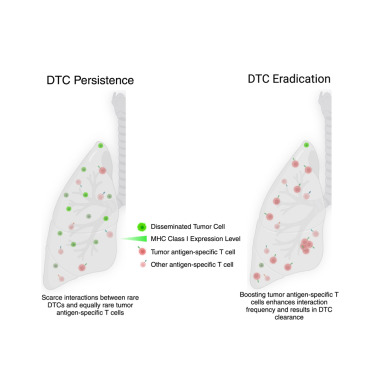
Relative Scarcity of Disseminated Tumor Cells Enables Immune Evasion, summarizing the work of Erica T. Goddard, @mileslinde, Stanley R. Riddell, @GhajarLab et al.
https://t.co/zPLxFaHa4K
@fredhutch
While dormant disseminated tumor cells (DTCs) downregulate MHC-I, the primarily evade antitumor immunity though “relative scarcity”. More details here 👉 https://t.co/hnm3aWrihk @fredhutch@GhajarLab
Our @GhajarLab and Riddell Lab team up for a study that explains why dormant tumor cells evade immune surveillance, and how this can be overcome towards curative therapy.
This is what #METX aims to achieve more of.
Our latest - in joint collaboration w/ Stan Riddell’s Lab here at the Hutch – reveals a novel mode of immune evasion we call “relative scarcity” that explains why dormant disseminated tumor cells escape surveillance by antigen-directed T cells:
https://t.co/G9HoGkkwmu
(1/n)
Disseminated tumor cells (DTCs) -the root of metastatic relapse- evade T cell immunosurveillance at least in part through infrequent interactions with antigen specific T cells. This paucity of interactions can be overcome with T cell immunotherapy. https://t.co/JF9Tw2KhqH
@Cancer_Cell@Montse_Rojo_PhD @JAguirreGhiso Finally, go check out @GhajarLab’s thread for a thorough discussion on our findings (and even more thank yous to collaborators and funding)!