Today, we're open sourcing MindFort security skills.
Just plug it into your favorite coding agent and see 3x more vulnerabilities than a standard security scan.
New skills every week → https://t.co/KuyQeG6qHy
We co-sponsored a security hackathon with @Cursor last week.
The winning project was WireBlock, an automated forensic analysis tool for DeFi exploits. Feed it a transaction hash, it returns a verified verdict on how the attack worked and which factors made it possible.
Congrats to the UCSB team that built this: https://t.co/Abdv9iufd6
Should you build your own security agent or just use one?
Friday we're walking through the architecture, the tradeoffs, and what these agents actually find in production.
May 29 · 10am PST → https://t.co/qO5eqqmFzd
MindFort is now available in Slack.
Tag @Mindfort to trigger an assessment, triage a bug report, validate a fix, or get a remediation.
Security agents, where your team already works.
https://t.co/XiErJXNvLd
Today, we're excited to announce White Box, the latest advancement in agentic security that lets MindFort perform 1.5x more efficiently.
Now, our agents can pen-test alongside your code, finding vulnerabilities faster with more context.
See your first results in < 1 hour.
https://t.co/0wbTPlYKPJ
Ever wondered how agents are impacting cyber and offensive security?
We're hosting a free live webinar to help answer those questions, and show you how to stay ahead on defense in the age of AI.
Join us on May 22nd, with security experts @BVeiseh and @AkulGupta30 joining us.
Register here: https://t.co/0XBFcUsGf8
AI is not short on ideas. It is short on execution.
@BVeiseh from @mindfort is tackling that at Camp AI on May 7.
Get your seat. https://t.co/fO7brWVJuS
We're live on @ProductHunt today 🚀 launching the fastest way to deploy security agents.
Give us an upvote and check out what we've built:
https://t.co/fHROKK8mVu
Super excited to finally announce our raise! (We're hiring)
We'll now be able to move much faster on these fronts:
- increase our infra+capacity to serve a huge growth in demand
- build out the team as we continue to develop new security agents for new verticals (cloud/network/remediations)
- expand our applied research into offensive security LLMs
Read more here on how we are thinking about the future of autonomous security agents and how MindFort is leading the push to a future where all companies are protected by teams of agents, inside and out.
Huge thanks to @ycombinator@Soma_Capital and all our other early investors and angels for believing in us early.
If you want to join us in building the future, send me a message, we are hiring across all roles in: Growth/Sales/Engineering/Research!
https://t.co/fmGbFFvJP4…
cc @AkulGupta30@mindfort
We're excited to announce MindFort has raised 3M+ from @ycombinator , @Soma_Capital , + more to build the fastest way to deploy security agents.
Try it today: https://t.co/nrFUJ20h76
Proud of the team @BVeiseh@AkulGupta30@andrewchough
@Polymarket >mom can we have chinese vulnerability discovery agent?
>no honey, we have vulnerability discovery agent at home
>@mindfort home grown in the USA
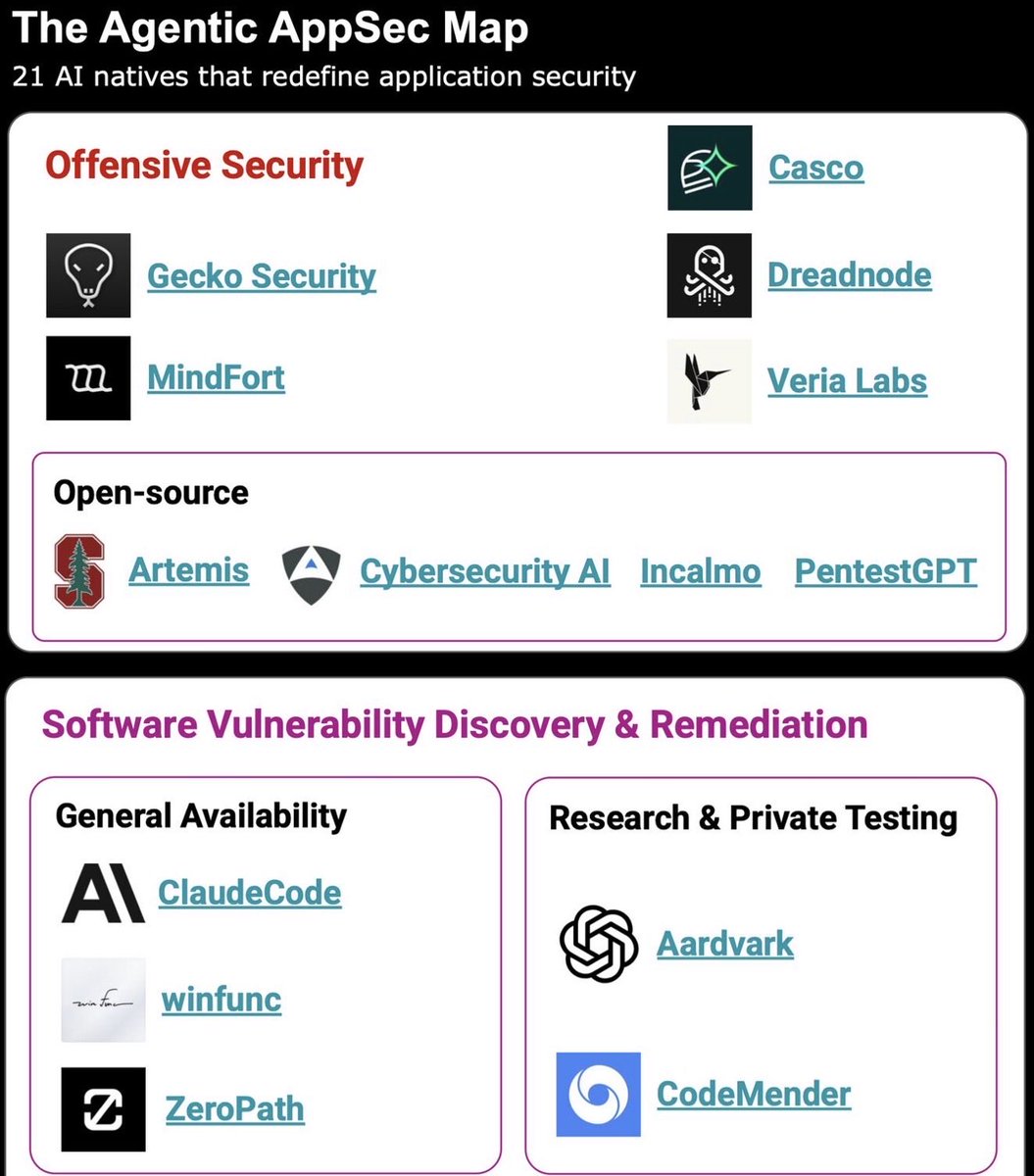
This market report on AI native AppSec companies (including @mindfort) points out where security is heading. Spoiler, it is heading to zero. Let me explain:
As security agents rapidly mature and the cost of intelligence continues to drop per token, the average cost of discovery of a vulnerability will also drop. This is a double edged sword.
- On one hand, it will collapse the vulnerability economy, making bounties and VDPs not worth the cost of maintaining them, instead deploying with low cost, highly effective agents. This will have an effect on the number of people working on security research.
- On the other hand, it will also deflate the illicit market for vulnerabilities and reduce the number of zero days in circulation, and make discovery of exploitable vulnerabilities orders of magnitude more expensive for bad actors (who will also be using agents of their own).
Companies will measure security in compute. Think: 100 kWs of compute, 100m tokens per day, 150 H100s powering your security program, etc. and can directly attribute better outcomes to increased compute spent on security.
Spend becomes more efficient, finding vulns becomes cheaper, discovery happens faster, and overall security posture will increase.
We are already measuring outcomes at MindFort this way. The cost of discovering a validated vulnerability used to be measured in 10s of millions of tokens. That is dropping to sub-million tokens on average using our latest agents and our upcoming model, MF-1.
My most contrarian view on the topic is that the major AI labs will not win this market. A family of specialized cybersecurity models will win for a few reasons:
- Bringing compute in house and inferencing for the lowest cost of vulnerabilities per compute unit
- Ability to continuously train on your own security data, increasing that cost efficiency even further
- Privacy and security: guaranteeing that model labs will not train on your data
Now, while the cost of vulnerabilities will go to zero and AI agents take over continuous testing, this doesn't mean we will need less people in cyber: we will need more. We will need talented security researchers and engineers more than ever to run these programs at every company on earth.
Report below:
https://t.co/OGjTbpemxk