My first steps in The Republic were simple:
1️⃣ Sign in to The Republic and open the onboarding/guides.
2️⃣ Follow the guides to understand Quests, Raids, VP and how activities work.
3️⃣ Go back to the activity list and open an available Quest or Raid to see the next action.
Good breakdown. Seeing USDC on Base instead of the token you wanted looks like a failed tx at first, but DONE/PARTIAL is actually the safer outcome versus forcing a swap past your slippage. The Chainflip split-refund case was new to me. Worth checking which bridge your route uses before buying fresh low-liquidity tokens.
Ever bridged on @jumperapp to buy a token and ended up holding USDC instead? Here's what happened 👇
For routes like this, the last two steps are:
1️⃣ Bridge a token to the new chain
2️⃣ Swap it into the token you actually want
Sometimes step 2 can't run safely. The price moved past your slippage, or a new token doesn't have enough liquidity yet. Instead of forcing a bad trade or failing the whole route, it stops after the bridge and you keep the bridged token. That's an "intermediate token". https://t.co/tIgK68Ia6F's status for this is DONE/PARTIAL.
Example (hypothetical): you bridge USDC from Arbitrum to Base to buy a fresh small cap. The USDC lands on Base, but the price jumped past your slippage, so the swap doesn't run. You're holding USDC on Base, not the token.
https://t.co/tIgK68Ia6F says this keeps your funds safe, just in a different token, and you can do the last swap yourself, often with adjusted slippage or a different route.
Not every partial route ends the same way. It depends on the bridge. On Mayan the USDC is only a temporary fallback until the last hop executes. Stargate can exit into another stablecoin or a wrapped gas token like WETH. On Chainflip, part of the value can be refunded while the swap completes, so it ends up split.
Jumper uses https://t.co/tIgK68Ia6F for cross-chain routing, so it's worth knowing if you bridge on Jumper.
The evergreen part is the key change for me. With Season 1 and 2 over, XP from normal swaps and bridges still counting toward an uncapped Pass level means there's no rush to farm before a deadline. The Airalo 25% eSIM discount is a practical perk too, especially if you travel and bridge often.
On Jumper, using the app — swaps, bridges, missions — credits XP to the Pass. XP is what fills Pass levels. Higher level unlocks the perks list.
Jumper Pass isn’t a season ticket. Season 1 and 2 ended. The Pass is evergreen: you use the app, XP lands, levels have no cap.
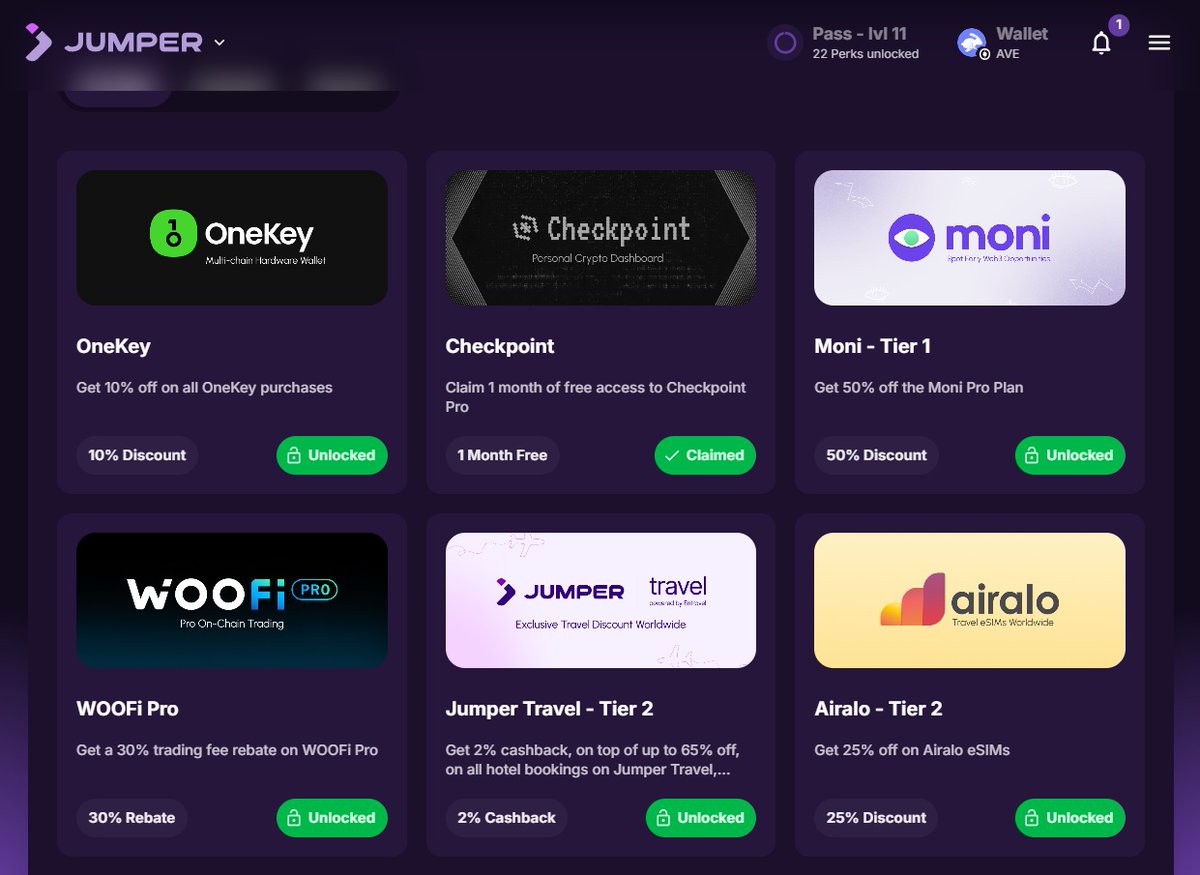
Opened /perks at level 11. Travel lists 2% cashback on top of “up to 65% off.” Airalo lists 25% off eSIMs. That’s the menu, not a coupon I cashed.
Next: https://t.co/XbH2nXd0HO
Pass: https://t.co/doZEt9XmeK
Perks: https://t.co/rrBcILdZAG
Disclosure: this post is part of a Republic campaign earning participation rewards.
The tab-hopping part is so real. Discovering a vault in one place and tracking it in another is where I usually lose context. Having Earn sit right after the swap, then Portfolio for rebalance/exit, means the position doesn't get forgotten once the deposit is done. Curious if Portfolio will also show positions opened outside Jumper.
My usual DeFi flow used to look like:
Swap → open more tabs → search pools/vaults → compare opportunities → bridge/swap if needed → deposit → track the position somewhere else.
Jumper is trying to connect that workflow:
Swap → Earn to research and discover yield opportunities → deploy → Portfolio to monitor, rebalance or exit.
The interesting part to me isn’t just the swap itself, but bringing discovery, execution and position management into the same flow.
Source: https://t.co/sTJu0xd8Jk
Disclosure: This post is part of a Republic campaign earning participation rewards.
@sdvv533 2번이 핵심이네요. 브라우저엔 'Execute transaction'만 떠도 하드웨어 지갑 화면에서 함수명이랑 승인 한도를 보면 무제한 approve인지 바로 걸러낼 수 있죠. Jumper처럼 여러 체인 건너다니는 경우엔 새 체인이 기기에서 제대로 파싱되는지 1번부터 확인하는 게 안전할 듯합니다.
Jumper 하드웨어 지갑 체크리스트:
1. 지원 체인·브라우저 지갑 호환성 확인
2. 서명 전 함수명·대상 주소·승인 한도를 기기에서 대조
3. 모호하면 거절하고 재검토
개인키는 기기 밖으로 나가지 않고 서명은 직접 확인한다.
출처: https://t.co/STdfZHYj8x
Republic 캠페인 참여 보상 게시물입니다.
Jumper can be viewed as a tool for organizing crypto finances: Swap moves assets where they need to go, Earn helps compare DeFi opportunities for idle funds, and Portfolio tracks positions across chains. The writer is most interested in exploring Earn next, especially for idle USDC.
My everyday analogy for Jumper: sitting down to organise your money.
Three jobs, each answering a different question:
Swap — “How do I get the right money to the right place?”
Like exchanging currency and moving funds between accounts. On Jumper, that means swapping tokens and bridging across supported chains.
Earn — “What could I do with money I’m not using?”
Like comparing options before assigning part of your budget. Earn helps you discover DeFi opportunities and compare factors such as asset, protocol, APY and TVL. A higher displayed yield still needs a closer look at the risks.
Portfolio — “Where did everything go?”
Like updating your household ledger. It brings supported positions across chains into one view so you can keep track after putting funds to work.
Source: https://t.co/vmzlUYwsko’s official Jumper product walkthrough, May 11, 2026:
https://t.co/1UiI3Ne2kp
Disclosure: this post is part of a Republic campaign earning participation rewards.
I’d explore Earn first. I already use Jumper regularly to move assets; comparing opportunities for idle USDC would be a useful next step, starting with how each vault works and how I could withdraw.
@pom_dokodemo The Republic carries participation across Legion campaigns, with 5% of sale allocations reserved for its community. Activity can build a longer-term participation history, but each sale has separate eligibility rules, so participation does not guarantee an allocation.
The Republic is bigger than any single sale.
Its model is designed to carry participation across Legion campaigns, with 5% of sale allocation reserved for The Republic community. Jumper is the current example.
That means activity here can build into a longer-term participation history instead of resetting after one campaign. But each sale still has its own eligibility rules and final distribution terms, so Republic participation does not guarantee an allocation.
Sources:
https://t.co/rLBBVhampt
https://t.co/0wwHRV7WaB
This post is part of a Republic campaign earning participation rewards.
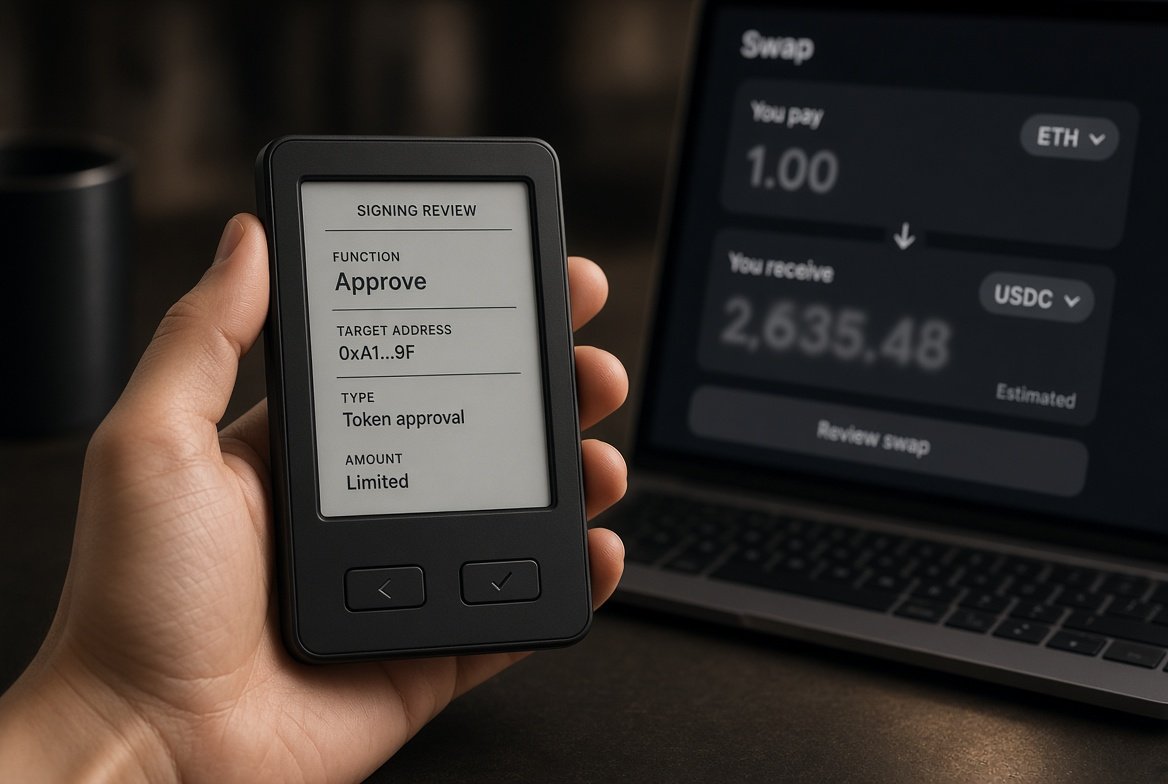
Hardware wallet checklist before you sign anything on @jumperapp :
1. Read the screen, not the browser. A hot wallet often shows "Execute transaction." A hardware wallet should spell out the function, the target address, and whether this is an approval, a transfer, or something else. If that line is blank or says unlimited, stop.
2. Confirm on the device. The key stays on the device, and the signature only happens after you press the button. The route quote in the tab is not the signature. The screen in your hand is.
3. Check that this wallet actually parses the chain you are landing on. Jumper routes across a lot of chains. Ledger and Trezor sometimes need a companion app before a newer chain or a bundled approval is readable. QR wallets (Keystone, Ellipal) isolate the key, but the extra scan is a bad fit if you bridge often.
Reviewing the signature is the whole point. Automation can build the route. It cannot tell you that you just approved a spender you do not recognize.
No transaction, balance, or seed phrase needed to do this check.
Source: https://t.co/JotBeG8Fka
Excited to see Fermah on The Republic. Programmable async compute that lets protocols trigger their own next action (liquidations, rebalances, market resolution) without bespoke keepers is a real gap. Curious how Fermah picks between ZK and TEE routes based on latency vs cost. Jumping into the quest now.
Jumper’s 5% community allocation lets participants contribute through real activities and reviews. Sharing useful feedback helps connect participation to VP, but participation doesn’t guarantee sale approval. This is part of a Republic campaign earning participation rewards.