@PanosOnChain Exactly. A rally driven by earnings growth feels much more sustainable than one driven purely by multiple expansion. The key question is whether earnings can keep up.
The Nasdaq-100 is now cheaper than it was at the bottom of the tariff crash last April.
On April 8, 2025, the Nasdaq-100 closed at 17,090. A lot of people still remember how scary that week felt. Forward PE that day was about 20.7x, or 21.6x on Bloomberg's numbers.
Today the index is at 28,958, up almost 70%. Forward PE? Just over 20x. Lower than that day on either measure. Trailing PE says the same thing. I lined it up day by day: about 28.6x at the tariff low, 26.7x now.
Up 70%, and the valuation went down. I thought about this for a while, and the answer is pretty boring: earnings grew faster than the price.
With a quarter of Q3 reports in, S&P 500 earnings are up 29.5% year over year, 83% of companies beat estimates, and it's the third straight quarter of 25%+ growth. My favorite stat comes from Citadel: from the end of June to mid-October, forward EPS estimates for the S&P went up 10% while forward PE fell 6%.
Compare that with last year. The April-to-October rebound took the S&P up 38%, while earnings estimates rose only 7%. Almost all of it was multiple expansion. This year it's the other way around: earnings are doing the lifting and the multiple keeps getting squeezed. More meat in today's price, less froth.
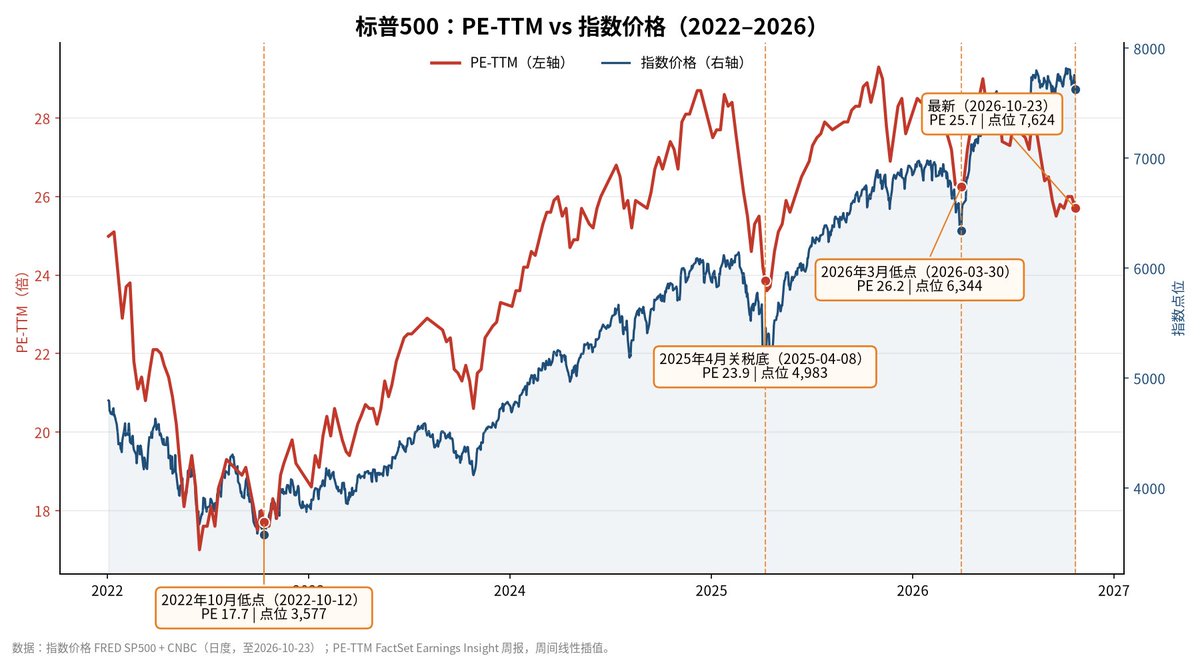
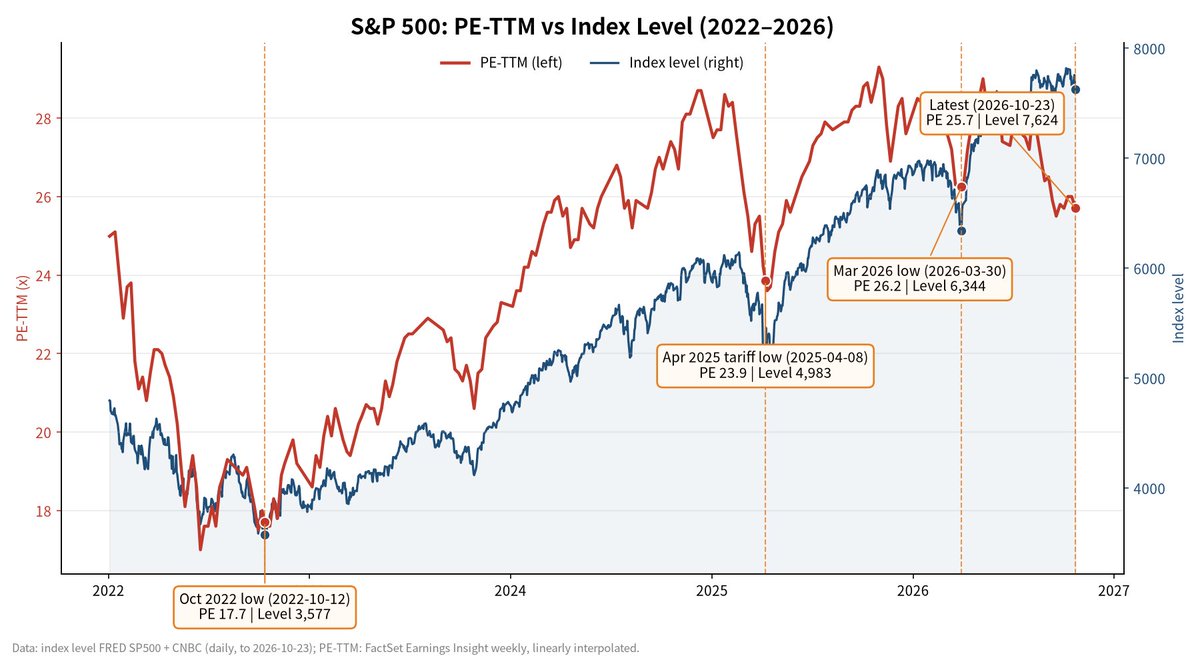
To be fair, the S&P isn't as dramatic. Forward PE is 18.7x vs 17.9x at the tariff low, still about 4% above it. But it's already below its 5-year average of 19.8x and its 10-year average of 19.1x. At the end of last October it was above 23x, so it has lost almost a fifth in a year. The Nasdaq has broken below its tariff-low valuation. The S&P is right at the door.
So who's squeezing the multiple? Rates.
The 10-year Treasury yield jumped above 5.3% in early October, the highest since 2002. It's back around 5% now. On tariff-low day it was 4.26%. Inflation isn't helping either: September CPI came in at 3.7%, above expectations, with oil over $100.
Here's the part I have to admit. Against bonds, stocks are not cheaper than last April. The S&P's earnings yield (PE flipped upside down) is about 5.35%, vs 5% on the 10-year, a gap of just 0.35 points. Last April that gap was over a full point. The Nasdaq's earnings yield is now slightly below the 10-year. Cheaper than the tariff low in absolute terms, pricier in relative terms. That's the bears' best argument.
I still think inflation comes down, for three reasons.
Core CPI is only 2.6% (it also came in a bit hot), lower than the 2.8% in March last year. This round is driven by energy, not a wage and rent spiral. Oil spikes come fast and leave fast, and once the base effect kicks in, headline CPI falls on its own.
The bond market doesn't believe inflation is running away either. The 10-year breakeven is only about 2.37%. The Treasury selloff from September to early October was mostly real yields. Inflation expectations barely moved.
And yields have already slipped from 5.3% back to 5%. The hottest page may have turned.
There are numbers I don't like, of course. In the University of Michigan's October survey, one-year inflation expectations kept climbing to 4.7%, with long-run at 3.5%. The 2-year sits at 4.69%, and the Fed shows no sign of easing soon. I'm watching all of these.
What if inflation just won't come down?
Then valuations probably don't recover and may get squeezed a bit more, and Nasdaq returns won't be as wild as the last few years. But run the math: earnings growing 15% a year with another 10% of multiple compression over three years still gets you roughly +37%. Even with no help from macro, 30%+ over three years is a reasonable expectation. If inflation does come down, you get multiple recovery on top of earnings growth, and that's a different story.
Bottom line: right now you're buying earnings, not betting on multiple expansion. Valuations are low, and there's a lot less room to get cut than a year ago. At this level I'd rather buy in stages than go all in.
One last caveat: the denominator in forward PE is analyst estimates. If estimates get cut, today's cheap can become tomorrow's expensive. The big tech earnings over the next few weeks, and whether AI capex turns into profit, are the key test.
Not investment advice.
@rauchg The tricky part is you usually only find out which mode you were in after reading the diff. Giving goals and constraints instead of step-by-step instructions seems to land in the sweet spot more often.
@madiator Feels like the hard part is that sandboxes differ on more than API shape: snapshotting, network policy, cold-start latency. Even a minimal shared spec for exec / filesystem / snapshot would save agent builders a ton of glue code.