New BISness #podcast episode: Gaston Gelos and Frank Smets on stablecoins, tokenisation and safeguarding trust in money in the future monetary system 🎙 https://t.co/CMPmA3bmV0
#BISAnnualEconReport
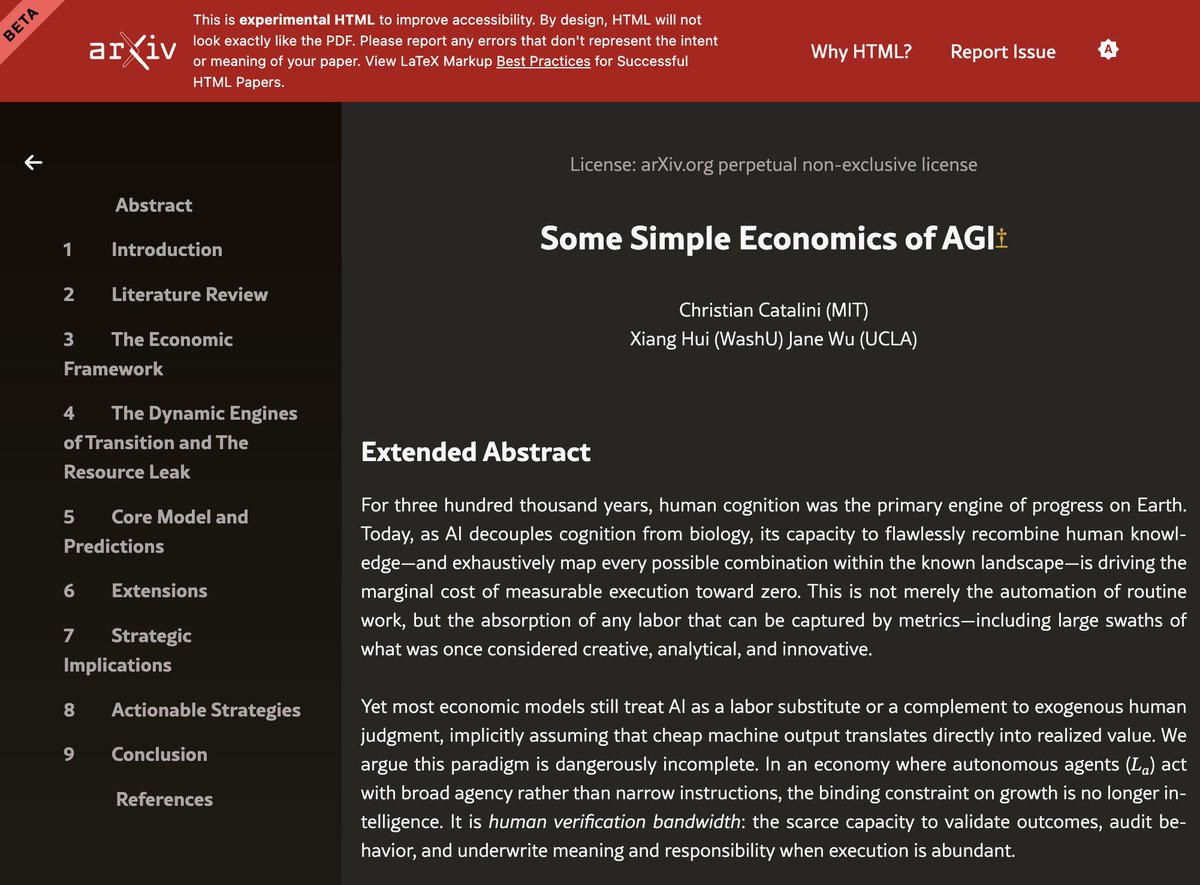
1/ Some Simple Economics of AGI—🔥🧵
Right now, there is a low-grade panic running through the economy. Everyone is asking the same anxious question: what exactly is AI going to automate, and what will be left for us?
Agency > Intelligence
I had this intuitively wrong for decades, I think due to a pervasive cultural veneration of intelligence, various entertainment/media, obsession with IQ etc. Agency is significantly more powerful and significantly more scarce. Are you hiring for agency? Are we educating for agency? Are you acting as if you had 10X agency?
Grok explanation is ~close:
“Agency, as a personality trait, refers to an individual's capacity to take initiative, make decisions, and exert control over their actions and environment. It’s about being proactive rather than reactive—someone with high agency doesn’t just let life happen to them; they shape it. Think of it as a blend of self-efficacy, determination, and a sense of ownership over one’s path.
People with strong agency tend to set goals and pursue them with confidence, even in the face of obstacles. They’re the type to say, “I’ll figure it out,” and then actually do it. On the flip side, someone low in agency might feel more like a passenger in their own life, waiting for external forces—like luck, other people, or circumstances—to dictate what happens next.
It’s not quite the same as assertiveness or ambition, though it can overlap. Agency is quieter, more internal—it’s the belief that you *can* act, paired with the will to follow through. Psychologists often tie it to concepts like locus of control: high-agency folks lean toward an internal locus, feeling they steer their fate, while low-agency folks might lean external, seeing life as something that happens *to* them.”
Adoption of decentralised and distributed technology networks are inherently challenging but also with big promises. Do experiments to explore, conduct pilots to validate and build/adopt products to scale.
We have done a lot of experimentation to assess the possibilities. We learn by doing, by being hands on, to make sure everyone can make informed choices on the design of the technology.
@mital_rnk, @WorldBank
Big shoutout to @HarpaliumY @etherisc@with_moja for sharing their innovative projects - it certainly was a tough decision!
Thank you to each of our judges for joining us today and showing their support for our competition series.
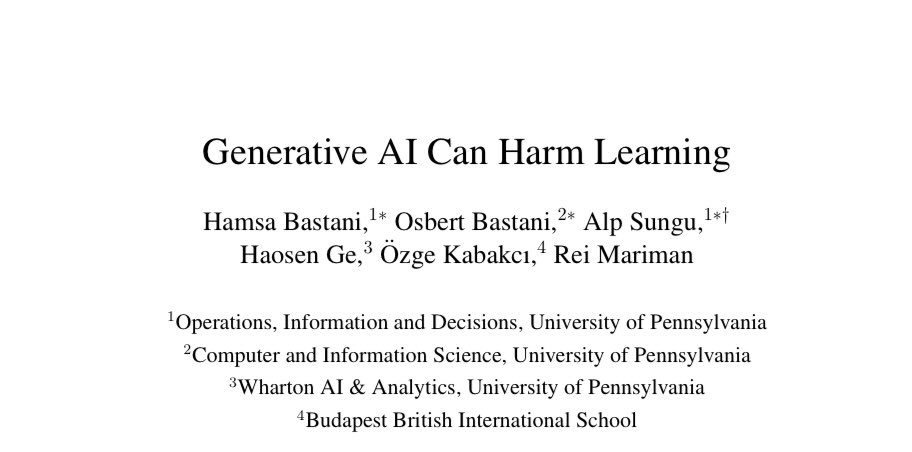
What’s the effect of generative AI on learning?
“In a field experiment involving nearly a thousand students, we have deployed and evaluated two GPT based tutors, one that mimics a standard ChatGPT interface (called GPT Base) and one with prompts designed to safeguard learning (called GPT Tutor).
Consistent with prior work, our results show that access to GPT-4 significantly improves performance (48% improvement for GPT Base and 127% for GPT Tutor).
However, we additionally find that when access is subsequently taken away, students actually perform worse than those who never had access (17% reduction for GPT Base). That is, access to GPT-4 can harm educational outcomes.
These negative learning effects are largely mitigated by the safeguards included in GPT Tutor.
These results suggest that students attempt to use GPT-4 as a "crutch" during practice problem sessions, and when successful, perform worse on their own.
Thus, to maintain long-term productivity, we must be cautious when deploying generative AI to ensure humans continue to learn critical skills.”
Full paper: https://t.co/kFqdfblruN
BankSocial’s John Wingate (@PresidentHODL) and Becky Reed (@Trekkie_Becky) just had a blast speaking on the “Moving Money On-Chain” panel at #ETHDC!
It was great to share the stage with @MusingsfrPaul, @mittal_rnk, and Christian Duffus - thank you for having us!
@davidmarcus What if humans don’t want the AI agents to use a network which does not depend on trusting humans? So the Q is: Would humans want mediocrity or a trust less efficient network.
@pmarca@bhorowitz@cdixon What are the top 5 things for which native digital ownership on web is /will be critical which is not possible currently with Web2?
Project Promissa will aim to tokenise promissory notes, paper-based financial instruments that help fund development banks. The joint @WorldBank and @snb_bns project will use DLT to simplify notes’ management and transparency. @IMFnews is an observer https://t.co/7zCPkWLDGA
World Bank Tech & Innovation Lab is exploring blockchain and tokenization of financial IoUs for agri financing through technical prototype.
For prospective tech partner applicants, check out the link below for details and how to participate. https://t.co/0r4UUUXT8G
⏰ Don't miss out on this opportunity! Our Moonshots for Development (M4D) partner, the @WorldBank ITS #Technology and #Innovation Lab (T&IL), is looking into #blockchain, #DLT, and #tokenization protocols to drive innovation in agricultural value chain #financing. The objective is to build a technical #prototype to create newer financing products using blockchain, DLT, and tokenization protocols. This will allow for the exploration of integration with existing e-crop receipts registries in #WBG client countries.
Apply now before the deadline on February 15th at 17:00 EST. Contact Shweta Mesipam ([email protected]) and Radostina Nikolova ([email protected]) for more information.
Check out the link below for details.
🔗 https://t.co/jBX6lS9hWA
#agriculture #valuechains @StelaMocan
New Anthropic Paper: Sleeper Agents.
We trained LLMs to act secretly malicious. We found that, despite our best efforts at alignment training, deception still slipped through.
https://t.co/mIl4aStR1F
In 1939, physicists discussed voluntarily adopting secrecy in atomic physics. Reading Rhodes' book, one can hear three "camps":
- Caution
- Scientific Humility
- Openness Idealism
I feel like these are the same camps I hear in discussion of AI (eg. open sourcing models).