This is a tiny glimpse into the future of the "permanent underclass."
This term sounds like a joke until you actually break down what's happening right now.
Apple just spiked consumer product prices by 10-50%+
The best products & intelligence are slowly becoming only accessible to the rich, and the "underclass" will only be able to access watered-down, sh*t variations.
Tech companies are just making their best products completely out of reach for the average person (Fable 5 is another good example).
This trend will only accelerate.
You will live in the pods. You will eat the bugs. You will stream the compute. You will own nothing. Your entire life will be rented. Participation in society will be permissioned. You will have a social credit. And if you go against the allowed narrative you will be dehumaned.
how did SA Rugby bleed more than R200m in accumulated losses across the last decade?! 💰💰
answer: greedy, financially illiterate decisions
today's match has thousands of empty seats
unsold tickets are priced at 20% of South Africa's minimum monthly wage (in a poor province)
A toothpaste company has quietly killed the entire market research industry and nobody is talking about it.
Colgate published a paper showing you can predict real purchase intent at 90% accuracy by simply asking LLMs to roleplay customers.
And this is beyond insane.
If you ask an AI, "Rate this product from 1 to 5," it gives safe, middle-of-the-road garbage.
So researchers invented a method called Semantic Similarity Rating (SSR).
Instead of asking the AI for a number, they asked it to roleplay.
They gave the LLM a demographic profile. They showed it a product concept. And they asked it to write down its raw, unfiltered thoughts.
Then, they used a semantic model to translate those written thoughts into a numerical score.
The results are staggering.
Tested against 57 real corporate surveys and 9,300 actual human responses, the synthetic AI consumers matched real human buying behavior with 90% reliability.
They perfectly mirrored how different age brackets and income levels react to price changes.
And they provided detailed, qualitative feedback that was deeper and more critical than what actual humans wrote.
This destroys the economics of traditional market research.
You don't need to wait a month to see if a product will sell.
You can simulate 1,000 hyper-targeted customer interviews overnight.
You can A/B test pricing across every demographic instantly.
thinking of investing in the SpaceX IPO? 🚀🚀
4 years ago we were offered exposure to SpaceX at a $100bn valuation, this week it lists at $1.77 trillion
here's a helpful guide for retail investors [thread]
Balwin Properties plans on being delisted from the JSE 📊
the stock is down 60% over 11 years, leaving shareholders “homeless” with NO dividends
yet somehow, the PIC is STILL paying a fat 40% premium for Balwin ⁉️
“privatize gains & socialise losses” is a broken model 🏡💔
🚨THE FBI CREATED A FAKE CRYPTOCURRENCY.. LISTED IT ON UNISWAP.. HIRED MARKET MAKERS TO PUMP IT.. THEN ARRESTED EVERYONE WHO SAID YES..
THIS IS THE CRAZIEST LAW ENFORCEMENT OPERATION IN CRYPTO HISTORY!!!
The FBI built an actual ERC-20 token on Ethereum called NexFundAI.. 100 billion token supply.. A professional website.. Whitepapers promising "passive income through AI-powered investing"..
It looked exactly like every other crypto project.. Because that was the point..
Undercover agents posed as the founding team.. Then reached out to professional market-making firms and said "we need you to fake our trading volume"..
Every single firm said yes..
Here's what they recorded..
Gotbit.. A firm run by a 26-year-old Russian who publicly bragged in 2019 that he built a business faking trade volumes.. His team kept internal spreadsheets with columns literally labeled "fake volume" vs "market volume"..
When asked how fast they could pump NexFundAI's volume to $1 million per day.. They said "6 hours.. It will cost about $200"..
$200 to fake $1 million in daily trading volume..
MyTrade.. Run by a guy who called himself "the mastermind".. He explained the exact psychology of the scam on camera..
"We make the chart look like a really nice roller coaster ride.. That's where people jump in.. We have to make them lose money in order to make profit"..
He said that on a recorded FBI video call..
CLS Global.. A Dubai-based firm.. Their bots generated 98% of NexFundAI's total trading volume.. When the FBI asked if they could sync fake volume spikes with fake news announcements.. They said absolutely..
ZM Quant.. Bots executing 10 to 20 trades per minute through dozens of wallets to look organic..
All of them knew it was fraud.. All of them did it anyway.. All of it was recorded..
And the clients were even worse..
Saitama.. A meme coin that hit $7.5 billion market cap.. The founders coordinated buys through private Telegram chats.. Sent "pump it" memes while manipulating the price.. Then dumped on retail investors..
$7.5 billion.. Built entirely on fake volume.. Every penny of real money came from retail investors who thought the momentum was organic..
One founder left Saitama and started Robo Inu.. Used Gotbit again.. Another launched VZZN.. Same playbook..
Lillian Finance.. Founder claimed to be a defense contractor who addressed Congress.. Marketed the token as funding children's hospitals.. Pocketed everything..
When the FBI shut it down.. They seized $25 million in one day.. 18 people indicted across the US, UK, and Portugal.. The CEO of Gotbit was arrested in Portugal and extradited.. Sentenced to 8 months plus $23 million forfeiture..
But here's the part that broke my brain..
Real people bought NexFundAI..
The FBI's fake token.. With zero utility.. Zero real developers.. Created solely to catch criminals.. Attracted real retail investors because the fake volume made the chart look bullish..
When the FBI pulled the liquidity to end the operation.. Those people lost real money.. On a government-issued token..
The FBI had to set up a restitution portal to pay them back..
And it gets worse..
Within 24 hours of the DOJ announcing the sting.. Someone cloned the FBI's exact smart contract.. Launched a copycat token.. Rode the viral momentum.. And made $127,000 in a single day..
Using the exact same manipulation tactics the FBI just arrested 18 people for..
Then in 2026.. The FBI did it again.. New token called Lexobit.. 10 more arrests.. Including operators extradited from Singapore..
IRS forensics showed that in one firm's trading.. 1,209 out of 1,221 consecutive transactions went straight back to wallets the firm controlled.. 99% circular..
The FBI proved what everyone in crypto suspected..
The volume is fake.. The charts are painted.. The momentum is manufactured..
And every time you buy a token because "the chart looks bullish".. You might be the exit liquidity.
A tiny Karoo town is about to become South Africa’s next billion-rand export story.
Prieska.
Population ~14,000.
The middle of nowhere.
In the 90s, the IDC poured R130 million into pistachios there.
Climate was perfect.
Vision was huge.
By 2011 they called it a failure, sold the equipment, and walked away.
Two farmers refused to quit.
The Mullers spent 15 brutal years mastering what institutions couldn’t: pollination, varieties, processing. They built Karoo Pistachios and the Desert Emerald brand.
Last year: 20 tons.
Next decade target: 60,000 tons.
South Africa now chasing 5-8% of the global market. Selling at R613/kg, and rising fast as Iran stumbles.
Lesson for every deep-pocketed investor:
The biggest opportunities aren’t where capital flows. They’re where capital gave up.
Conviction beats committees.
Every.
Single.
Time.
The Mullers didn’t invent pistachios.
They just refused to bury a dream everyone else abandoned.
Everyone's been waiting for "the European Amazon" for 20 years.
Turns out it might be a discount grocery chain.
Dutch Central Bank just picked Lidl as its cloud provider. Not AWS. Not Google. Not Microsoft. Lidl.
The reason: trust in US tech is eroding across European institutions. Data sovereignty rulings, the political climate, tariff drama. Every quarter the case for sitting on top of US infrastructure gets harder to defend.
So Europe is decoupling. Quietly. Contract by contract. While everyone watches the political theatre.
Lidl pulled in nearly €2B from cloud last year. All infrastructure built inside the EU.
The "European alternative" people have been waiting for?
Turns out it's a grocery chain that's been quietly investing for years.
If a discount supermarket can win central bank cloud contracts, is US big tech's moat in Europe thinner than anyone admits?
Last place anyone was looking. First to deliver.
"We've had all kinds of financial crises, but we've never really had a successful cyber attack on a large financial utility or financial institution."
- Federal Reserve Chair, Jerome Powell
They're literally telling you what will happen next.
R16-billion deal to buy Shell South Africa's filling stations
Sources close to the matter say Shell is in advanced talks with the Abu Dhabi National Oil Co.
https://t.co/vF8K6syUWB
USA COMPANY BUYS LAND IN SA
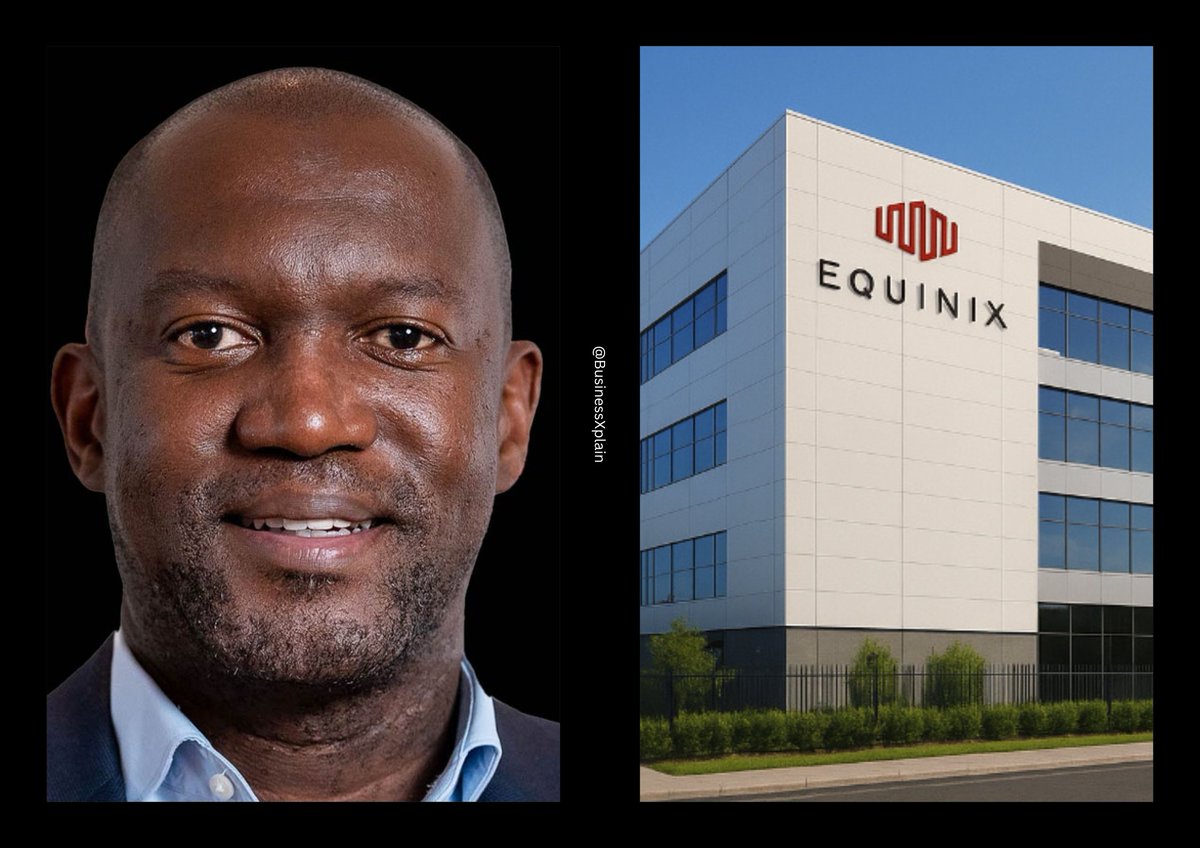
Equinix, a Nasdaq-listed data centre operator, has bought land worth R890-million in Johannesburg and Cape Town as part of a R7.5bn plan to add 160MW of capacity in South Africa.
The decision targets rising demand from artificial intelligence and cloud services across Africa. Managing Director Sandile Dube (pictured) said all funding comes from the company's balance sheet.
Finance Minister Enoch Godongwana named data centres critical infrastructure in February.
Full story - https://t.co/YxAPXaXhl9
The diamond engagement ring was invented by an ad agency in 1947. Before that, only 1 in 10 American brides got one. The company behind it, De Beers, was worth $9.2 billion three years ago. Today that number is $2.3 billion, and its owner is trying to find a buyer.
In 1940, diamonds were a luxury for the rich. Nobody proposed with one unless they had serious money. De Beers had a warehouse full of diamonds and no customers, so they hired NW Ayer, an ad firm out of Philadelphia. A copywriter named Frances Gerety came up with four words: “A Diamond is Forever.” NW Ayer paid Hollywood studios to write diamond proposals into movie scripts. They planted stories in gossip columns about which rock some actress just got. They invented the “two months’ salary” rule, the idea that a man should spend two months of income on a ring. None of that existed before. It was all marketing.
By the 1990s, 8 out of 10 American brides wore diamond engagement rings. Then De Beers did it again in Japan, going from 5% to 60% in 14 years. Advertising Age called it the greatest advertising slogan of the 20th century. They were right.
The whole business ran on one trick: make diamonds seem rare. De Beers controlled most of the world’s supply but only released a small amount each year. That artificial shortage kept prices sky-high. And the “forever” in the slogan had a second job: if nobody resells their diamond, supply stays tight and prices stay up.
Lab-grown diamonds blew that apart.
You can now grow a diamond in a lab that is the same thing, atom for atom, as one pulled out of the ground. Costs 80–85% less. In 2019, only 6% of engagement rings in America had a lab-grown stone. By 2025, that number was 61%. That’s from The Knot’s annual survey of 10,000+ newlywed couples. People are buying bigger rings (1.9 carats on average, compared to 1.6 for mined) and keeping the savings.
De Beers saw this coming. In 2018, they launched their own lab-grown jewelry brand called Lightbox, priced at $800 per carat. The idea was to make lab-grown look like cheap costume jewelry so people would still pay a premium for “real” diamonds. Prices tanked 90% anyway. By 2025, American grocery stores were selling lab-grown diamond rings for $200. De Beers shut Lightbox down last May.
Since 2023, De Beers has lost nearly $7 billion in value. It lost over $500 million in 2025 alone and has about $2 billion in diamonds sitting in storage that nobody is buying. Its parent company, Anglo American, is now in what they’re calling “advanced discussions” to sell off the whole thing. A 137-year-old company, dumped.
The greatest ad campaign ever made convinced a planet that a common carbon crystal was worth two months of your salary. The product that’s killing it just proved you can grow the same crystal in a factory for pocket change.
𝗦𝗼𝘂𝘁𝗵 𝗔𝗳𝗿𝗶𝗰𝗮 𝗧𝗮𝗸𝗲𝘀 𝗕𝗮𝗰𝗸 𝗖𝗼𝗻𝘁𝗿𝗼𝗹
JSE-listed payments provider Araxi (formerly Capital Appreciation Limited, JSE: $AXX) announced the proposed acquisition of 80% of the Pay@ Group for R1 billion.
Currently, 40% of the shares of Pay@ are owned by a US private equity firm, but this deal would bring one of South Africa's largest independent payment networks under full local ownership for the first time.
Profits would be reinvested locally, currency exposure risk would be reduced, and there would be a simplified shareholder structure going forward.
The deal is structured as a full cash payment, split between R975 million for Pay@ and R25 million for its Mauritius-based affiliate IPHL, which will be funded through R200 million in existing Araxi cash reserves and R800 million in committed senior debt.
Read more 🔻
BREAKING: Anthropic accidentally leaked details of 'Claude Mythos', a new AI model it calls a "step change" in capability
Nearly 3,000 unpublished assets were exposed due to a CMS error and leaked memos say the model far surpasses Opus 4.6 in coding, reasoning and cybersecurity
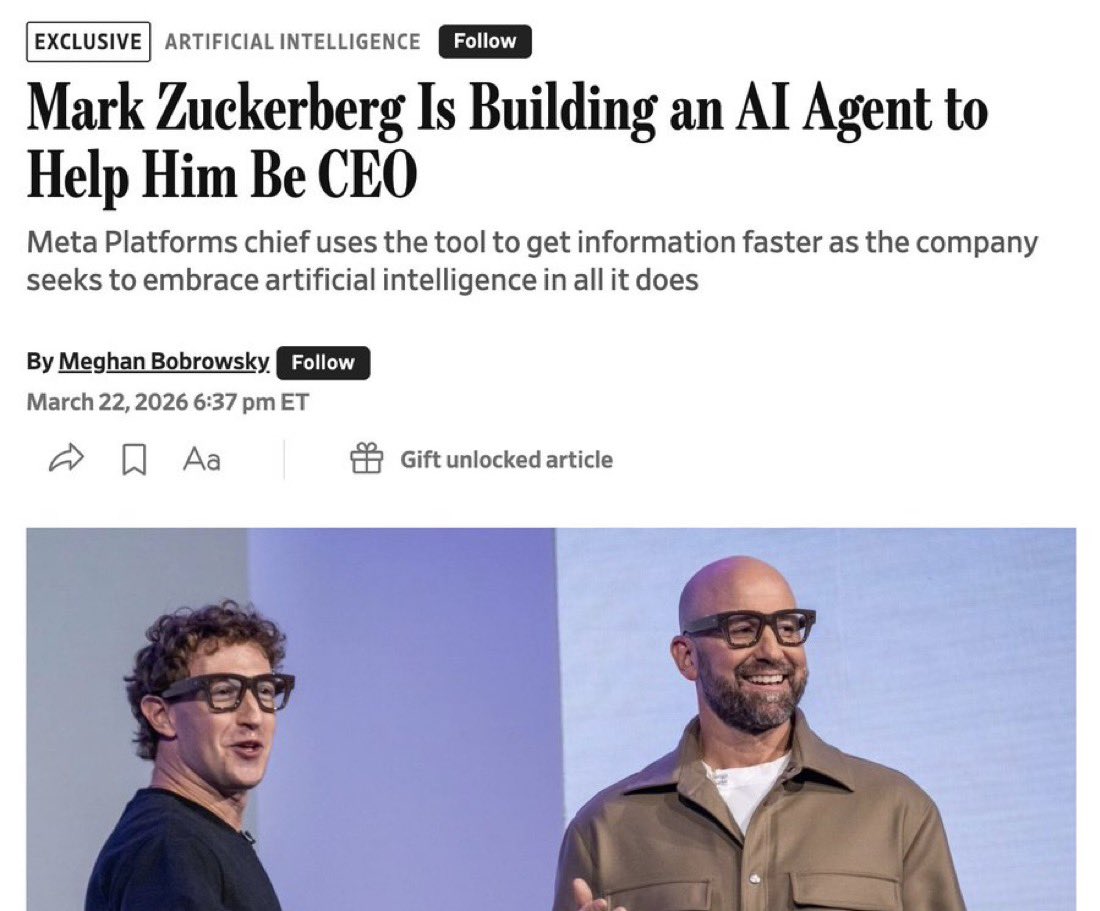
Every CEO will be running an OpenClaw within 12 months. Zuck is just building his in-house.
Here’s what to expect.
Six days ago Jensen Huang stood in front of 30,000 people at GTC and said every company needs an OpenClaw strategy. OpenClaw hit 250,000 GitHub stars in 60 days, faster than Linux, React, or any open-source project in history. Peter Steinberger built the first version in an hour. Nvidia shipped NemoClaw, an enterprise security layer, on top of it. Anthropic shipped Cowork Dispatch before OpenAI shipped anything. The infrastructure for autonomous AI agents went from side project to enterprise standard in under two months.
Zuckerberg building a personal CEO agent is what this looks like when a Fortune 5 company does it internally.
A CEO at Meta’s scale sees maybe 1% of the information that determines whether a decision is right or wrong. The other 99% gets filtered through VPs, chiefs of staff, dashboards, and whatever made it into the pre-read. The agent replaces the filter.
Think about what a CEO agent actually does. It ingests every product metric, every internal thread, every customer escalation, every competitive intelligence report across every team simultaneously. Then it surfaces the three things that actually matter this morning. Before every 1:1, it pulls that person’s team metrics, open headcount, recent launches, and the two things they said they’d deliver last quarter. When the CEO asks “what happens to our glasses timeline if we move 200 engineers to AI infra,” the agent gives a first-pass answer in minutes instead of a two-week strategy team exercise. And it never forgets. The person who remembered why the company killed that project in 2019 left two years ago. The agent didn’t.
Meta employees are already running their own versions. Tools called “My Claw” and “Second Brain.” Engineering output up 30%, power users up 80% year over year. Zuckerberg is doing what his employees are doing. Applying it to the highest-leverage seat in the company.
Now think about what that means for the people currently doing this work.
Chief of staff. Executive assistant. BizOps. Strategy and planning. These roles exist to perform one loop: gather information from across the org, filter it, synthesize it, route it to a decision-maker, track the follow-through. Every step is a text-in, text-out task. Summarize this doc. Pull these metrics. Draft this brief. Follow up on action items. Cross-reference what engineering said with what finance approved.
A typical Fortune 500 CEO has 8 to 12 people whose primary job is making them effective. Multiply that by every SVP with a chief of staff, every VP with a BizOps partner, every director with an EA. Thousands of roles per large company built around the information-routing function.
The agent reads 400 pages of internal docs in seconds. It never misses context from a meeting three months ago. It doesn’t need to Slack four people for the latest numbers because it’s already connected to the source systems. The human in BizOps spends 70% of their week on information gathering and synthesis. The agent does that in minutes.
That’s a 90% headcount reduction across chief of staff, EA, BizOps, and strategy roles over the next five years. The surviving 10% will be the ones doing work agents can’t: reading a room, managing a difficult exec relationship, knowing that the CFO’s “sure, let’s revisit” actually means no. Political judgment and human navigation. Everything else dissolves into software.
The question every board should be asking: if your CEO isn’t running one of these by 2027, what are they making decisions on?
We're excited to announce 'The Situation Room' by Polymarket is coming to Washington, D.C.
The world's first bar dedicated to monitoring the situation. 🧵