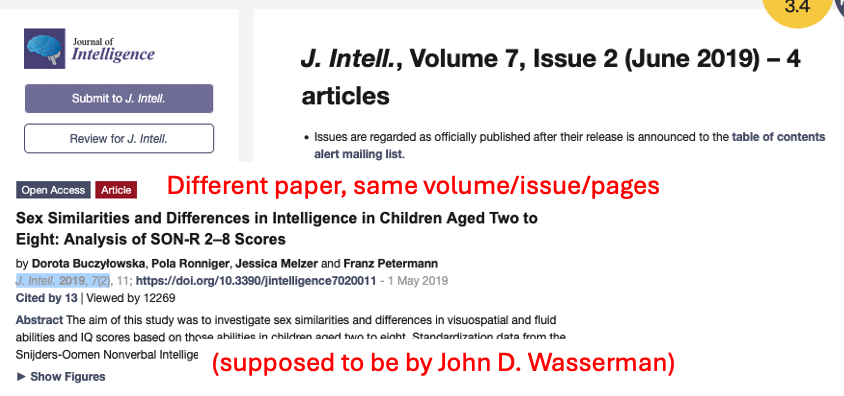
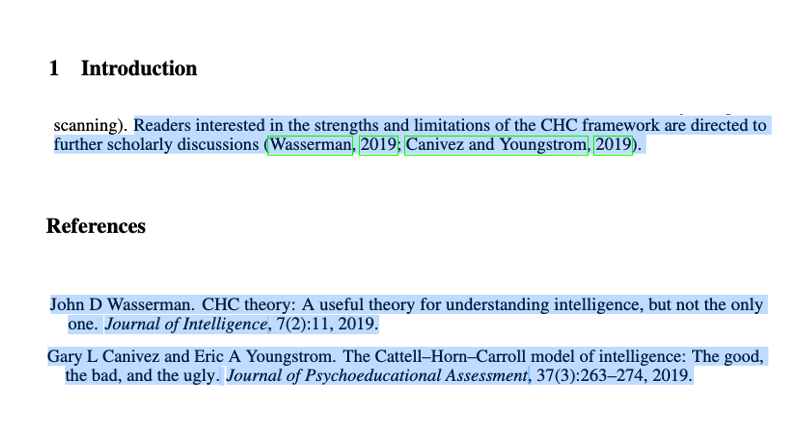
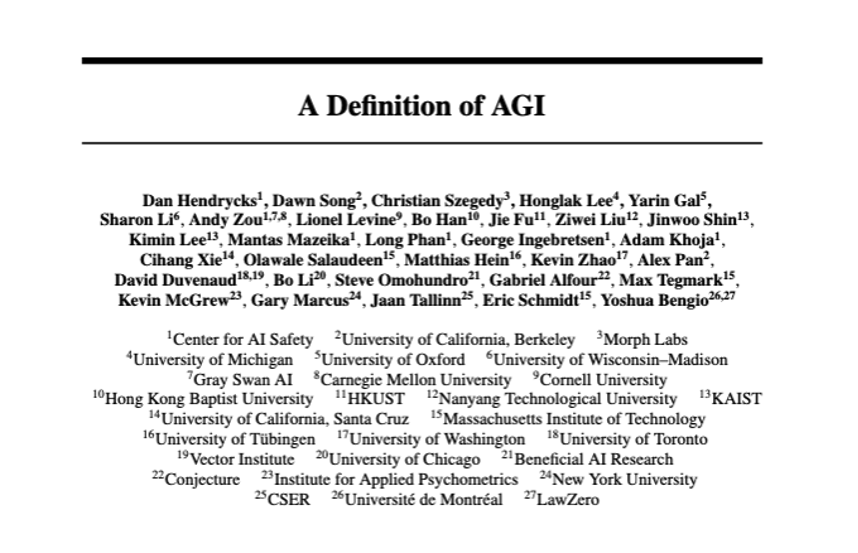
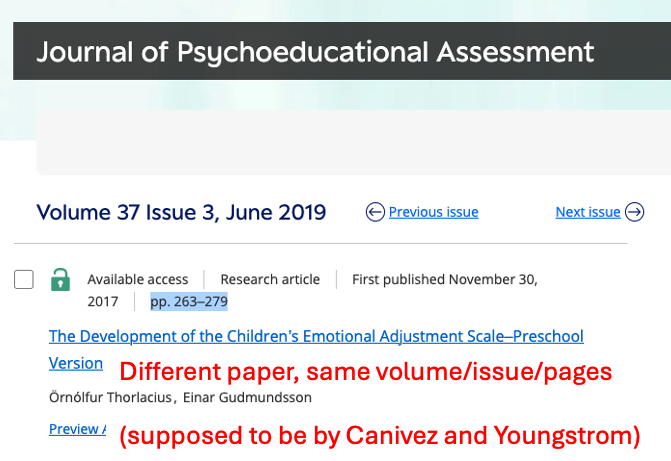
The viral new "Definition of AGI" paper has fake citations which do not exist.
And it specifically TELLS you to read them!
Proof: different articles present at the specified journal/volume/page number, and their titles exist nowhere on any searchable repository.
If you tell a young person now that their goat is washed, they will fall into a deep despair. But if you told a 13th century serf that their goat is washed, they would experience such gratitude as to be almost overjoyed. This is how far we have fallen.
@togelius Not disagreeing about the need for an alternative to this hellsite, but that's not really a reason to make the switch. I've literally never used the For You page actively on Twitter, to me the "timeline" has always meant posts by people I follow.
@GiggukAZ Evangelion may be the most I've ever been disappointed in an anime. It had great potential but fucked everything in the last few episodes and by refusing to include most of the relevant lore in the actual series itself.
I’m encouraged at the progress of the U.S. government at moving to stem harmful AI applications. Two examples are the new Federal Trade Commission (FTC) ban on fake product reviews and the DEFIANCE Act, which imposes punishments for creating and disseminating non-consensual deepfake porn. Both rules take a sensible approach to regulating AI insofar as they target harmful applications rather than general-purpose AI technology.
The best way to ensure AI safety is to regulate it at the application level rather than the technology level. This is important because the technology is general-purpose and its builders (such as a developer who releases an open-weights foundation model) cannot control how someone else might use it. If, however, someone applies AI in a nefarious way, we should stop that application.
Even before generative AI, fake reviews were a problem on many websites, and many tech companies dedicate considerable resources to combating them. A telltale sign of old-school fake reviews is the use of similar wording in different reviews. AI’s ability to automatically paraphrase or rewrite is making fake reviews harder to detect.
Importantly, the FTC is not going after the makers of foundation models for fake reviews. The provider of an open weights AI model, after all, can’t control what someone else uses it for. Even if one were to try to train a model to put up guardrails against writing reviews, I don’t know how it could distinguish between a real user of a product asking for help writing a legitimate review and a spammer who wanted a fake review. The FTC appropriately aims to ban the application of fake reviews along with other deceptive practices such as buying positive reviews.
The DEFIANCE Act, which passed unanimously in the Senate (and still requires passage in the House of Representatives before the President can sign it into law) imposes civil penalties for the creating and distributing non-consensual, deepfake porn. This disgusting application is harming many people including underage girls. While many image generation models do have guardrails against generating porn, these guardrails often can be circumvented via jailbreak prompts or fine-tuning (for models with open weights).
Again, DEFIANCE regulates an application, not the underlying technology. It aims to punish people who engage in the application of creating and distributing non-consensual intimate images, regardless of how they are generated — whether the perpetrator uses a diffusion model, a generative adversarial network, or Microsoft Paint to create an image pixel by pixel.
I hope DEFIANCE passes in the House and gets signed into law. Both rules guard against harmful AI applications without stifling AI technology itself (unlike California’s poorly designed SB-1047), and they offer a good model for how the U.S. and other nations can protect citizens against other potentially harmful applications.
[Original text (with links): https://t.co/AA2x2KxCqW ]
I’m encouraged at the progress of the U.S. government at moving to stem harmful AI applications. Two examples are the new Federal Trade Commission (FTC) ban on fake product reviews and the DEFIANCE Act, which imposes punishments for creating and disseminating non-consensual deepfake porn. Both rules take a sensible approach to regulating AI insofar as they target harmful applications rather than general-purpose AI technology.
The best way to ensure AI safety is to regulate it at the application level rather than the technology level. This is important because the technology is general-purpose and its builders (such as a developer who releases an open-weights foundation model) cannot control how someone else might use it. If, however, someone applies AI in a nefarious way, we should stop that application.
Even before generative AI, fake reviews were a problem on many websites, and many tech companies dedicate considerable resources to combating them. A telltale sign of old-school fake reviews is the use of similar wording in different reviews. AI’s ability to automatically paraphrase or rewrite is making fake reviews harder to detect.
Importantly, the FTC is not going after the makers of foundation models for fake reviews. The provider of an open weights AI model, after all, can’t control what someone else uses it for. Even if one were to try to train a model to put up guardrails against writing reviews, I don’t know how it could distinguish between a real user of a product asking for help writing a legitimate review and a spammer who wanted a fake review. The FTC appropriately aims to ban the application of fake reviews along with other deceptive practices such as buying positive reviews.
The DEFIANCE Act, which passed unanimously in the Senate (and still requires passage in the House of Representatives before the President can sign it into law) imposes civil penalties for the creating and distributing non-consensual, deepfake porn. This disgusting application is harming many people including underage girls. While many image generation models do have guardrails against generating porn, these guardrails often can be circumvented via jailbreak prompts or fine-tuning (for models with open weights).
Again, DEFIANCE regulates an application, not the underlying technology. It aims to punish people who engage in the application of creating and distributing non-consensual intimate images, regardless of how they are generated — whether the perpetrator uses a diffusion model, a generative adversarial network, or Microsoft Paint to create an image pixel by pixel.
I hope DEFIANCE passes in the House and gets signed into law. Both rules guard against harmful AI applications without stifling AI technology itself (unlike California’s poorly designed SB-1047), and they offer a good model for how the U.S. and other nations can protect citizens against other potentially harmful applications.
[Original text (with links): https://t.co/AA2x2KxCqW ]
@CosmicSkeptic Do you think there's any way to determine with certainty whether an AI has achieved true consciousness, and what criteria or tests would be necessary to make such an assertion?
@RichardDawkins@ylecun Aren't you on record for believing that any potential life we may find in the universe must have evolved through Darwinian means? There is nothing like that within the models under discussion.
Meidän suvussa on joku myöhäisiän koulutusbuumi. Äiti aloittaa syksyllä toisen vuoden opinnot amk:ssa ja täti pääsi tänään yliopistoon. Molemmat jotain 50v.
Itehän sain just kandidaatintyön valmiiksi. Sukuni ensimmäinen korkeakoulutettu, vaan selvästikään en viimeinen. 😅
Interesting contrast between the Nordics and the rest of the EU in today's elections. In all three of Finland, Sweden and Denmark, the winning parties were left of center, green and pro-EU. The total opposite seems to be true for Europe as a whole, though to a lesser extent.
@engineers_feed If we assume the statement as it is presented here to be accurate, it is clear that π and e do not refer to their physical constants but are merely variables. Therefore, the conclusion directly follows by the transitive property.
I had quite a cynical and limited view of philosophy in high school. Dan Dennett was instrumental in showing me an alternative approach that doesn't just rely on formal proof or the musings of ancient men. May he live on as a meme in our minds.
"There is no such thing as philosophy-free science; there is only science whose philosophical baggage is taken on board without examination."
—Daniel Dennett, RIP