Excited to present our project UNISURF at #ICCV2021 in Session 5A & 5B with @songyoupeng and @AutoVisionGroup.
Paper, Video, code, and more:
https://t.co/AqCrpouWpo
Super excited to introduce
✨ AnyUp: Universal Feature Upsampling 🔎
Upsample any feature - really any feature - with the same upsampler, no need for cumbersome retraining.
SOTA feature upsampling results while being feature-agnostic at inference time.
📢 Our paper CubeDiff has been accepted to ICLR 2025! 🎉🎉🎉
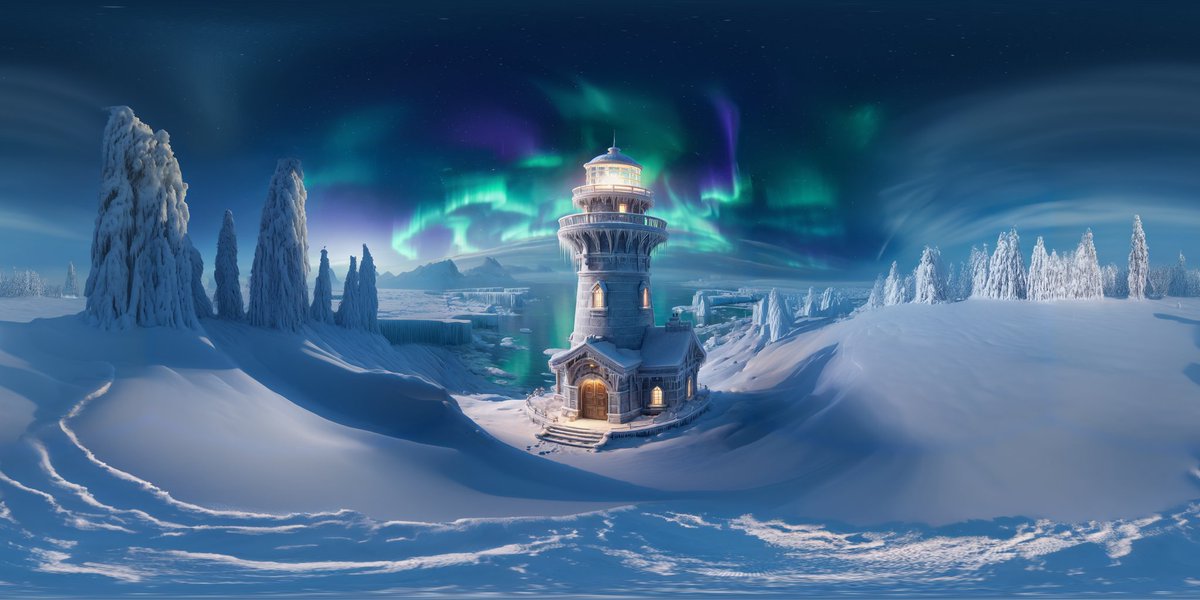
CubeDiff achieves SOTA panorama generation with only minimal architectural modifications to existing T2I diffusion models.
Check out our website @ https://t.co/Tntz4dtszy and paper @ https://t.co/JwwbmynsVD.
Recent reconstruction systems focus on either complex scenes (e.g. Neuralangelo) or shiny surfaces (e.g. Ref-NeRF). In UniSDF, we combine strengths from both worlds both leading to high-fidelity reconstructions of complex scenes with reflections: https://t.co/lFYRl1DQfJ
Introducing SMERF: a streamable, memory-efficient method for real-time exploration of large, multi-room scenes on everyday devices. Our method brings the realism of Zip-NeRF to your phone or laptop!
Project page: https://t.co/WOzE4ApKAH
ArXiv: https://t.co/lugQXu3mQZ
(1/n)
In less than an hour I am going to present our paper MERF at #SIGGRAPH2023 in Petree Hall D.
MERF allows you to interactively explore large scenes on a laptop in the browser. Check out our web demo: https://t.co/a4uOxriY1D
By the way we have also released the entire code now!
🚨 Check out our @NeurIPSConf Oral paper: Shape As Points (SAP)!
We represent watertight meshes of any topology as a lightweight point cloud at speed. The key idea is to bridge them with a super simple, fast, versatile, and differentiable Poisson solver.
https://t.co/cKBHLFwNpg
Do you ever wonder what's really going on in your GAN? Our NeurIPS'21 paper investigates the cause of frequency artifacts in generated images. Nice addition: we develop simple testbeds to analyze generators and discriminators individually.
https://t.co/HuYFzdrU2N
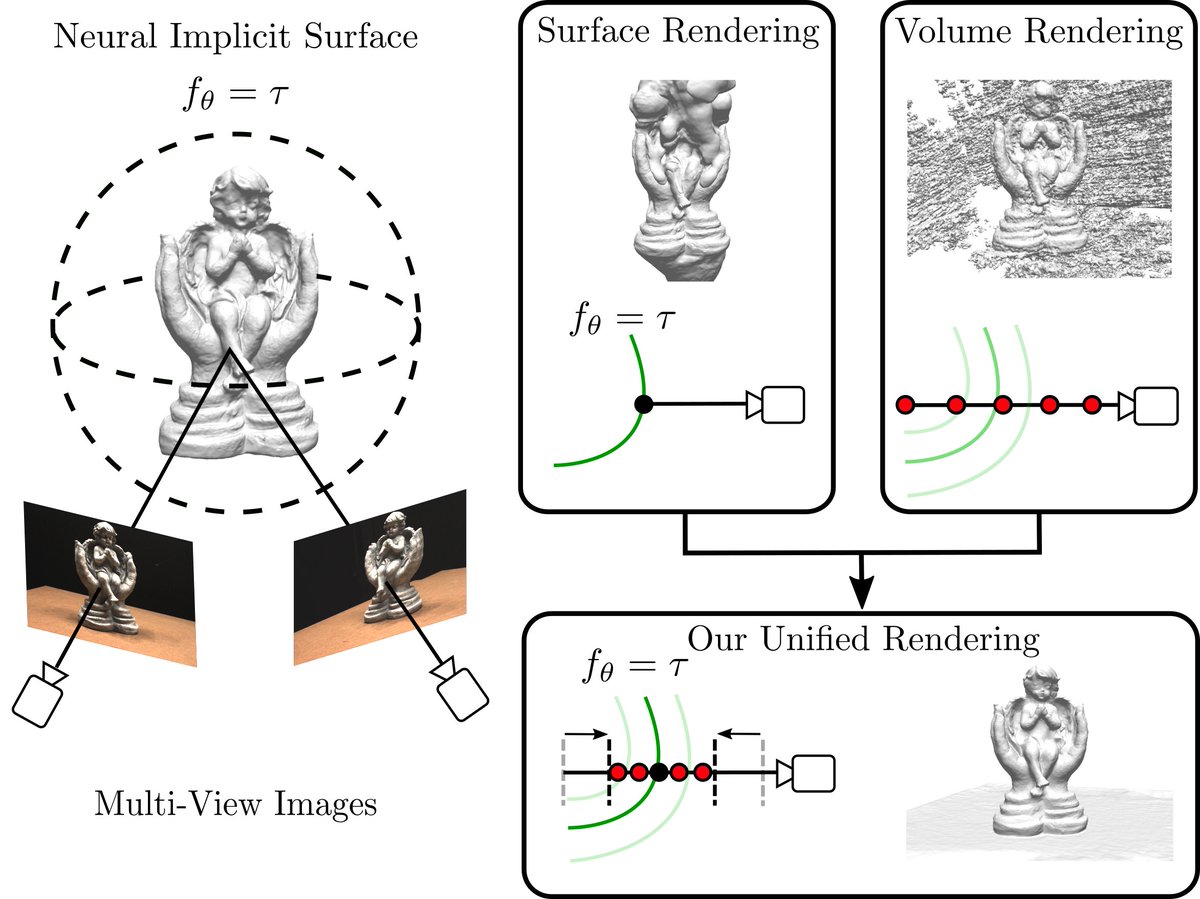
Our key insight is that implicit surface models and radiance fields can be formulated in a unified way, enabling both surface and volume rendering using the same model. This unified perspective enables reconstructing accurate surfaces without input masks.
Excited to present our project UNISURF at #ICCV2021 in Session 5A & 5B with @songyoupeng and @AutoVisionGroup.
Paper, Video, code, and more:
https://t.co/AqCrpouWpo
KiloNeRF was accepted at #ICCV2021!! By using thousands of tiny MLPs novel views can be rendered in real-time (50 fps) with NeRF's quality. Setting it apart and crucial for scalability, the repr. is decoded on the fly and so only needs <100MB of GPU mem.
https://t.co/6GZ4Jyk1CW
🧐 Can Quantum Machine Learning Models outperform classical ML models?
We worked on a few steps towards answering this question: https://t.co/kZiWiywTMM
with Simon Buchholz and @bschoelkopf
a Thread 📜 1/8
We just published the code for KiloNeRF including pretrained models and an interactive viewer:
Code: https://t.co/TPRY5VHFy2
Paper: https://t.co/3PJ6eAs5mr
We further optimized the implementation and the Lego scene is now rendered at smooth 50 FPS!