A Saga of Dharma
long thread please read. you wont regret!
- Ashwin Sampatkumaran , Advocate
For the past couple of years, every time I traveled with Satheeshan Namboothiripad, I couldn’t help but notice a fascinating routine—his unwavering commitment to waking up at 3 AM for japa. But one incident truly etched itself into my memory.
We had landed in Bangalore late one night—our flight touched down at 1 AM, and by the time we reached home, it was 2:30 AM. Exhausted, I was ready to sink into the comfort of a warm bed, the cool Bangalore weather only making sleep more tempting. But as I prepared to drift off, there he was—Satheeshan Namboothiripad—calmly stepping out for a bath. At 2:30 AM. In the biting cold.
I watched, amazed, as he completed his bath, settled into his spot, and began his japa with serene focus. There he sat, completely immersed, while the rest of the world was fast asleep. This continued until 5:30 or 6 AM, unwavering and undisturbed.
It wasn’t the first time I had seen his dedication to Dharma, but every such moment reinforces my belief in the strength of his resolve. It’s in these small yet extraordinary acts that his true character shines through.
And this, dear reader, is just the tip of the iceberg. Hold your breath as you read on—his journey of devotion is long but profoundly inspiring, and by the end of it, you might just find yourself covered in goosebumps!
The years 2020–2021 were a testing time for humanity. The pandemic weighed heavily on all of us, changing our routines, and filling our days with uncertainty. But amidst the chaos, Satheeshan Namboothiripad of Nedumapally Tharananaloor Illom chose to embark on an extraordinary mission—a commitment to chant the Gayatri mantra 1,008 times every single day.
It wasn’t just about the japa; it was about showing that even in the darkest of times, Dharma lights the way forward. And so, while the world grappled with lockdowns and restrictions, he quietly began his spiritual endeavor, creating a ripple of positivity and resolve that would inspire many.
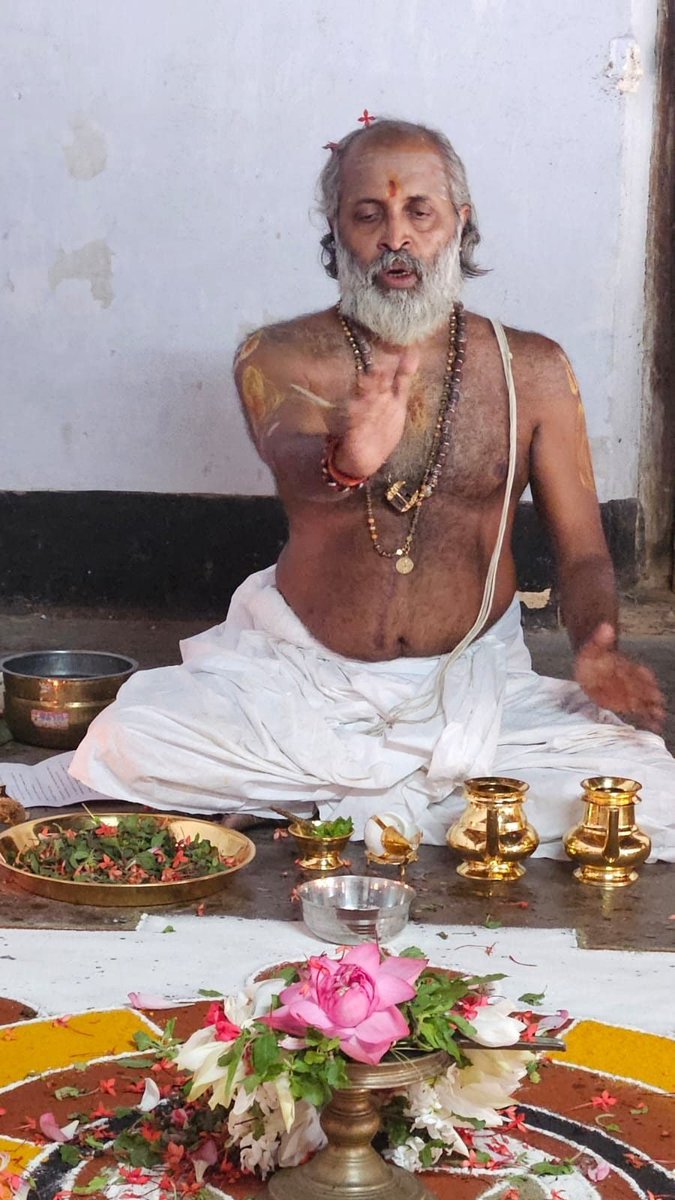
As the world slowly opened up and travel restrictions were lifted, he seized the opportunity to do something even more profound. One day, at his ancestral home, he organized a Gayatri Homam, assisted by his loyal parikarmis who had been with him through countless rituals.
During this sacred occasion, he shared a thought that had been stirring in his mind—a desire to adopt a mantra for upasana (spiritual practice). After deliberation, the choice became clear. The mantra would be:
"Vedo Akhilo Dharma Moolam"
(The entire Vedas are the root of Dharma)
Gayatri, being the foremost mantra for a Brahmin, naturally complemented this choice. With this decision, a spiritual journey began—one that would demand not only time but also relentless determination and unwavering faith.
Purashcharana: A Herculean Effort in Three Phases
In Vedic tradition, for a mantra to bear fruit, it must be fortified through Purashcharana, a series of disciplined practices. Following the guidelines of the Rigvidhana, Satheeshan Namboothiripad undertook this rigorous endeavor in three monumental stages:
Phase 1:
• Gayatri Japa: 30,000
• Gayatri Homa: 3,000
• Time Taken: 15 Days
This was only the beginning. His focus sharpened as he entered the next phase.
Phase 2:
• Gayatri Japa: 1,00,000
• Gayatri Homa: 10,000
• Time Taken: 2 Months
The numbers were growing, and so were the stakes. Yet, his resolve remained unshaken as he moved into the final phase—a feat that could humble even the most disciplined.
Phase 3:
• Gayatri Japa: 24,00,000
• Gayatri Homa: 2,40,000
• Gayatri Tarpana: 24,000
• Gayatri Abhisekam: 2,400
• Gayatri Namaskaram: 240
• Brahmana Bhojanam: 24
The sheer scale of this phase is staggering. It demanded countless hours of chanting, meticulous rituals, and a deep reservoir of physical and mental strength. And today, he has completed Phase 3, a momentous milestone in his spiritual journey.
Satheeshan Namboothiripad’s commitment doesn’t end with personal practice. His vision for Dharma is far-reaching, and he has worked tirelessly to bring others along this path of light.
1. Hari Valam:
At the Padmanabhaswamy Temple in Thiruvananthapuram, he initiated this practice where devotees chant the Hare Rama Hare Krishna while circumambulating the temple’s outer fort on every Ekadasi.
2. Mass Vishnu Sahasranama Japa:
He organized a historic event where 5,000 devotees came together to chant the Vishnu Sahasranama six times in a single day. The energy of thousands chanting in unison was nothing short of divine.
Satheeshan Namboothiripad’s life is guided by a single desire:
Dharma should thrive. Our culture should flourish. Temples should prosper. And in this, mankind will find its ultimate prosperity.
⚙️ epoll vs io_uring vs sync I/O
Great walkthrough of serving files over HTTP in C three ways:
1. thread-per-request sync I/O
2. epoll event loop –
3. io_uring completions
https://t.co/E37uZUkyTj
MIT just made one of the best Computer Vision books available for FREE.
If you are interested in robotics, embodied AI, autonomous driving or vision AI, this is a must-read.
Topics
• Image Formation
• Cameras & Optics
• Machine Learning Fundamentals
• CNNs & Transformers
• Image Processing
• Feature Extraction
• Representation Learning
• Generative Models
• Camera Calibration
• Stereo Vision
• 3D Reconstruction
• Structure from Motion
• Radiance Fields (NeRF)
• Motion Estimation
• Vision-Language Models
• Object Recognition
• Research & Paper Writing
Perfect for
• Computer Vision Engineers
• Robotics Engineers
• Embodied AI Engineers
• Autonomous Driving Engineers
• AI Researchers
Learn from MIT for free:
https://t.co/8odQmXFTzg
Everyone recommends K&R. almost nobody tells beginners about this.
Modern C by Jens Gustedt is one of the best books for learning modern C.
The free edition is worth keeping in your library.
You started walking on four, then on two, ensure you don't walk on three when you grow older (picked from the TOI article below)
At 45, I see most friends, cousins around my age, not following any kind of strength training. Most are at best just doing simple 40 min walks.
Follow the basics: Protein + Strength training.
Poor muscles after 40 will impact your lifestyle.
Happy to read this on leg day :)
One pattern I find useful for working with LLMs is a nice long ramble session. Sometimes the LLM needs more bits to understand what you're trying to achieve, but you're too lazy to type them. In these cases I like to lean back, switch to /voice and just ramble for like 10 minutes, total mess, anything goes, full stream of consciousness. Sometimes I declare it up top, something like "switching to speech recognition sorry for any typos...". Sometimes I turn it into a small interview of a few turns. But I find that the LLMs are somehow very good at reconstructing long incoherent rambles and often their echo of your own tangle of thoughts comes out quite a bit cleaner than what you started with. The result is that you improve the mind meld and have to correct things less from that point on.
I talk to engineers at other companies every day and hear the same thing: one person is 10x'ing their output with Claude but the rest of the org hasn't caught up.
Watching teams adopt AI, I keep seeing the same 4 steps.
I mapped them out here: Steps of AI Adoption https://t.co/kQnRAUMKpP
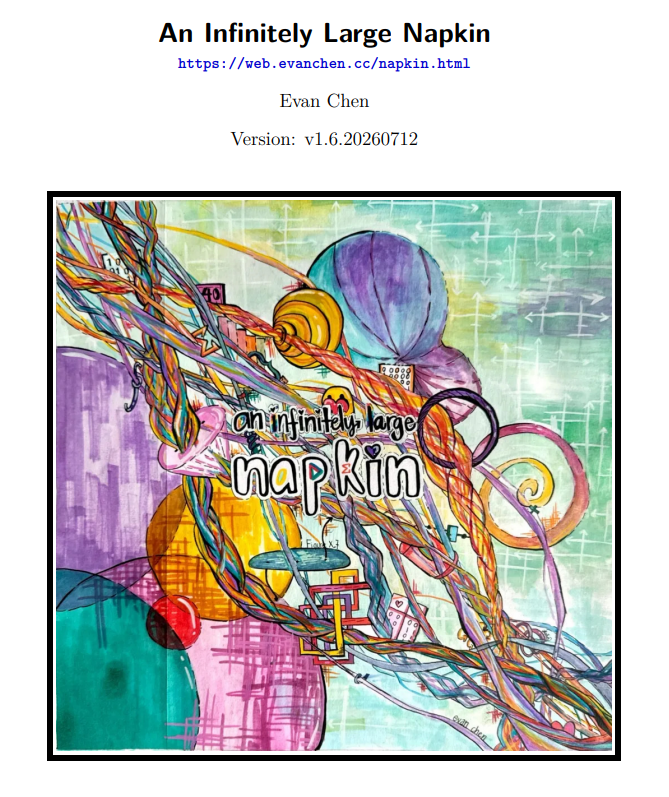
just found An Infinitely Large Napkin
this book gives you a crash course through all the major area of math. and it's still ust a draft! which you can read for free!
Something I have been thinking about: in the past, the best engineers I knew spent a lot of time automating their work in various ways. Better vim/emacs automations, writing lint rules to catch repeat code issues, building up a suite of e2e tests so they don't need to smoke test the app manually. These kinds of things were the highest leverage activities an engineer could do, because it multiplied their own output, which in turn meant they could build more things.
I think many of these automations have become even more important now. This is true for a number of reasons.
First, infra and DevX automation speeds you up. And if you are running an army of agents, each of those agents will be sped up also. More automation == more output per unit of time.
Second, moving things to code improves efficiency. Your agent could fix an issue every time it sees that issue happen, but that uses tokens and might miss cases. If Claude instead writes a lint rule, CI step, or routine, that class of issue can be fully automated forever. This is really what people are talking about when they talk about loops -- it's about automating entire types of busywork rather than solving them one off. This isn't a new idea at all. Engineers have been doing this for a long time!
Third and most importantly, automation makes it possible for others to contribute to the codebase more easily. Increasingly what I am seeing is engineers are contributing to codebases on day one because Claude can navigate the codebase for them, and that non-engineers are able to contribute to a codebase as effectively as engineers can. What gets in the way of both of these is domain knowledge that lives in peoples' heads rather than in automation -- the stuff you used to have to learn when ramping up. What has changed thanks to agents is the domain knowledge that can be encoded as infrastructure is no longer limited to what is expressible in lint rules and types and tests; it can now capture nearly all domain knowledge, encoded as code comments and skills and CLAUDE.md rules and memories. If I put up a PR for an iOS codebase I don't know and a code reviewer rejects it because it doesn't use the right framework, or if a designer builds a new feature and it gets rejected because it doesn't follow the right architectural patterns, these are failures of automation.
Every team should be writing the CLAUDE.md's, REVIEW.md's, skills, and docs that enable agents to productively work in their codebase with zero additional context from the prompter. This sounds crazy, and at the same time is a natural extension of the stuff engineers have always done: automate, and encode domain knowledge as infrastructure. As the model gets smarter and as the harness matures, this task becomes easier. In the meantime, it is on every team to look for ways to convert their domain knowledge to infra so that Claude can write code better, so that code review catches issues automatically, and so the next person working on your codebase can contribute more easily.
When your mind is restless, listen to Sri Kulasekhara Azhwar’s famous Mukunda Mala.
Absolutely brilliant rendition here by Sriman ‘Kainkaryam’ Rangarajan ji at Thirunarayanapuram. Hope to go there soon again and have Darshanam of Perumal!
☺️🙏🏼☺️🙏🏼☺️
I had the honor of giving a keynote at the International Conference on Machine Learning in Seoul last week titled “What will be left for us to work on?” I addressed the widespread anxiety about how we should adapt as AI capabilities increase. I was thrilled by the talk’s reception, so I have made my slides available, annotated with a lightly edited transcript: https://t.co/vNgRJCL57B
I made three arguments. First, the "AI as Normal Technology" framework is a correct and useful as a way to think about AI’s impacts, unless and until there is some future discontinuity such as through recursive self-improvement. Second, even though we should take recursive self-improvement seriously, there is no milestone that companies might achieve in the lab that will suddenly put us all out of work. Third and finally, jobs of the future will be radically different, and a lot of adaptation will be needed. I shared my thinking about what this might look like and ended with a vision of human/AI “co-superintelligence”.
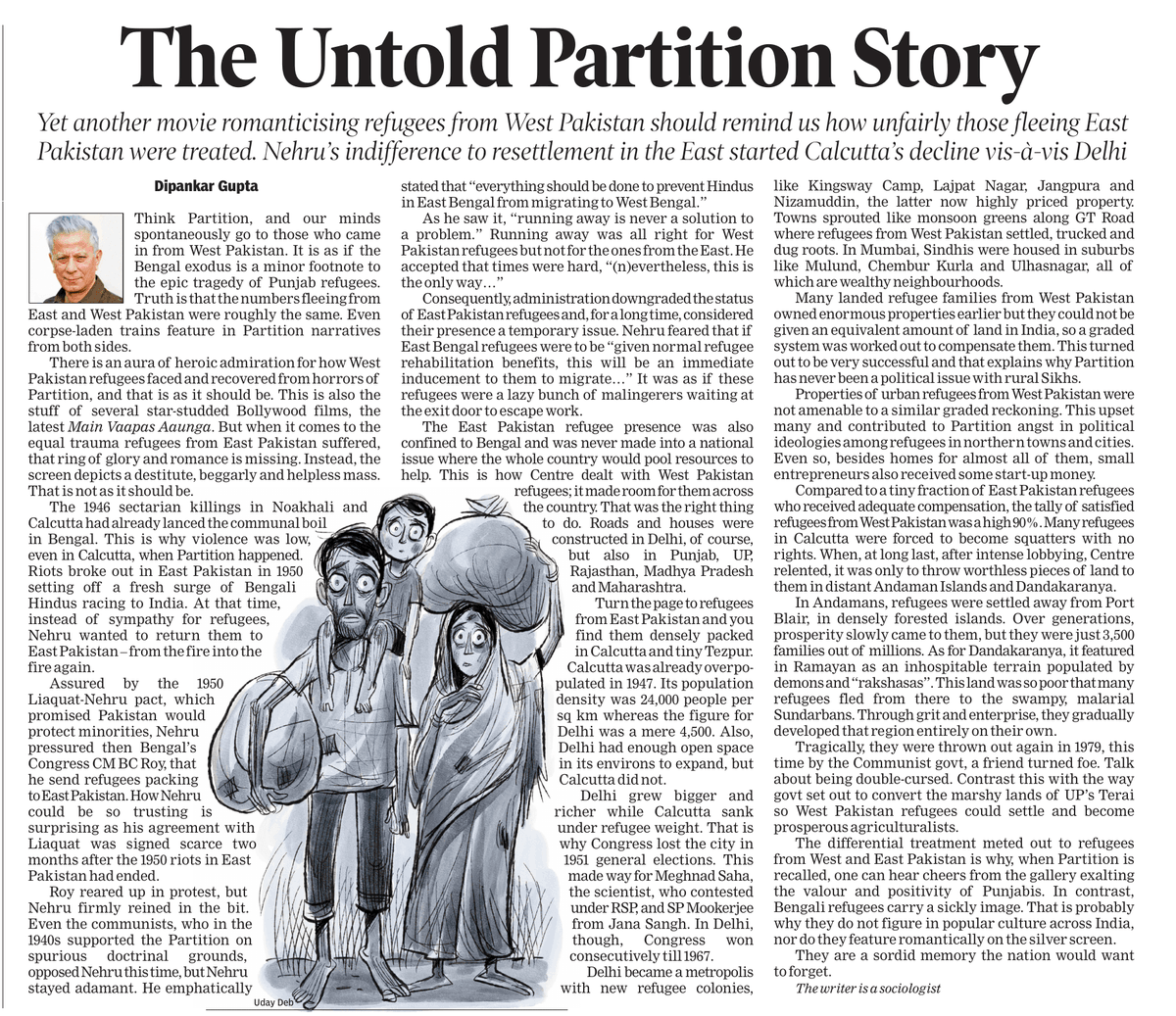
When we think of Partition, the dominant imagery is overwhelmingly from West Pakistan.
The displacement of Bengali Hindus from East Pakistan, Dipankar Gupta argues, has never received comparable historical or cultural recognition.
I taught JEE physics for years. That paper breaks strong kids in three hours.
This exam is five hours of theory and five hours of lab work, and these five did close to perfect scores on it.
Let me tell you what actually happened.
The International Physics Olympiad is the world championship of school physics. It was the 56th edition. Held in Bucaramanga, Colombia, from July 5 to 12.
381 students. More than 85 countries. Every one of them the best physics student their country could find.
India sent five kids.
All five came back with gold.
Their names are Kanishk Jain from Pune. Riddhesh Anant Bendale from Indore. Rishit Garg from Dwarka in Delhi. Shresth Suraiya from Mumbai. Svarit Joshi from Ahmedabad.
We know a hundred cricketers by their nickname and not one of these boys. :)
That clean sweep put India at joint World Number One. Tied with China, Russia, Kazakhstan, South Korea and Taiwan.
Those are countries that pour serious money and national pride into science education. We are standing level with them.
Now here is what the exam actually was.
Two papers. Each five hours long.
The theory paper had three problems. One on the thermodynamics of paramagnetic cooling. One on the photoionisation of ozone. One on the dynamics of electron positron pairs.
The experimental paper was another five hours in a lab, working through heat transfer and thermodynamic processes in fluids.
That means you get given equipment you have never seen, and you have to design your own experiment, take your own readings, handle the errors, and reach a real answer.
Not multiple choice. No shortcuts. No pattern recognition. You either understand physics or you sit there for five hours.
HBCSE says the Indian students were near perfect on theory and excellent on the practical too.
Now, this was India's 27th appearance at the IPhO.
Across all those years, about 44 percent of Indian students have won gold, 41 percent silver, 10 percent bronze.
In the last ten years, every single Indian student has come home with a medal. 62 percent gold, 38 percent silver.
Not one kid has gone and come back empty handed in a decade.
Five golds in one year has happened only twice. This year, and in 2018.
So who built this.
The programme is run by HBCSE, the Homi Bhabha Centre for Science Education. It sits under TIFR, which sits under the Department of Atomic Energy.
They run the whole funnel. A national exam, then a national olympiad, then a brutal selection and training camp, and out of everyone in the country, five kids get on a plane.
The team was led by Professor Anwesh Mazumdar of HBCSE-TIFR and Dr Leena Joshi from St Xavier's College, Mumbai.
The scientific observers were Professor Ananda Dasgupta from IISER Kolkata and Nisha Kelkar from Gogate-Joglekar College in Ratnagiri.
Yes. Ratnagiri. A college in a small coastal town in Maharashtra.
This is public education doing something the private coaching industry could never do on its own.
The coaching industry is very good at one thing. Teaching you to solve a known problem fast.
That is what JEE and NEET reward, and I say that with love because I was part of that world.
But an olympiad paper does not have a known type. There is no shortcut chapter. There is no formula sheet that saves you. You have to sit with a problem you have never seen and think.
That is a completely different muscle. And a government funded centre has been quietly building it in Indian teenagers for 27 years.
So yes, be proud. Loudly.
HBCSE also shared that around 64 percent of India's olympiad medallists go on to do a PhD.
But only about 32 percent of medallists end up settling in India.
I do not say that to spoil the moment. These kids owe the country nothing. They earned every option they have.
But it should tell us something. We are excellent at finding this talent. We are excellent at training it. We are still not great at giving it somewhere worth staying.
Congratulations Kanishk, Riddhesh, Rishit, Shresth and Svarit. This is one of the best things an Indian did this year and most of the country will never hear about it.
I did a massive cleanup of the ML Engineering book
So now you get 400+ pages of a much better copy
https://t.co/J1jdEp9YqX
The pdf/epub versions are here https://t.co/ajxIEuK9Gt
I finally made the pdf cover work.
The Art of Debugging Open Free book is now available in pdf/epub and finally sports a book cover
https://t.co/NPgds6WpOW
While a lot of the focus is on Unix/Python/Pytorch, the methodology chapter is applicable to any Software Debugging.
It currently sports 161 packed pages in 5 solid chapters and more coming...
The discussion sparked by a recent statement on Passport Seva Divas has generated more heat than light.
The Ministry of External Affairs stated that a passport is a travel document, not a document of citizenship. Legally, that is correct. A passport is issued under the Passports Act, while citizenship is governed by the Citizenship Act, 1955. One law regulates the document; the other regulates the legal status.
But law and public understanding are not always the same.
For most Indians, the passport is the most authoritative document the Republic issues. It bears the name of the Republic of India, carries the holder’s identity, and is accepted around the world because foreign governments trust that India has verified the bearer’s nationality before issuing it. It is therefore entirely understandable that many people asked: if a passport is not proof of citizenship, then what is?
The answer requires some nuance.
A passport does not create citizenship. Nor is it the legal instrument that finally determines citizenship if that status is challenged before a court. Like many democracies, India distinguishes between citizenship law and passport law. In rare cases involving fraud, disputed parentage or illegal acquisition, citizenship may have to be established through the provisions of the Citizenship Act and supporting evidence. That is why a passport is not regarded in law as conclusive proof in every conceivable circumstance.
But that should not be confused with its practical significance.
A passport is issued only after the Government has satisfied itself that the applicant is entitled to one. In everyday life, and in international travel, it is the strongest evidence of Indian nationality that most citizens will ever possess. Nothing said by the MEA changes that. No immigration officer abroad will suddenly regard an Indian passport with suspicion because of a legal clarification made in New Delhi.
The episode does, however, remind us of a larger challenge.
India’s systems of civil registration developed unevenly over many decades. Millions of older Indians were born when birth registration was incomplete. Names were recorded differently across school certificates, land records and electoral rolls. The painful experience of the Assam NRC showed how documentary inconsistencies can create profound hardship when citizenship itself becomes the subject of legal scrutiny.
The lesson, therefore, is not that passports have somehow lost their value. It is that India needs stronger and more comprehensive civil registration, universal birth registration and reliable archival records so that citizenship can never become hostage to missing or inconsistent paperwork.
Sometimes a legally precise statement can create unnecessary public anxiety if it is not accompanied by explanation. A better way of putting it might have been this:
A passport is issued only after the Government has verified that the applicant is an Indian citizen. While citizenship itself is governed by the Citizenship Act, the passport remains the Republic’s most trusted document for international travel and, in ordinary life, the clearest evidence of Indian nationality.
That is both legally accurate and reassuring. The law need not be diluted, but neither should public confidence in one of the Republic’s most important documents.
To distil the argument:
A passport is issued because the Government has satisfied itself that you are an Indian citizen. It is therefore powerful evidence of citizenship in ordinary life and in international travel. But in a legal dispute over citizenship itself, the governing law remains the Citizenship Act, and a passport is not conclusive proof that overrides all other evidence
A senior Google engineer just dropped a 19-page PDF on "Loop Engineering" for LLM and agentic systems.
Act → Observe → Learn → Repeat
• Act: the LLM proposes a code transformation (tile this loop, parallelize that one).
• Observe: a compiler runs it and reports back - is it valid? faster? slower? by how much?
• Learn: the LLM reads that feedback and adjusts its next move.
• Repeat until it stops finding improvements.
The agent gets smarter purely from grounded feedback inside its own context window.
This 19-page PDF totally changed the way I’m building agentic systems today.
Read it now, then explore the article below.