I’m curious if the solution lies primarily in the storage layer or the communication layer?
Our human brains compartmentalize info all the time. Mine manages personal and work, private and public knowledge. It segregates by client and by whom I’m speaking with. It has a couple compartments for TS information from the Skunk Works and from the post-9/11 IC. It knows how to sanitize what I say - though not so much what I think.I shape what I say and how I say it based on the context and audience.
That system is fast and surprisingly good albeit not perfect. It’s largely a result of what we’d call behavioral economics - the incentives (aka “reinforcement learning”) that shaped my habits and neural pathways over the course of my life.
On my mind today as I design the architecture for AI systems that can learn across a wide array of matters while protecting attorney-client communications and other privileged and confidential information.
Behavior is downstream from economics. Nothing will change until scientists and institutions are forced to internalize the costs of such conduct (whether reckless indifference or fraud).
That’s why we spend far more time and money on IT systems for grant administration than on systems for research transparency and reproducibility.
Thanks @cremieuxrecueil for calling this out. Shaming on https://t.co/XXlFasHEKy is not nearly enough. Nothing changes unless we amp up the likelihood of detection, the likelihood of punishment, and the costs.
Last year I called for federal pre-emption of heterogeneous state laws regulating healthcare AI, and for the creation of a new entity within HHS to evaluate AI systems.
I am glad to see @Bob_Wachter and @ZekeEmanuel endorse and build on these ideas in JAMA.
According to Wachter and Emanuel, "at least 47 states are considering more than 250 clinical AI bills and some have enacted laws addressing data privacy, transparency, bias, and payment policies."
Fragmentation and poorly designed state laws like Mia Bonta's AB 1979 in California, which would ban clinical AI, do not serve patients and physicians. Federal pre-emption - aligned with President Trump's July 2025 AI Action Plan - should be a a bipartisan priority.
Most big companies' business models will be disrupted within 2-5 years... They probably can't self-disrupt, so how could they survive?
Bring in talented entrepreneurs that understand AI and new tech and fund them to disrupt YOU!
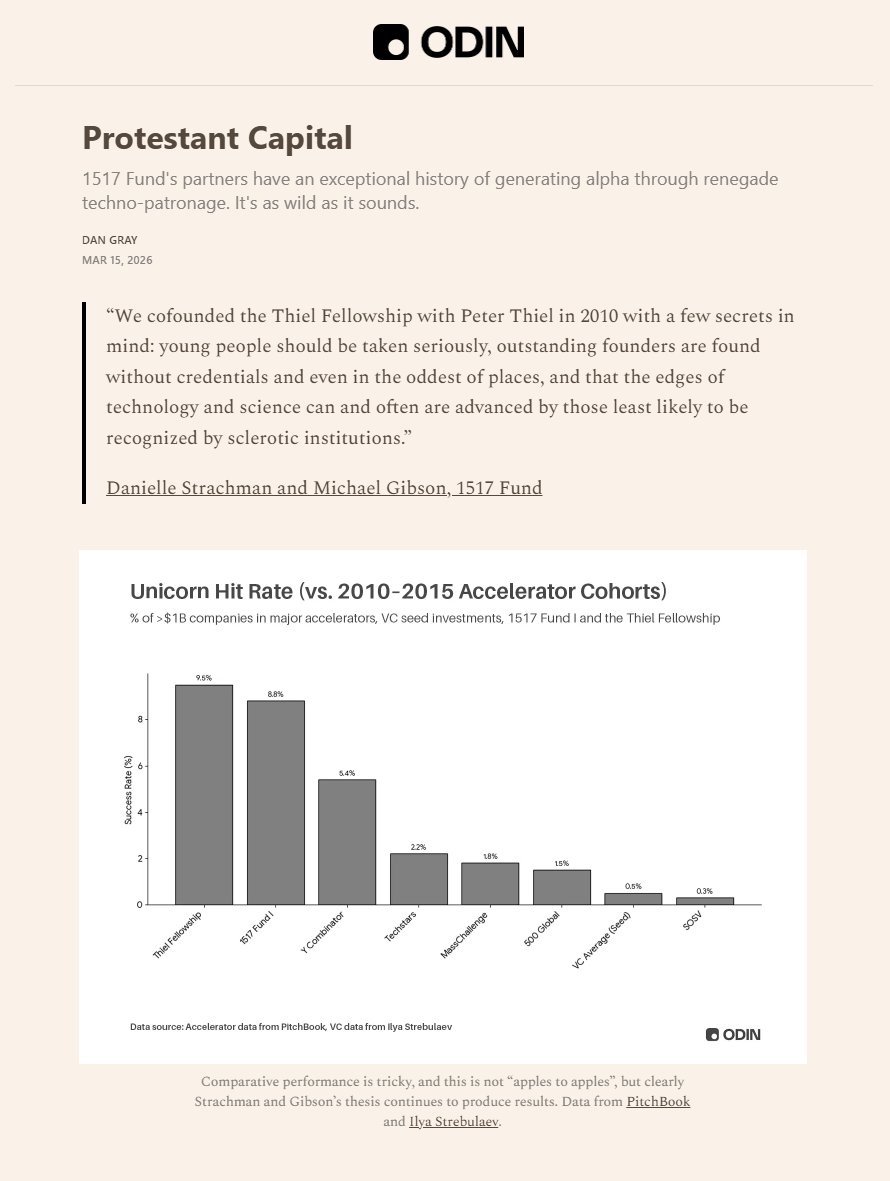
It’s not that patterns and credentials are “irrelevant.” It’s that @DStrachman and @William_Blake find what we might call anti-patterns (like Friday Night Dyson Spheres) and anti-credentials (like departure from traditional academic paths) that correlate highly with performance.
It's hard to find a better example of what venture capital should look like than @1517fund.
@DStrachman and @William_Blake have been the first believers in many of the greatest and gnarliest tech success stories. The source of their power is a philosophical rejection of lazy thinking.
Essentially, if the greatest entrepreneurs are outliers, patterns and credentials must therefore be irrelevant.
It sounds simple, but living that principle as an investor means sailing into headwinds. There's no simple narrative to sell LPs, the future is never clear, capital coordination is difficult, and your capacity cannot endlessly scale.
It's the harder path, but it's the only true path to greatness as a venture capitalist. Success is extremely idiosyncratic; there are no shortcuts.
You might reach this conclusion by studying the library of research on venture capital. Or, you could reach it much more quickly by just meeting a few of 1517's portfolio companies.
We have myriad easy solutions. All are *impossible* unless we disband the postal workers unions.
Follow the money:
More mail means more postal jobs. It’s a massive wealth transfer from taxpayers to a relatively small group of government employees.
More jobs and more wages means more dues paid to the postal unions.
More money to the unions means more money to lobbyists and congressional campaigns to protect the grand racket against disruption.
They even use our own money against us to amplify demand, such as by subsidizing bulk mail.
It’s not exactly corruption, but it’s “close enough for government work.”
Burn it to the ground.
Of the two tweets I've ever posted that drew the most pushback, one argued that the USPS should shift to 3 day/week letter delivery and the other that the criminal justice reform movement should prioritize making prisons safe over expanding Pell Grants. I stand by both.
Promising leadership on AI regulatory policy from @DavidSacks and the White House. We all must work together to resist the descent into regulatory chaos. A web of incoherent, inconsistent laws would actually increase the risks that any one state's regs might try to mitigate.
In December, President Trump signed an Executive Order tasking us with the development of a national framework for AI, what he called “One Rulebook.” This was in response to a growing patchwork of 50 different state regulatory regimes that threaten to stifle innovation and jeopardize America’s lead in the AI race.
Today we are releasing that framework. It will help parents safeguard their children from online harm, shield communities from higher electric bills, protect our First Amendment rights from AI censorship, and ensure that all Americans benefit from this transformative technology.
We look forward to working with our colleagues in Congress to turn the principles we are announcing today into legislation.
https://t.co/9fwatPYP5M
I’m extremely honored to be nominated by President Trump to serve as Director of the National Science Foundation.
Heroic scientists have always challenged consensus to advance the frontiers of knowledge. Recently, many institutions have weakened academic freedom and lost the trust they once enjoyed. Yet across our country, a new golden age of discovery is dawning. Information is open source and debate is public.
The marketplace of ideas is not an efficient market. Finding and funding independent thinkers and builders has taught me to eliminate bottlenecks and favor rigorous science that replicates. Private funders are developing frontier models and useful technology. Government should take bigger financial risks to pose and answer deeper questions.
NSF’s scientists and staff have built something worth strengthening. Working together, scientists, engineers, investors, research institutions, and businesses can support American genius, enhance national security, enrich our economy, and improve our quality of life.
Entropy is on the march and China is not waiting.
@SebastianCaliri Any books from recent experience that stand out as particularly great for this purpose?
I’m working on one here in ATX - a bit more mixed media, starting with the film Sita Sings the Blues and a talk by a local artist.
@DStrachman We had to reschedule given that my DJ couldn’t make it. I’m game if you want to throw a joint party, anywhere in the world, during the next 45 days.
New polling shows that the public favors a single national AI framework over a 50 state patchwork by 20 points, and moreover, supports executive action until Congress can act. Total vindication for President Trump’s One Rulebook approach.
https://t.co/PqJwslcuYz