Nebius is putting every other neocloud to shame and this morning alone proves it (Save this).
Nebius just signed a $1 billion compute deal with Reflection AI, running through 2029 and giving Reflection direct access to NVIDIA GB300 chips.
This is the deal everyone should be paying attention to, because of who Reflection is.
Reflection AI was founded by former Google DeepMind researchers behind Gemini's reward modeling and AlphaGo.
They raised to a $20+ billion valuation in early 2026, backed by NVIDIA, Sequoia, and with direct US government support, their mission is to build America's open source frontier model, a Western answer to DeepSeek.
In June 2026 they signed a $6.3 billion compute deal with SpaceX at $150 million per month for access to the Colossus 2 data center in Memphis.
Now they are adding Nebius as a second major compute provider on top of that.
The fact that Reflection chose Nebius, not AWS, Azure, Google Cloud for that relationship says everything about where the neocloud sits in the frontier AI infrastructure hierarchy.
The CEO himself explained the ambition in a recent interview: "How many companies today provide hundreds of thousands of GPUs in a publicly available cloud? Well, there is the three hyperscalers and us."
That is a direct challenge to Amazon, Google and Microsoft on their own turf, with the contracts to back it up.
The India news this morning adds another dimension entirely.
Nebius just posted two hardware infrastructure roles in Hyderabad, Field Technical Lead for Data Center Deployments and Technical Program Manager for New Data Center Launches.
This is exactly how Nebius signals a new market entry, the Wales data center from yesterday was flagged the same way through a recruiter post before any official announcement.
India would be Nebius's first footprint in Asia, entering the fastest growing AI market outside the US and China at a moment when data sovereignty regulations make domestic compute infrastructure a strategic priority for Indian enterprises and government contracts.
This all comes on top of a buildout that is already staggering, a 310 MW AI factory in Finland, a 240 MW facility in France, a £1.7 billion UK expansion across three sites, Wales, a $20 billion contracted backlog from Meta and Microsoft, and $3.75 billion in convertible notes raised in March 2026.
The only constraint on this company is how fast it can build.
Bullish on Nebius and make sure to follow me @MelvinInvests for more underlooked AI oppurtunities.
Eli Lilly is going much HIGHER and it has almost nothing to do with weight loss drugs (Save this)
Zepbound & Mounjaro are the reason the stock sits near ATHs
but the AI platform $LLY is building under the drug business is what matters
it started w/ Lilly Pod, a 1,000 GPU Nvidia Blackwell supercomputer at its Indianapolis HQ, the most powerful supercomputer owned by any pharmaceutical company on earth
In January 2026 Lilly and Nvidia committed $1 billion over five years to a new AI co innovation lab running on Nvidia's BioNeMo platform and Vera Rubin architecture
The lab pairs robotic wet labs with AI models in a closed loop: propose a molecule, synthesize it, test it, feed the result back in, and repeat at machine speed instead of human speed
The next wave is data:
Lilly CEO Dave Ricks has pointed out that Lilly alone holds data on roughly 3 million failed drug candidates, while the entire pharma industry has only ever produced about 4,000 approved drugs total
No AI startup training on public internet data can replicate 150 years of proprietary clinical and safety data like that. This is their moat in an AI world
And finally, wave 3 is about distribution:
TuneLab launched in September 2025, giving outside biotechs access to AI models built on over $1 billion of Lilly's proprietary drug discovery data through federated learning
Over 70 biotech partners are already on it
That is Lilly starting to look like infrastructure the rest of the industry builds on, closer to what AWS became for cloud computing than a normal drug company
Even better is that Eli Lilly is funding this bet entirely off cash flow from drugs that already work, Zepbound, Mounjaro, and the new oral pill Foundayo, so the AI platform is optionality stacked on top of a business that does not need it to succeed
The drug franchise is already crushing, the AI platform is the option most of the market has not priced in yet and what will take $LLY much higher
Follow me @kylereidhead for more analysis on AI, robotics and markets. Also, you can track my real-time portfolio (which includes $LLY) for just $1 at Milk Road PRO (see link in bio to join)
🚨🇩🇪Germans have just launched mass calls to leave the EU!
After the European Parliament passed the mass internet surveillance law known as "Chat Control," Germans have started calling for DEXIT!
"We will not allow our rights and freedoms to be crushed."
.@chamath says Palantir CEO Alex Karp is " an incredible, smart, brilliant guy" who "completely nailed it and called out on its face the huge risk" of giving your company's alpha to OpenAI and Anthropic:
"If you are a reasonable company, why are you not finding an independent way to access this intelligence in a way that doesn't leak your edge away?"
"To do so at this point now is kind of becoming derelict and irresponsible."
"Back then, you could be experimenting because you didn't know any better."
"Now, when you know all of these data points, to continue to make the same decision is really insanely dumb."
Via @theallinpod@DavidSacks@friedberg@Jason
Go ahead and short Micron, I dare you and you will get burned (Save this).
This chart shows data center memory demand goes from $60 billion in 2024 to $1.4 trillion by 2030.
That's 23x in six years and that number doesn't include phones, laptops, or cars but just data centers.
Three companies make this memory, Samsung, SK Hynix, and Micron and no one else is coming and China's CXMT is years behind on advanced nodes and isn't a factor in HBM at all.
The product everyone actually wants right now isn't regular DRAM but it's HBM, High Bandwidth Memory.
These chips are physically bonded onto Nvidia's GPUs and sit millimeters from the compute die.
A single Blackwell GB200 needs 192GB of it while one NVL72 rack needs 13,824GB.
Meta and Microsoft are ordering these racks by the thousands and every single one is a guaranteed HBM purchase.
Micron sold out its entire 2026 HBM supply before the year even started.
Micron has signed 16 take or pay contracts locking in $100 billion in minimum revenue and customers have already wired $22 billion in upfront cash for chips that haven't been made yet.
That's not a commodity business anymore but rather customers paying in advance because they're scared of running out.
AI capex has officially gone parabolic, Meta $145B, Amazon $100B, Microsoft $80B, and Google $75B in a single year and every dollar of that capex eventually touches memory.
This chart shows AI data center memory going from $106 billion in 2026 to $285 billion in 2028 to $517 billion in 2030, growing 40–60% a year, every year, backed by capex that's already been announced.
Micron owns about a third of the global memory market, a third of $1.4 trillion is $470 billion flowing to one company from data centers alone before a single consumer device ships.
Shorting Micron means betting hyperscalers stop building, AI demand disappears and somehow one of three companies with a physical monopoly on critical infrastructure loses its seat at the table.
Milk Road Pro subscribers are up massively on Micron, come join us just for a dollar to see rest of our trades using the link below!
Adam Back: Strategy Selling BTC to Pay Dividends Is Not a Bearish Signal
Blockstream CEO Adam Back said in a Bloomberg interview that concerns over Strategy’s sale of 32 BTC to pay preferred stock dividends are overblown. Back argued the move demonstrates Strategy’s ability to meet investor obligations using Bitcoin while reducing leverage, rather than signaling weakness in its Bitcoin treasury strategy.
Erik Voorhees: The future political divide will be 'accelerationists vs decelerationists.'
And in democracies, the majority who feel left behind will use government to punish those doing well.
"Stealing from those who produce to giving to those who don't. That will be accelerated greatly."
"That mass ignorance is going to be amplified through the political process to cause great harm."
FT @RaoulGMI@ErikVoorhees@RealVision.
David Friedberg just said what a lot of people in tech are thinking but won't say out loud and the evidence backs him up (Save this).
@friedberg argument is that the people who talk loudest about inequality, fairness, and protecting the working class are the same people building the most sophisticated machinery of economic control this country has ever seen and disguising it as virtue.
He calls it the Great American Politburo.
The Politburo, for context, was the small committee that ran the Soviet Union controlling the economy, education, media and what citizens could and couldn't do, while insulating its own members from the rules they imposed on everyone else.
Freeberg's case is that Elizabeth Warren, Bernie Sanders, and Ro Khanna are doing the exact same thing, American edition.
And here is the evidence.
Congressional members outperformed the S&P 500 again in 2024 , Democratic representatives averaged 31% returns while Republicans averaged 26%, compared to a 24.9% gain for the S&P itself.
Nancy Pelosi's Nvidia positions have returned 586% since 2021 while she simultaneously sat on committees regulating the semiconductor industry.
Elizabeth Warren publicly calls for soaking the rich while financial disclosures reveal she has made millions on Wall Street investments, the same markets she campaigns against.
A nonpartisan tracker of congressional wealth found that roughly half of all 540 members of Congress match or beat the S&P 500 on an annualized basis.
These are people with access to intelligence briefings, regulatory decision-making, and committee hearings held months before public disclosure and they're trading the whole time.
The AI angle is where this becomes directly relevant to every reader of this newsletter.
In February 2026, Sanders and Khanna held a town hall at Stanford specifically calling for slowing down AI development warning of profound dangers from AI controlled by billionaires like Musk, Zuckerberg, and Thiel.
They called for keeping humans in the loop," broad AI regulation, a federal AI regulatory agency, and ensuring productivity gains are shared with workers.
On the surface, that sounds reasonable. Who could be against sharing gains with workers?
But look at what that agenda actually means in practice, a federal AI regulatory agency means political appointees deciding which companies can and cannot deploy AI, which models can and cannot be released, and which applications are approved or denied with no market mechanism and no accountability to the people actually building the technology.
That is the Politburo structure Freeberg is describing, translated into tech policy.
the US government literally just banned Fable 5 for non-Americans due to cybersecurity concerns...
but you're still being lazy with your digital security? lol
your bank accounts, photos, social media, and identity are more vulnerable than ever thanks to AI.
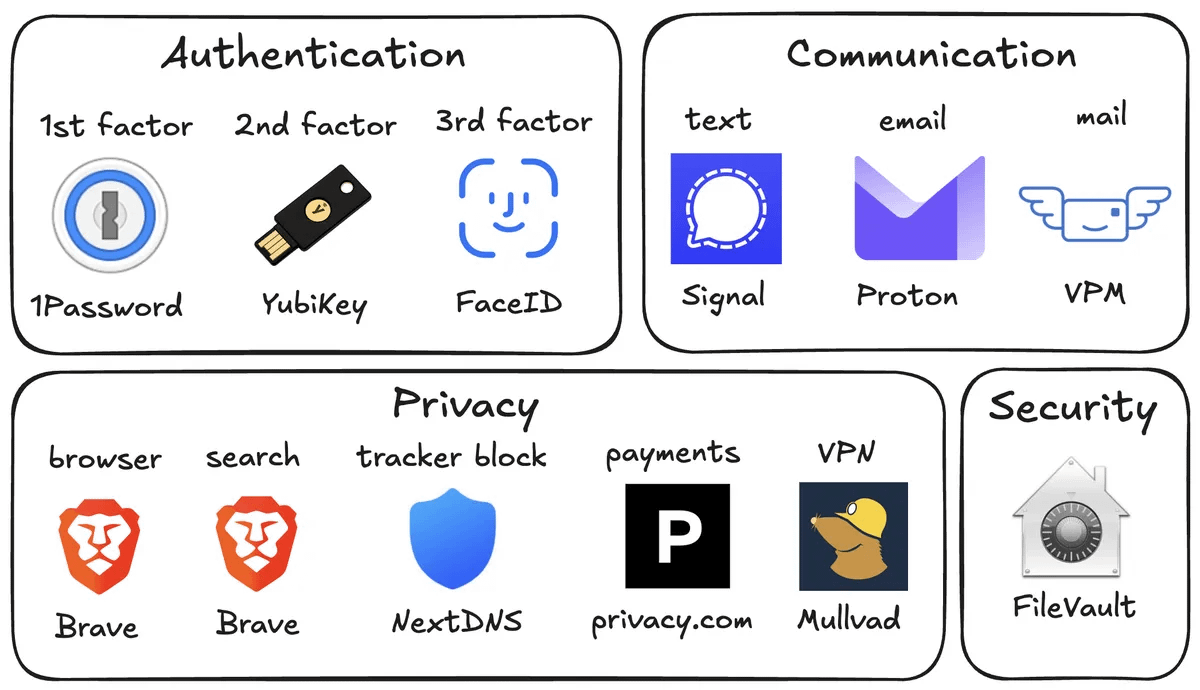
this is why Karpathy's digital hygiene guide is probably the most important thing you can read this week.
> use a password manager for every account
> set up physical security keys so attackers can't log in
> enable face id and fingerprint everywhere
> randomize your security question answers
> encrypt your hard drive
> get rid of unnecessary smart home devices
> switch to signal for private messaging
> use brave instead of chrome
> switch to brave search instead of google
> mint virtual credit cards for every purchase
> get a virtual mailing address
> never click links inside emails
> use a vpn on public wifi
> block ads and trackers at the dns level
> install a network monitor to see which apps are spying on you
full breakdown of each step below:
Grayscale Research believes $AAVE may be undervalued at current levels
Our fair value is $80 to $100, with a base case of ~$175 in a year
Cash-flow driven tokens like @aave can be valued like a financial business
Read the full report here:
https://t.co/9fHSTV5QbF
Today, we enable AutoResearch in the physical world for the first time! Introducing ENPIRE: we give 8 Codex agents a fleet of robots, an allocation of GPUs, and generous token budget. We set them free with a simple goal: solve the task as quickly as possible, keep the robots busy but stay safe, don't waste precious compute. Make no mistake.
Then humans step aside and our watch begins. The robot fleet starts to come alive: they learn to look for visual clues, reset the scene, practice novel skills, tinker with control stack, read papers online, debate, reflect, get stuck, and try again directly on the hardware. All we did is to give Codex an API to the world of atoms, and the rest is emergence.
ENPIRE is able to solve high-precision tasks like tying zip-ties, organizing fine pins, and installing GPUs all by itself. We also discovered a new type of "physical scaling": 8 robots exploring in parallel improves significantly faster than fewer ones.
A part of our NVIDIA GEAR lab now self-improves tirelessly over night. We just read the reports in the morning.
/goal: we all take a holiday and Jensen wouldn't even notice ;)
We will be open-sourcing everything, so you can host your self-running robot lab at home too! Deep dive in the thread:
SpaceX - EchoStar Update
Want a $1 for 50 to 60 cents?
By the end of the day today, EchoStar should be free from any further liability to make further payments to the FCC for the AWS-3 re-auction - this removes one big uncertainty.
I've updated the numbers in the article below to reflect yesterday's closing prices.
TLDR: a large discount persists and most of EchoStar's value going forward will be tied to SpaceX, thus making it a solid (and much cheaper) alternative to owning SPCX.
SpaceX hit $3 trillion market cap today.
This means Elon Musk made more money in the last 24 hours than Warren Buffett made in his entire lifetime.
Insane.
🚨UPDATE: ANTHROPIC SHUTS DOWN ACCESS TO MYTHOS MODELS FOR ALL CUSTOMERS
🇺🇸 U.S. officials reportedly tried to BLOCK Anthropic from releasing Claude Fable 5 before imposing export controls, cutting out all foreign access.
Anthropic has now cut access for everyone worldwide.