Te invito a suscribirte a Dynamic Markets, un newsletter que analiza temas de sostenibilidad y economía digital en detalle y profundidad.
https://t.co/ti8enyi7JU
If life is strictly about the narrow elimination of biomarker distress, we really should stop having children.
Not cut back. Eliminate procreation.
The science is clear.
> raising babies increases cortisol
> disrupts REM sleep
> shrinks hippocampal volume
> elevates resting heart rate
> raises inflammatory markers
@FedexSTi Clave. Buenísimo resaltar esta idea.
En finanzas les enseñan a hacer Excel re complejos (importante saberlo hacer), pero después la rentabilidad de un negocio o la toma de decisiones se resume a un par de números que capturan el 95% de lo que ocurre. #DiTella
GLP-1 drugs are the ultimate validation of the techno-solutionist approach to society's most challenging problems.
The obesity crisis seemed liked it would just get worse and worse forever. Scolding from public health officials didn't work. Proposals to completely overhaul our food systems were dead on arrival.
Instead, we invented a weekly shot (based on Gila monster venom!) that fixes obesity directly.
And now, thanks to the economic incentives in our biomedical industry, we have follow-on drugs that will be cheaper, even more effective, and easier to administer (by taking a pill instead of a shot).
Policymakers should be focused on figuring out how we can get more breakthrough drugs like GLP-1s (and faster). They also should think hard about which slopulist ideas might inadvertently kill the goose that lays the golden eggs.
"The wealth taxi is moving to Miami."
— typo in an email from Ron Conway about all the founders who are leaving California because of the proposed wealth tax
Few facts are more surprising than that, as of early 2026, Latin America has a lower fertility rate than the U.S., reversing a long-standing historical pattern.
I was therefore very glad to see this morning a truly fascinating paper by Milagros Onofri, Inés Berniell (@InesBerniell), Raquel Fernández (@raquel1fernan), and Azul Menduiña on Latin America’s recent fertility decline at @nberpubs:
Understanding Latin America’s Fertility Decline: Age, Education, and Cohort Dynamics
https://t.co/LxCJnx72Jg
I have not yet had time to fully digest all its findings, but I will be reading it repeatedly over the next few weeks.
From a first reading, here are five key results (which align very well with some of my previous posts here on X):
1️⃣ The decline in period fertility between 2000 and 2022 is driven primarily by reductions in within-group birth rates, rather than by changes in population composition.
2️⃣ The largest contributions to the fertility reduction come from younger and less-educated women.
3️⃣ The decline in completed fertility reflects substantial reductions in the average number of children per woman.
4️⃣ This is driven primarily by lower fertility among mothers, rather than by rising childlessness.
5️⃣ There is currently a negative correlation between female labor force participation and the total fertility rate, suggesting that greater engagement of women in market work is not directly driving the fertility decline.
Findings 2️⃣ and 5️⃣ contradict some of the overfacile explanations one often reads in the media (or in the comments section): the reduction in fertility in Latin America is not concentrated among “liberated,” highly educated women with jobs in the market. Finding 3️⃣ says the observed reduction in fertility is not mainly about timing. Yes, timing matters, but much less so than reductions in completed fertility. Finding 4️⃣ is interesting, and perhaps different from more advanced economies.
My own conjectures (not the authors’!):
1️⃣ Their data end in 2022, since they need to rely on final consolidated sources. Everything I have seen in the provisional data for 2023–2025 fully supports their findings and perhaps even reinforces them.
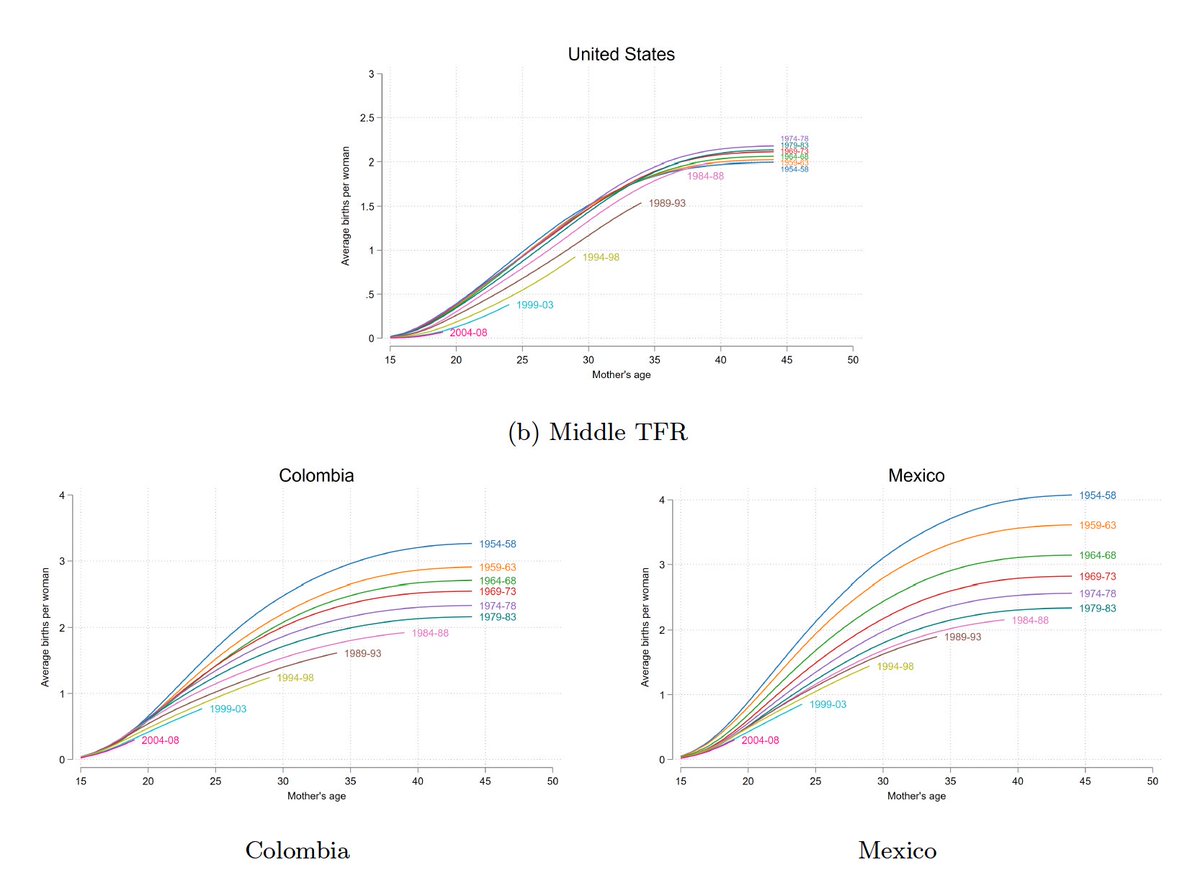
2️⃣ By looking at the cohort level, I do not see much of a differential effect between cohorts with and without access to cell phones. Instead, I see a constant decline over time.
To make this latter point, I include one of the figures from the paper, plotting, for several countries and five-year birth cohorts from 1954–1958 to 2004–2008, the cumulative average number of children a woman has had by each age.
The only point where perhaps I diverge somewhat from the authors is in their more optimistic assessment of the WPP data than mine. But that is a very minor quibble.
Otherwise, anyone interested in Latin America’s fertility should read this paper with utmost attention. This is social science research at its best.
@SuperhumanMail, I have a subscription to your services, but I don't have access to the rest of the @Superhuman services... will the accounts merge? Or do I unsubscribe from mail and subscribe to Superhuman directly?
Not a single word from @UN_Women on the situation in Iran.
Nothing.
The UN body for women's rights hasn't got anything to say.
A weird, fake organisation.
If you *only* used SAT to admit to elite colleges, share of admits from top 1% income falls 15.8% → 9.9% and representation from <$200k rises by +8.8%, with no reduction in post-college outcomes.
It's 'holistic review' and 'ban SAT' policy that allows the most wealthy and powerful to virtue signal while getting an edge.
If you *only* used SAT to admit to elite colleges, share of admits from top 1% income falls 15.8% → 9.9% and representation from <$200k rises by +8.8%, with no reduction in post-college outcomes.
It's 'holistic review' and 'ban SAT' policy that allows the most wealthy and powerful to virtue signal while getting an edge.
Shipmas Day 2: Bonus Drop. 🚢🎁
We taught Nano Banana Pro to see like a user. 👀
Introducing Predictive Heatmaps.
Now you can run an instant attention audit on any screen you design. Ensure your users are focused exactly where you want them to be—before you write a line of code and without waiting for data.
Live now in the Generate menu.
¿Alguien me explica qué hacemos hablando del IIGG personales en lugar de estar mirando el "elefante en el bazar" de la estructura tributaria argentina?