🚨 In 2024, a 1-hour lecture on the Bloomberg Terminal quietly showed how trading markets actually work.
Most people still overlook it.
Because instead of theory, it reveals how markets move in real time with real data, real decisions, and real consequences.
You start to see what professionals see.
How information flows. How sentiment shifts. How small signals turn into big moves. It’s not about predicting perfectly it’s about understanding faster than everyone else.
And that’s the real edge.
Not more knowledge but better interpretation.
Once you watch it, charts stop looking random. News stops feeling noisy. Everything starts connecting.
Bookmark this and give it one hour today, no matter what.
It might be the most productive start you can give your week.
Then go deeper with the article below.
A community college professor taught the same study skills lecture for 30 years, and the video quietly became one of the most watched educational recordings on the internet.
His name is Marty Lobdell. He spent his career as a psychology professor watching students fail not because they were lazy, but because nobody had ever taught them how their brain actually works under the pressure of learning something hard.
The lecture is called "Study Less Study Smart." Over 10 million views. Passed around in Reddit threads, Discord servers, and university study groups for over a decade. And the core insight buried inside it has been sitting in cognitive psychology research for years, waiting for someone to explain it in plain language.
Here is the framework that completely changed how I think about effort.
Your brain does not sustain focus the way you think it does. Studies tracking real students found that the average learner hits a wall somewhere between 25 and 30 minutes.
After that, efficiency doesn't just decline. It collapses. You're still sitting at your desk, still looking at the page, but almost nothing is going in.
Lobdell illustrated this with a student he knew personally. She set a goal of studying 6 hours a night, 5 nights a week, to pull herself out of academic probation. Thirty hours of studying per week. She failed every single class that quarter.
She wasn't failing because she lacked effort. She was failing because she had confused time spent near books with time spent actually learning. The 25-minute crash hit her at 6:30pm every night. She spent the next five and a half hours sitting in the wreckage of her own focus and calling it studying.
The fix sounds almost too simple. The moment you feel the slide, stop. Take five minutes. Do something that actually gives you a small reward. Then go back. That five-minute reset returns you to near full efficiency. Across a six-hour window, the difference is not marginal. It is the difference between thirty minutes of real learning and five and a half hours of it.
The second thing he taught destroyed something I had believed about how memory actually works.
Highlighting feels productive. Going back over your notes and recognizing everything feels like knowing. But recognition and recollection are two completely different cognitive processes, and your brain is very good at making you confuse them.
You can see something you've read before and feel completely certain you understand it, even when you couldn't reconstruct a single sentence from memory if the page were blank.
He proved this live in the room. He read 13 random letters to his audience. Almost nobody could recall them. Then he rearranged the same 13 letters into two words: Happy Thursday. The whole room got all 13 without effort.
Same letters. Same count. The only thing that changed was meaning.
The brain stores meaning. Not repetition. The moment new information connects to something you already understand, the retention changes entirely.
This is what the cognitive psychology literature calls elaborative encoding, and it is the mechanism underneath every effective study technique.
The third principle was the one that hit me hardest, and the one almost nobody applies.
Lobdell cited research showing that 80 percent of your study time should be spent in active recitation, not passive reading. Close the material. Say it back in your own words.
Teach it to someone else, or to an empty chair if no one is around. The struggle of retrieval is where the actual learning happens. Reading your notes again is watching someone else do the work.
His parting line has stayed with me longer than almost anything else I have read about learning.
He told the room that if what he shared didn't change their behavior, they hadn't actually learned it. It would just live in their heads as something they had heard once and felt good about.
He was right. And most people leave every lecture exactly like that.
The students who remember everything aren't putting in more hours.
They stopped confusing the feeling of studying with the fact of it.
This 1 hour lecture from a Carnegie Mellon professor who had 3 months to live will teach you more about living than every self-help book you’ve ever read combined.
Bookmark this & give it 1 hour today. It’s the most productive start you can give your week.
10 AI companies offering free courses to master AI for $0.00:
1. OpenAI: https://t.co/ZJO4B6sk4n
2. Google: https://t.co/dRv5SBhxqD
3. Microsoft: https://t.co/DzECDJB6M6
4. NVIDIA: https://t.co/HQigWByhbG
5. DeepLearningAI: https://t.co/6JmJRiBm9Y
6. Meta: https://t.co/UFX6zQ6UuE
7. AWS: https://t.co/IV2EDaVpCT
8. IBM: https://t.co/ZUrGOLgggt
9. Hugging Face: https://t.co/0Vr7J6tmV7
10. Stanford: https://t.co/pnA50hawYH
Most people pay for AI courses.
But the real ones are actually free.
Stop buying expensive $500 courses to learn AI.
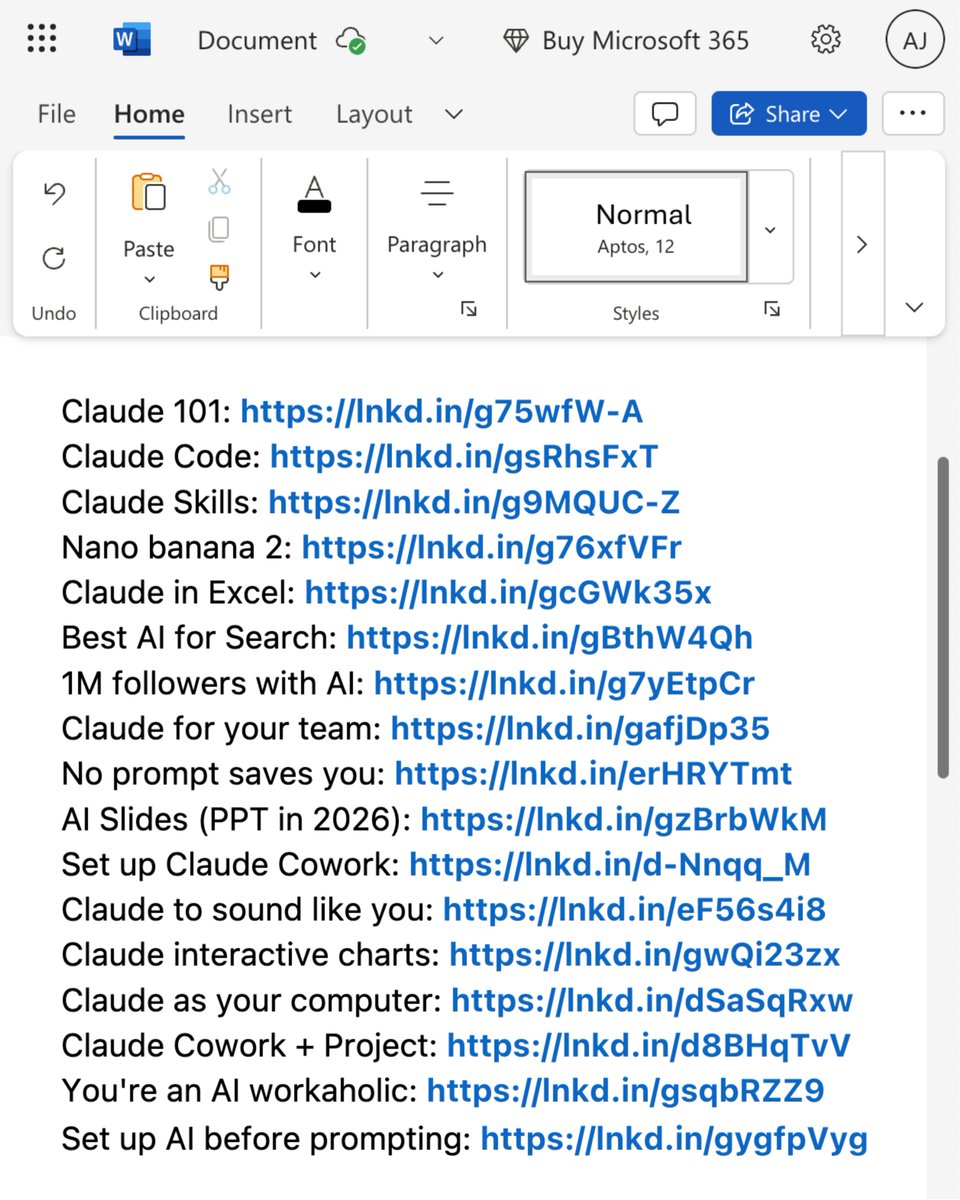
I’ve already done it for you. With one list:
Straight to the point. Zero confusion. And no fluff.
Claude 101: https://t.co/Jv1jsvFB7T
Claude Code: https://t.co/WYZd5ltnXo
Claude Skills: https://t.co/jT4uB5AFtY
Nano banana 2: https://t.co/qfHT594CCI
Claude in Excel: https://t.co/mfcXYSA57j
Best AI for Search: https://t.co/77BmjbJjP0
1M followers with AI: https://t.co/1TV9LYAptv
Claude for your team: https://t.co/U1JsBVC299
No prompt saves you: https://t.co/SDKJWykHE4
AI Slides (PPT in 2026): https://t.co/RfcyYRQ2Ad
Set up Claude Cowork: https://t.co/ZE0fKKrF3A
Claude to sound like you: https://t.co/99RzxXTvzs
Claude interactive charts: https://t.co/ebCHGZqgPt
Claude as your computer: https://t.co/TxYuHPiImn
Claude Cowork + Project: https://t.co/Q7AN9CZ2mg
You're an AI workaholic: https://t.co/mCIvB3ZPA5
Setup AI before prompting: https://t.co/pE3OF722aw
___
1. Save this list for later (three dots, top right).
2. Share it with a friend by ♻️ reposting this image.
3. Subscribe to my free newsletter: https://t.co/psB7XxAv8w.
In 2010, Stanford neurologist Dr Frank Longo gave a 2-hour lecture on how memory really works.
Everything you’ve learned about memory is mostly wrong.
His frameworks:
• The Magic 7 rule
• How sleep moves memories to storage
• Use it or lose it
15 lessons on memory:
🚨 Sam Altman literally gave a 43-minute masterclass on turning ideas into billion-dollar companies.
Most people will never watch it.
And instead of hype, he broke down what actually makes startups work.
No fluff. Just reality.
He explained that ideas don’t matter nearly as much as execution. The difference between something small and something massive isn’t the idea it’s how relentlessly it’s built and improved over time.
He also emphasized that the best founders don’t chase everything. They focus on one thing that truly matters and push it forward with extreme clarity. Distraction kills more startups than competition ever will.
And then there’s scale. Truly big companies aren’t built for a niche they solve problems that millions of people care about. If the market isn’t large enough, the outcome won’t be either.
His biggest insight? Startups don’t win because they’re smarter they win because they stay in the game longer and iterate faster.
That’s why this masterclass stands out.
Because while most people are waiting for the perfect idea…
The best ones are already building.
In 2012, Bill Ackman (Net Worth - $9 Billion) gave a Masterclass on Finance and Investing.
On Finance / Business:
The first segment of the video is ideal for beginners and students as it combines concepts from introductory accounting, finance and business classes. He covers topics such as:
- How business works
- How to raise capital
- How to monetize your business investment
- Dynamics of investing in debt versus equity
- Assessment of risk
- Valuation
On Investing:
The second part of the video delves into investing, noting that "The most valuable asset in investing is time." He highlights the keys to successful investing:
- Invest in public companies
- Understand how the company makes money
- Invest at a reasonable price
- Invest in a company that could last forever
- Find a company with limited debt
- Look for high barriers to entry
- Invest in a company immune to extrinsic factors
- Invest in a company with low reinvestment costs
- Avoid businesses with controlling shareholders
Ackman summarizes things by saying, "Find a business that you understand, has a record of success, makes an attractive profit, and can grow over time."
Most Important part: Do not just shoot for the fences, but avoid losses.
🚨Breaking: This 1-hour MIT lecture on Probability Theory might teach you more about prediction markets than a 2-month quant internship.
Most people will skip it.
And that’s exactly why they’ll stay confused about how uncertainty actually works.
It’s not just math it’s a way of thinking. A framework for making better decisions when outcomes aren’t guaranteed.
Watching it feels like unlocking a new lens.
The biggest insight? Prediction isn’t about certainty it’s about probabilities. The best thinkers don’t guess outcomes, they assign likelihoods and update them as new information comes in.
It also shows why most people get decisions wrong. They rely on intuition, ignore base rates, and overreact to noise instead of signals.
And that’s the real edge. Not complex models but clear thinking under uncertainty.
That’s why this MIT lecture is worth your time.
Because while most people chase shortcuts…
A few will understand the system behind every prediction.
Bookmark this & give it 1 hour today, no matter what. It’s the most productive start you can give your week.
Instead of watching an hour of Netflix, watch this 2-hour Stanford lecture on AI careers. It will teach you more about winning in the AI race than all the AI content you’ve scrolled past this year.
This 1 hour talk from a 28-year-old Steve Jobs in 1983 predicted the next 50 years of technology.
Bookmark this & watch it today. It’ll be the most valuable hour you spend this week.
In 2003, Elon Musk gave a 46-min masterclass at Stanford.
His framework:
- The feature nobody cared about became PayPal
- "Best idea wins"
- Why he never went back to school
12 lessons: