Director de Datos Abiertos en @AgenciaGobMx. Construyo cosas con datos. Los datos no son recurso para generar valor, son herramienta para entender nuestro mundo
Dos casos activos de envenenamiento de animales en CDMX y el gobierno de Brugada sólo despliega una respuesta inmediata en uno
En Parque España, Cuauhtémoc, tres perros han muerto por comer alimentos envenenados. En el parque fueron localizados varios cebos y uno de ellos contenía una pastilla azul.
Desde la mañana intervinieron la Secretaría de Seguridad Ciudadana, la Brigada de Vigilancia Animal, la Alcaldía Cuauhtémoc, la Fiscalía, la Policía de Investigación, peritos y PAOT.
Revisaron el parque, iniciaron una carpeta de investigación y comenzaron a analizar las cámaras.
Pero existe otro caso activo.
En San Luis Tlaxialtemalco, Xochimilco, vecinos reportan 36 perros, 9 gatos, 13 aves silvestres y 2 tlacuaches muertos por envenenamiento.
Son los propios ciudadanos quienes han colocado lonas de advertencia, presentado denuncias y pedido vigilancia.
Ahí no existe un despliegue público equivalente del gobierno de Brugada.
Horas después de que la Alcaldía Cuauhtémoc, la SSC y la Brigada de Vigilancia Animal ya se habían desplegado en Parque España, Ana Villagrán publicó para deslindarse que las áreas caninas eran responsabilidad “exclusiva” de las alcaldías.
Y que apenas revisarían con el C5 la posibilidad de colocar cámaras.
Pero ya la Fiscalía había informado que las cámaras ya estaban siendo revisadas y otras autoridades sí fueron a trabajar al lugar.
Más tarde, el propio gobierno de Brugada difundió un comunicado conjunto de Fiscalía, SSC y PAOT para informar las acciones realizadas en Parque España en coordinación con autoridades de Cuauhtémoc.
Villagrán fue excluida, otra vez, del comunicado oficial del gobierno de Brugada. AGATAN tampoco aparece entre las dependencias que realizaron las diligencias.
El organismo descentralizado creado para la atención animal no aparece en la respuesta oficial y su directora publicó horas después sin reflejar siquiera conocimiento del caso.
Villagrán, no se ha pronunciado con la misma intensidad sobre San Luis Tlaxialtemalco, donde vecinos reportan ya 60 animales muertos y exigen vigilancia.
¿Para qué sirve AGATAN, sí no tiene una acción mínima? Ni siquiera coordinando o apareciendo en la orilla de la foto.
Su directora llega después de que otras autoridades ya actuaron y tampoco encabeza una respuesta en otro caso menos mediático.
Utilizar un caso donde ya murieron animales para protagonizar y entrar en una disputa política.
En lugar de concentrarse también en el otro caso de envenenamiento, termina convirtiendo una tragedia animal en zopiloteo político.
Esto es el colmo y es un escándalo: Los lodos contaminados de la presa Las Pintas están siendo tirados en calles aledañas y en terrenos baldíos en El Salto. Urge que @ProepaJalisco detenga este crimen ambiental, esos residuos de manejo especial deben ser enviados a un sitio especializado, similar al de los sedimentos de las aguas negras, NO A ZONAS URBANAS en la intemperie, hablamos del concentrado de desechos urbanos e industriales que contaminaron ya el agua de toda la Ciudad de Guadalajara. No por la prisa de "sanear" este humedal deben ignorar la legislación ambiental. Las imágenes las comparte @unsaltodevidaac
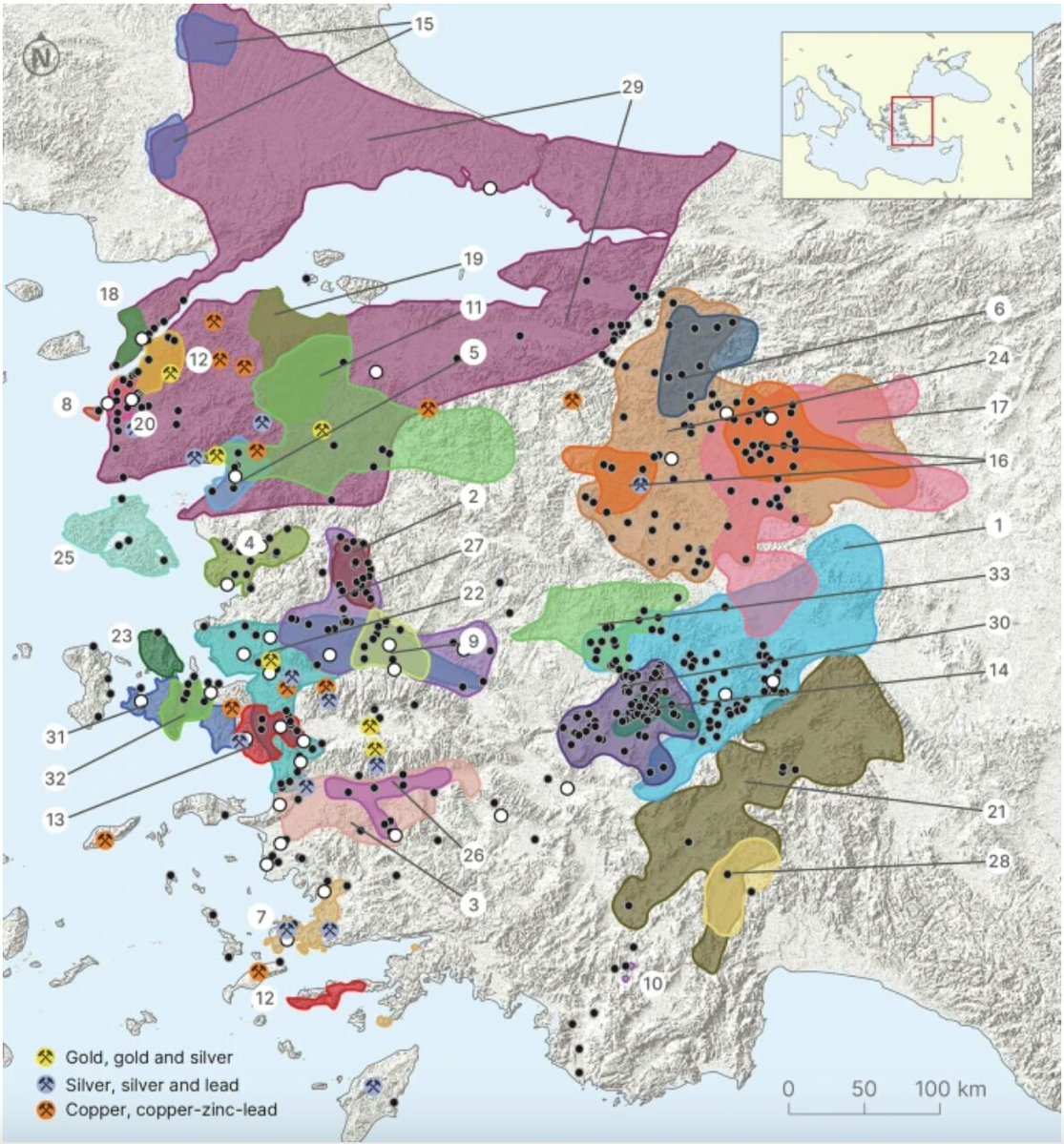
Geospatial data science and archeology - in particular, Bronze Age archaeology with a georeferenced catalogue of 483 Middle and Late Bronze Age settlements across western Anatolia. Compiled from excavation reports, surveys, historical sources, and remote sensing, the dataset standardizes metadata, links entries to external knowledge bases, and is openly published in machine-readable formats
More: https://t.co/zBbykFUXss
𝐓𝐡𝐞 𝐍𝐞𝐰 𝐒𝐜𝐢𝐞𝐧𝐜𝐞 𝐨𝐟 𝐌𝐚𝐩𝐬 - https://t.co/qRwV1ryEG1
In Mexico City and Rio, the longest commutes belong to informal workers, while in Los Angeles they belong to formally employed suburbanites.
That gap gets lost in how cities usually measure access to work. Planners count the jobs within 30 minutes or 10 km of a neighbourhood, and the standard commuting models assume bigger places pull in more workers while distance weakens the pull. They treat a warehouse job and a job in a dense business district as interchangeable, and say nothing about why people pick one over the other.
Researcher built WorkReach, which adds a couple of things. The first is how sophisticated a neighbourhood's economy is (this is essentially judged by how many different industries cluster there) and how specialised they are (i.e. 'economic complexity'). The second is how much of the workforce where people live works informally, without contracts, social security or health cover.
They tested it on four cities of similar population: the San Francisco Bay Area, Los Angeles, Mexico City and Rio de Janeiro, covering more than 5 million commutes. In the two Latin American cities they worked out home and work locations from six months of anonymised phone location data. For the US cities they used Replica's simulated weekday commuting.
The geography of opportunity differs quite a bit between the two pairs. In Mexico City and Rio, neighbourhoods full of informal workers sit far from the complex job hubs, and the longest commutes belong to people from those neighbourhoods heading into the centre. In the Bay Area and Los Angeles, the longest commutes belong to formally employed suburbanites driving to the same kind of hub, while informal workers live spread across the city.
The model also learns how far people go before job quality starts to count. In Mexico City, choices within roughly 16 km are driven almost entirely by proximity, and in Rio that zone stretches to about 25 km. In the US cities job quality kicks in almost immediately, which fits places built around highways and suburban houses far from offices. Distance still dominates: a Mexico City workplace 1% further away is about 3.7% less likely to be chosen.
WorkReach predicts commuting flows about as accurately as the established models, and every number it produces reads as a trade-off people are making.
link to full article: https://t.co/jMX9XCz807
«¿Por qué los libros escritos con IA están ganando concursos? Hay que recordar lo que decía Von Trier sobre los certámenes artísticos: las obras arriesgadas, fuertes, no suelen ganar porque dividen al jurado; sólo las obras tibias, bien portadas, correctas, generan el consenso»
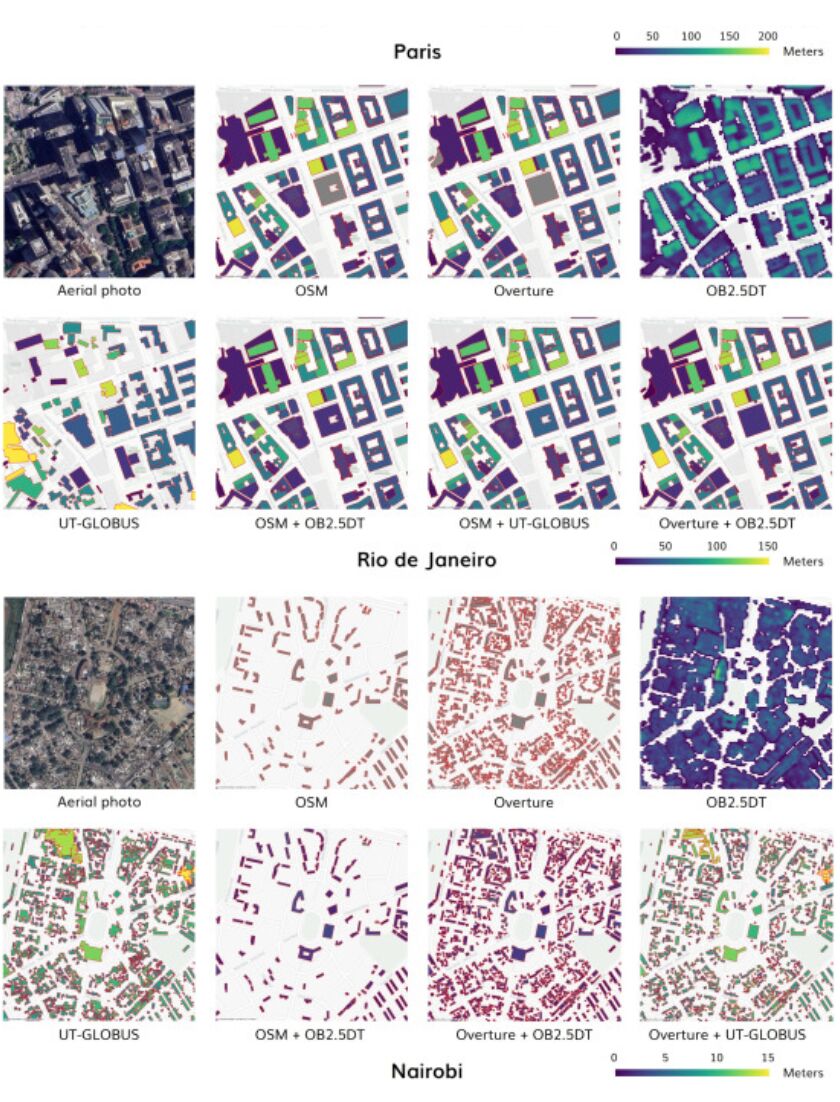
A paper I found genuinely useful: a piece from the NUS Urban Analytics Lab on 3D urban simulation by introducing an awesome voxel-based framework for generating semantic city models from open geospatial data. Using global datasets on building height, canopy height, land cover, and terrain, VoxCity automates data integration, voxelization, and more - in a py package:
Link: https://t.co/GeRbtksUw1
More: https://t.co/QmvRGpspRk
𝐓𝐡𝐞 𝐍𝐞𝐰 𝐒𝐜𝐢𝐞𝐧𝐜𝐞 𝐨𝐟 𝐌𝐚𝐩𝐬 - https://t.co/qRwV1ryEG1
Love #data?
Love when it looks beautiful?
Marthe Viallet nailed it one more time! ❤️
Check the data art exhibition she organised for the ENSAI.
It's open for 2 more weeks in Rennes, France.
Follow her for more details on it.
Soon to be added in https://t.co/FxaHnI2rc9
Reviewed 40+ #dataviz projects for the Pacific Dataviz Challenge. Top caveats:
💀 Claude default look
📚 40 charts, no story
➖ Useless buttons
🥸 Text nobody reads
😮 Wrong chart type
🐣 Long lines
📽️ Endless animations
📍 Legends, not labels
Details 👇
https://t.co/xkb1lBfWHr
Did human mobility ever actually follow a universal power law?
A long-standing assumption in network physics is that human travel mirrors scale-free Lévy flights. Our new paper suggests this "universal law" is largely an aggregation artifact.
https://t.co/JRFxcNOeqD
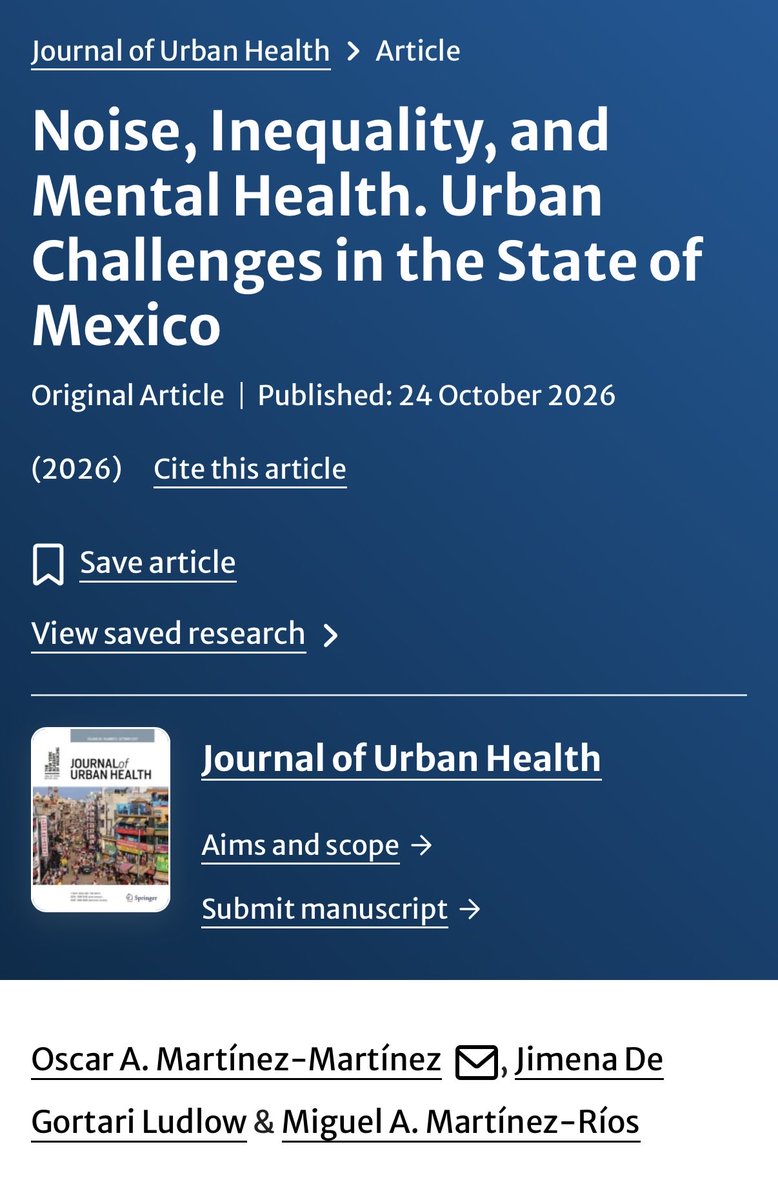
¡Finalmente se publicó nuestro artículo sobre #ruido percibido y salud mental en el Estado de México!
Con @oamartinez2@IBERO_mx
Les invito a leerlo: https://t.co/60dUMeU1mD
The complexity theory result is actually huge.
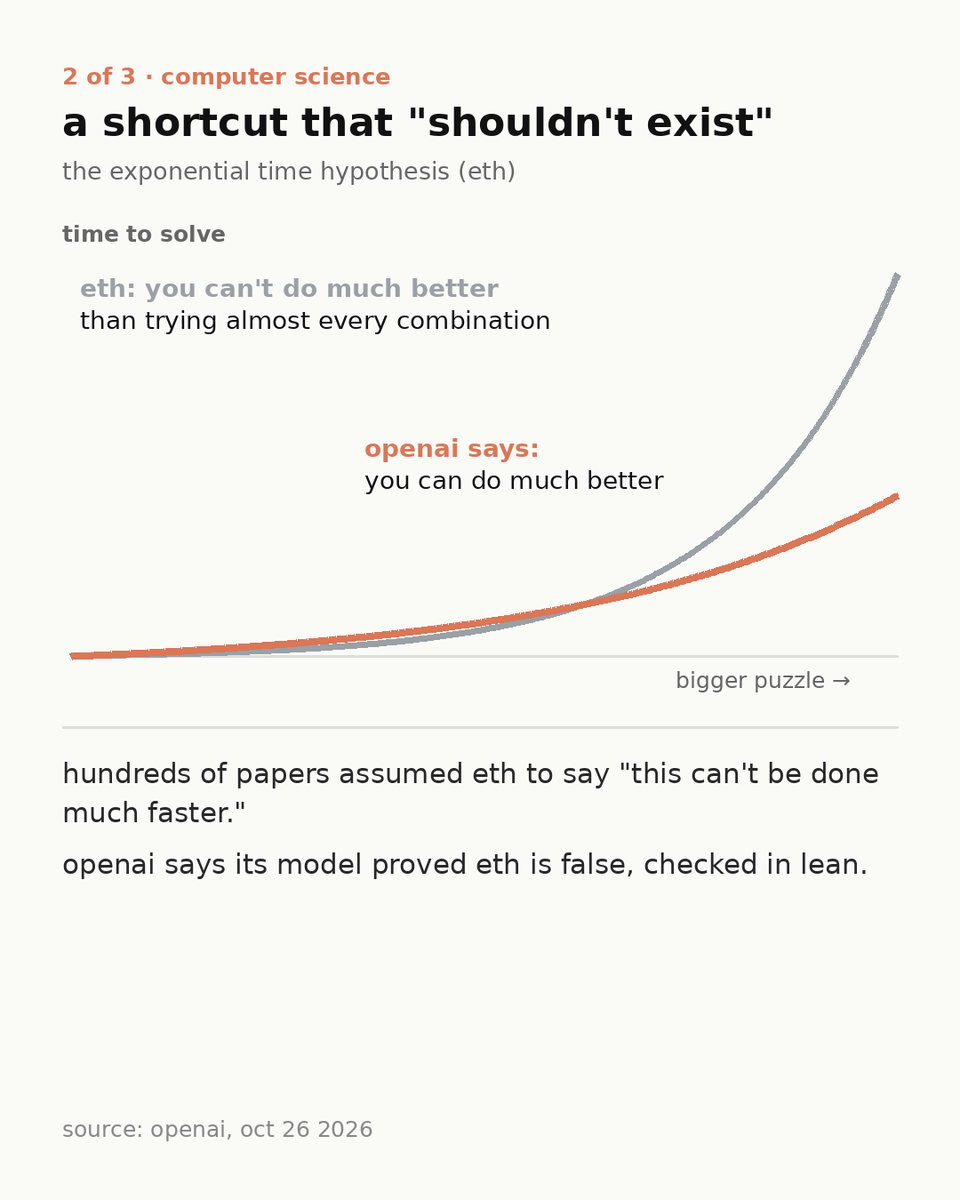
P problems can be solved in polynomial time. It was widely believed that NP-complete problems require exponential time.
P = NP states that NP-complete problems can be solved in polynomial time. OpenAI didn't prove that. But, they proved that (some) NP-complete problems can be solved faster than exponential time, meaning:
- P = NP, or
- the complexity of NP problems is a "middle thing" between polynomial and exponential, eg. O(n^log n)
If it survives peer reviews, this could be one of the biggest CS breakthroughs in decades.
openai says its ai just solved three famous open problems at once: one in math, one in computer science and one in physics.
the math one has been open since 1991. the computer science one is an assumption hundreds of papers were built on, and openai says it's wrong. the physics one touches a millennium prize problem. outside experts are now checking all three, so none of it is settled until they're done.
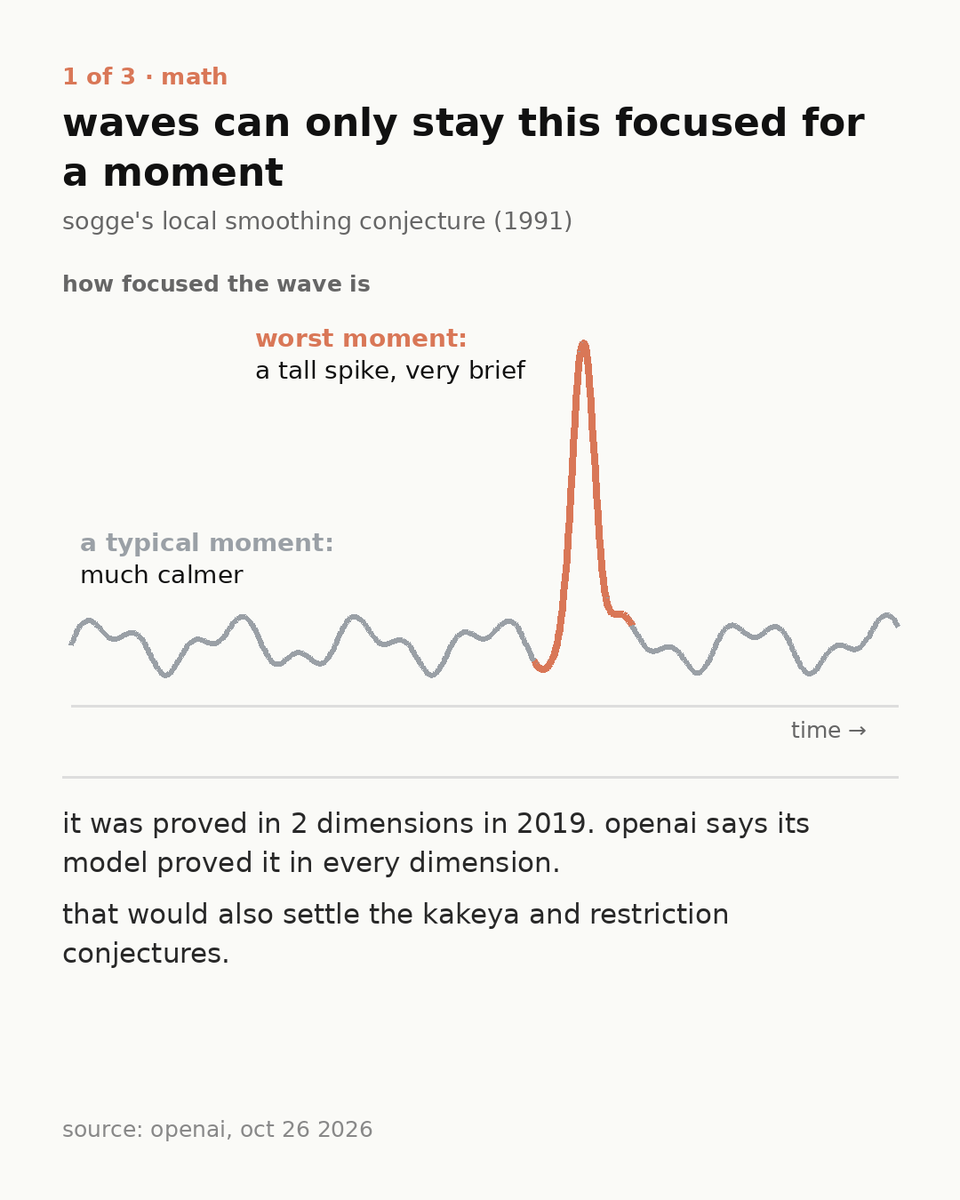
1. math: waves can't stay focused for long
picture ripples in a pond all rushing toward one spot. for a split second they pile up into a tall spike, then spread out again. in 1991 a mathematician named sogge guessed that this extreme focusing is always brief, and that at a random moment a wave is much calmer than at its worst.
it was proved in 2 dimensions in 2019. openai says its model proved it in every dimension, which also settles two other famous problems, the kakeya and restriction conjectures. the next day it was checked in lean, a program that only accepts a proof if every single step is correct.
2. computer science: a shortcut that "shouldn't exist"
some puzzles seem to force you to try nearly every combination, like a lock where the only way in is testing code after code. the exponential time hypothesis (eth) is the widely believed idea that for puzzles like this there's no big shortcut.
hundreds of papers in graph theory, biology, databases and more lean on it to say "this can't be done much faster." openai says its model proved eth is false, also checked in lean. that reopens how much faster a lot of those tasks could get.
the researchers who first proposed eth, impagliazzo and paturi, are leading the group checking it, with ryan williams. the proof is public for anyone to look at.
3. physics: putting the strong force on solid math
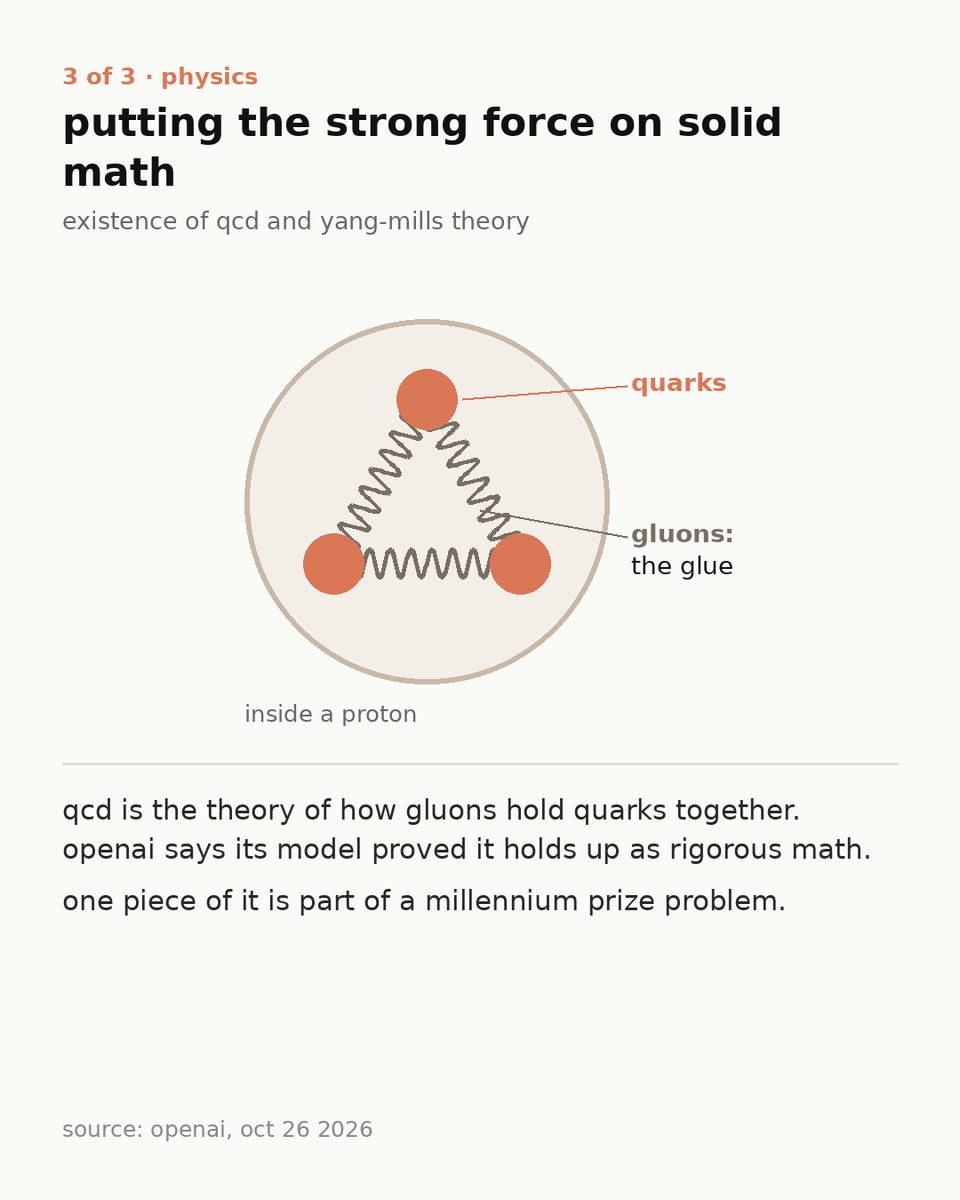
the strong force is what holds tiny particles called quarks together inside every atom, using carrier particles called gluons as the glue. physicists describe it with a theory called qcd and use it constantly, but nobody had proved it holds up as rigorous math.
openai says its model proved it does, and did the same for a unified version of the standard model, physics' main theory of particles. one piece of the work, proving that yang-mills theory exists, is part of one of the clay institute's millennium prize problems.
the physics group is led by david gross, who shared a nobel prize for work that helped establish qcd. they're holding the ai's work for now and writing it up themselves.
openai says it wants no academic credit for any of this. the experts checking it are unpaid, signed no ndas, and are free to publish whatever they find.
¿Por qué debe recaer la carga de prueba en los acusados y no en el acusador, @el_pais? Si ustedes publicaron la acusación, era su labor sustentar o desmentir lo que señaló Pangram además de explicar si pidieron permiso al autor y la editorial para pasar la obra por el detector.
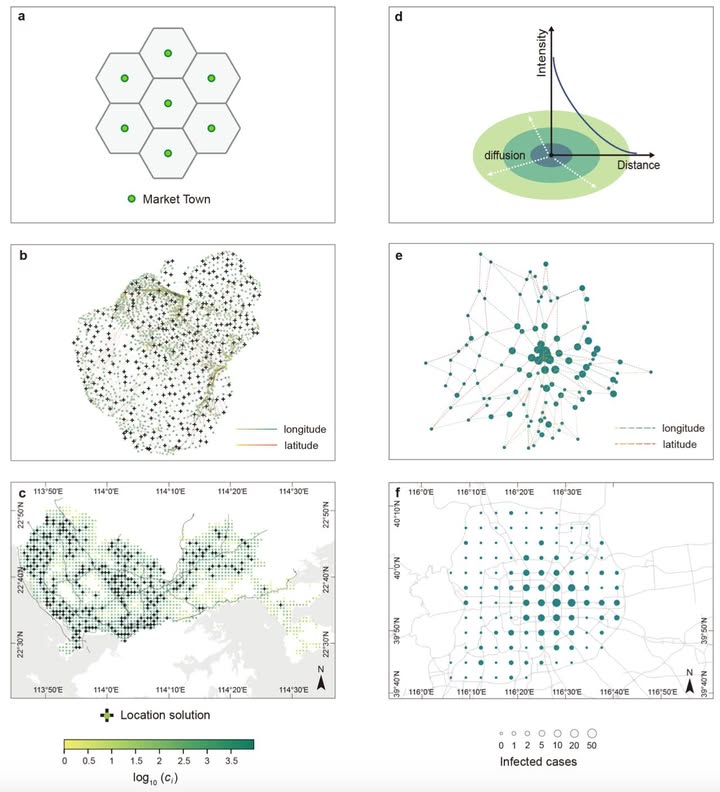
This one is about the theory behind urban mobility. Our mobility patterns are full of hotspots, in this paper called localities. These are clusters of places where people’s movement patterns are tightly connected, such as home and work centers. However, these hotspots are usually not directly defined by admin boundaries, but are quite detectable by various algorithmic methods.
This piece proposes a new one, combining topology and network science to detect these hotspot areas from mobility data.
More: https://t.co/mjTg7txO7T
#365Papers #Day304
—--------------------------------------------------------
𝐓𝐡𝐞 𝐍𝐞𝐰 𝐒𝐜𝐢𝐞𝐧𝐜𝐞 𝐨𝐟 𝐌𝐚𝐩𝐬 - https://t.co/qRwV1ryEG1
Today’s pick is about coastal and hydrographic mapping, introducing a new approach to bathymetric monitoring - mapping underwater topography. The paper relies on a very impressive methodological stack includng Single- and Multibeam Echo Sounders, LiDAR (airborne and mobile), and UAV photogrammetry.
Ten, the paper presents a novel weighted average data fusion method combining each sensor’s measurements to build a high-precision coastal model. If you are interested in coastal modeling or combining multi-layered geospatial sensor data, check this out!
More: https://t.co/rY4Qg3Hxs1
#365Papers #Day300
—--------------------------------------------------------
🌍 𝐋𝐞𝐚𝐫𝐧 𝐠𝐞𝐨𝐬𝐩𝐚𝐭𝐢𝐚𝐥 𝐝𝐚𝐭𝐚 𝐬𝐜𝐢𝐞𝐧𝐜𝐞 𝐰𝐢𝐭𝐡 𝐦𝐞: https://t.co/wmFld7BGBC
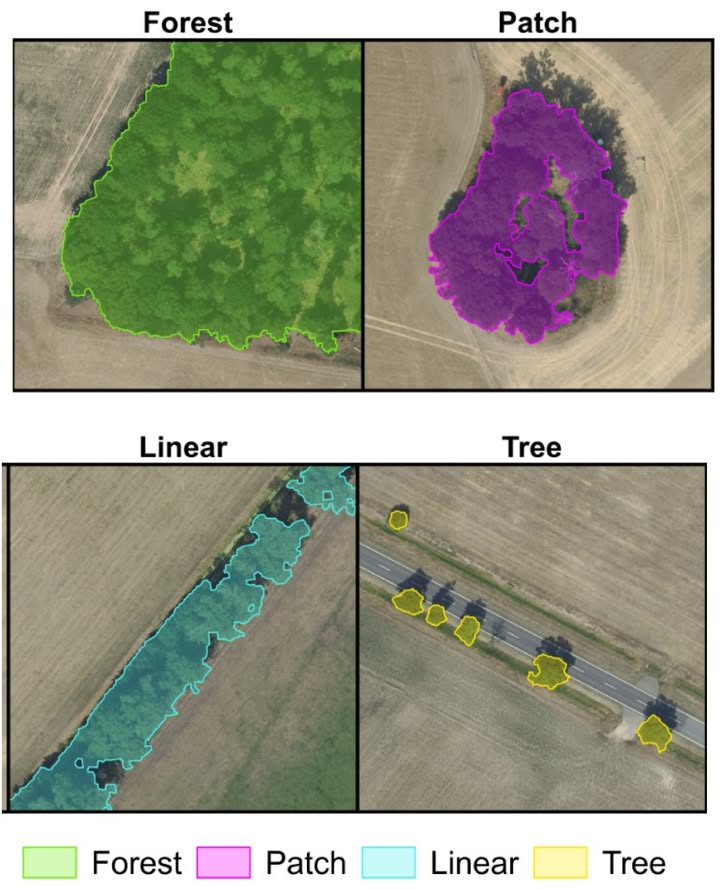
This preprint shows how deep learning and high-res aerial imagery can accurately map trees outside forests - those scattered across fields, hedgerows, and groves that are often overlooked in environmental monitoring, or sometimes even considered as data artufacts. Check out how this vision transformer-based model works:
More: https://t.co/q4zvA7ELbF
#365Papers #Day316
—--------------------------------------------------------
🌍 𝐒𝐞𝐞 𝐡𝐨𝐰 𝐈 𝐭𝐞𝐚𝐜𝐡 𝐠𝐞𝐨𝐬𝐩𝐚𝐭𝐢𝐚𝐥 𝐝𝐚𝐭𝐚 𝐬𝐜𝐢𝐞𝐧𝐜𝐞: https://t.co/wmFld7BGBC