@svembu@svembu , A friend at Google X — deep battery expertise — is eyeing retirement and wants to spend it building next-gen batteries for India 🇮🇳
If you're working on energy storage in India and want to connect, please DM me.
Jai Somnath!
2026 marks 1000 years since the first attack on Somnath took place. Despite repeated attacks subsequently, Somnath stands tall! This is because Somnath’s story is about the unbreakable courage of countless children of Bharat Mata who protected our culture and civilisation.
Here is my OpEd on this issue.
#SomnathSwabhimanParv
https://t.co/R03Yu1iaYD
@DrAmberRez @KLcj22@ALANAKRGHATAK@THEEURASIATIMES Remind us again which city in Pakistan was World’s most wanted terrorist Osama Bin Laden was killed in and by which country that flew deep inside your country’s airspace?
Right…now go back to whatever hole you came out of.
@PhysInHistory From simple English perspective...the sentence:
"Now I am become Death, the destroyer of worlds."
Does not even make sense unless Death is a noun. It is like saying Death causes destruction.
The noun in the original verse is Time: The cause of death and destruction.
@PhysInHistory This is such an incorrect interpretation of Gita: the verse 32 is referred is in Chap 11.
[https://t.co/ldYtnTeFWM]
The correct interpretation of word Kala = Time.
The hence: I am mighty Time, the source of destruction that comes forth to annihilate the worlds.
Genuine question about image generation:
If someone uses a generative AI tool to produce an image that is substantially similar to a copyrighted piece (a drawing, painting, movie screenshot, etc), who should be liable for copyright infringement?
Should it be:
A. the company producing the tool?
B. the (human) creator of the piece?
C. the person or entity posting/publishing the piece?
D. the communication platform through which the piece is distributed?
1. Copyright law protects against unauthorized exact or near-exact copies of a painting, photo, movie, or other visual piece.
2. When a person distributes a sufficiently similar copy of an art piece, it's a violation of copyright regardless of the tools and process used to produce it.
3. The liable person is the person *distributing* the piece, not the artist, and not makers of the tools.
4. Image generation systems are trained to generate images that are on the "manifold" of nice-looking images. Obviously, the training images are on this manifold.
5. Hence, sufficiently detailed prompt will produce images that are substantially similar to images from the training set. It is not at all surprising that a prompt like "The Batman movie, rooftop scene, screenshot, 4k..." will produce an image very similar to an actual screenshot from the movie.
6. Whether using publicly available-yet-copyrighted screenshots and other materials as part of the training set constitutes a violation of copyright is a separate question. As far as I can tell, this question is not legally settled in the US.
@lopp@Bitcoin Is there an estimate of what is the "capital" or "$" needed in present day dollars to recreate 100% hashrate? This would be good measure as well of the challenge.
I suspect this to be in 100s of billion dollars...
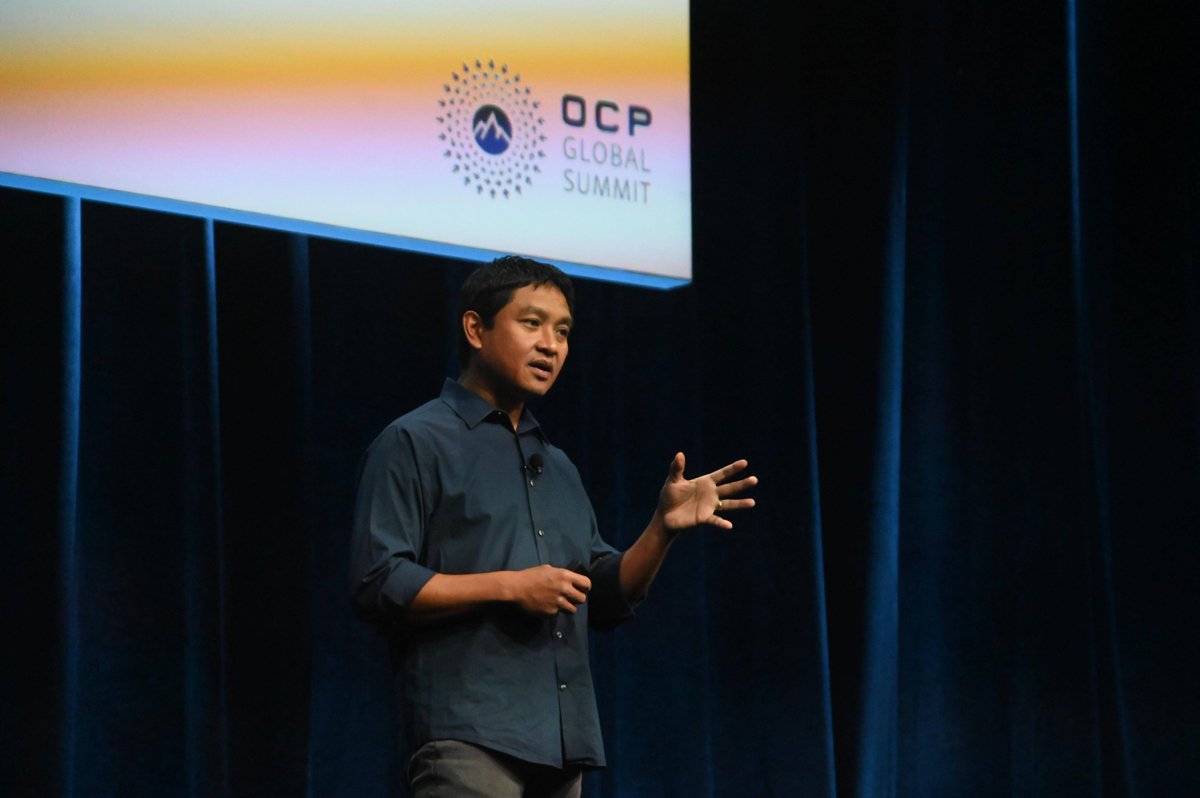
💻@Meta’s Director of Engineering, Omar Baldonado, spoke on stage today at the 2021 OCP Global Summit, sharing the incredible work our Meta Infrastructure teams have done over the past 10 years through the Open Compute Project. Learn more about our work: https://t.co/SOEuUTh8Kl
@NGKabra Now they should start selling customized zoom backgrounds to increase whatever parameter individual wants to emphasize and the business model is complete!
@RationalEtienne@Frisson14127073@elonmusk@benmezrich#bitcoin mining is ruthless in its economic. Unless you have access to cheap, renewable energy you cannot make money mining.
#bitcoin mining is always automatically allocated to areas were energy is abundant but not transferable.