@awealthofcs 7/ even rolling 20 year periods
( And it would be far easier to justify allocating to international stocks if they could demonstrate even a single 20‑year stretch of clear outperformance ! )
What a remarkable outcome: the world's largest ever oil supply disruption failed to create a major energy crisis.
The IEA said 2026 shock was worst than 1973, 1979 and 2022 together. And yet, the cost of oil, natural gas, electricity and coal never surpassed the previous peaks.
There’s a scene in Breaking Bad where Walter White’s wife realizes he’s made $7.5 million and says:
“There’s no way we can wash this money through a car wash. No car wash in the world makes that kind of money in a year.”
That line hit me. Because it exposes a truth most people ignore: How much you earn is capped by the kind of business you run.
You can work harder, stay longer, even get smarter - but you’ll never make more than what your business model is designed to carry.
If you have followed oil long enough, you know never to trust the Barrel Counter Bros.
The Barrel Counters always seem in command of the minutiae, well-informed, & convincing. Yet somehow, they always miss some key fact, and end up torching the people who listen to them.
Q1 earnings season is just about done, and this Q has been great for software. Looking at the YoY growth in quarterly net new ARR added, this was the best quarter (by a long shot) in last ~5 years
Yardeni Research Chart of the Day (June 8, 2026)
S&P 500 Materials ranks fifth in ytd performance at 9.9%, but its 2026 earnings story may be underappreciated — a 39.7% EPS growth forecast puts it third among all sectors. Are investors paying enough attention?
Fascinating chart from CBA showing how long the median home remains for sale on market by capital city.
The rise one would expect in Sydney and Melbourne, but Brisbane and Perth rocketing like demand just fell off a cliff vs the previous hot markets.
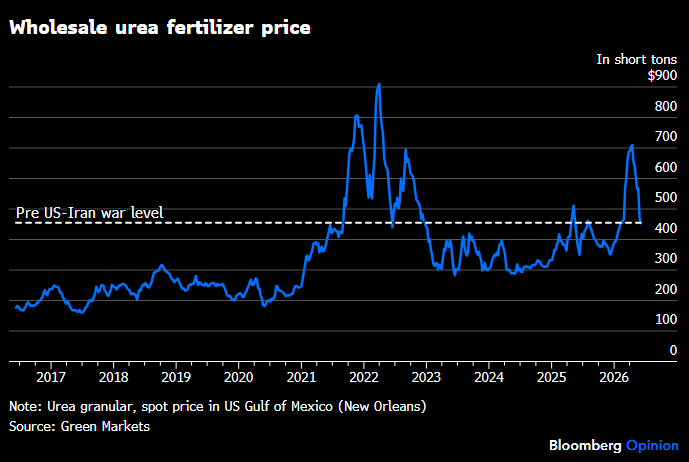
CHART OF THE DAY: The cost of the most important nitrogen fertilizer is back to pre-war levels in the US, benefiting from ample natural gas supply in America. Urea prices are sharply down too in Europe and Latin America, but remain elevated in most of Asia.
Here is my take, which is consistent with the Goehring & Rozencwajg letter in the repost?
----
Every crisis—1997, 2008, 2020—starts with the same institutional script: treating a structural problem as a temporary liquidity glitch. Wall Street is hardwired to assume that everything will safely revert to a mean, fearing the phrase "this time is different." It takes months of frustration to realize the rules of the game have changed.
Today, I fear we are repeating this exact behavioral trap.
Believing the closure of the Strait of Hormuz is a brief, 60-day hurdle, governments and oil companies are aggressively draining inventories to bridge the gap. They are treating a potential permanent, structural deficit in the world’s crude supply as a short-term liquidity problem.
Burning the lifeboats to build a temporary bridge only works if a resolution is guaranteed. By artificially delaying gradual demand destruction today, we ensure it hits all at once tomorrow should inventories slam into operational minimums.
Why is the market so blind to this? Because over the last five years, macro investors have developed deep scar tissue from listening to "experts":
* Q2 2020: Virologists scared investors into selling at the pandemic market bottom.
* April 2020: Commodity bears screamed that oil was irrelevant right as it hit its historic generational low.
* H2 2022: Economists panicked investors into dumping equities at the peak of 9% inflation.
* Q2 2023: Banking analysts screamed sell at the market bottom following Silicon Valley Bank's failure.
* April 2025, Policy Analysts scared investors about tariffs and Liberation Day to sell the low of the year.
The market learned that when the experts scream trouble, buying the dip makes money, and hedging for disaster loses it.
But ignoring the energy sector today, investors might be confusing past false alarms with a looming physical reality ... tanks really are running dry, and prospects for the Strait to "normalize" are nonexistent.
And again, and again, and again, the market proves to be more flexible and adaptable than the engineers, extrapolating, with their calculators expect. When prices change, behaviour changes. Believe in substitution, in elasticity, in human ingenuity, that is, in the market, and you will get a closer approximation than all doom-mongers. For this of course, a market must exist (e.g., does not apply to the fertility collapse).
- Bet on Strait of Hormuz closure, a black swan event they said could never happen because it would be so damaging to the global economy
- Be correct
- Make no money
- Markets have sharpest rally in financial history