It’s been another tough few weeks of layoffs in the tech industry and we’re wishing everyone impacted success navigating the unexpected transition.
If you’re looking for a new engineering opportunity, we're hiring. To learn more, please reach out to [email protected]
Anti Gravity. Flow. Spark. Gemini. Omni. Flow. Jules. Halo.
So many fancy brand names launched by Google Marketing team. This makes me think they’re thinking more about the branding than the actual products.
The vibes in SF feel pretty frenetic right now. The divide in outcomes is the worst I've ever seen.
Over the last 5yrs, a group of ~10k people - employees at Anthropic, OpenAI, xAI, Nvidia, Meta TBD, founders - have hit retirement wealth of well above $20M (back of the envelope AI estimation).
Everyone outside that group feels like they can work their well-paying (but <$500k) job for their whole life and never get there.
Worse yet, layoffs are in full swing. Many software engineers feel like their life's skill is no longer useful. The day to day role of most jobs has changed overnight with AI.
As a result,
1. The corporate ladder looks like the wrong building to climb.
Everyone's trying to align with a new set of career "paths": should I be a founder? Is it too late to join Anthropic / OpenAI? should I get into AI? what company stock will 10x next? People are demanding higher salaries and switching jobs more and more.
2. There’s a deep malaise about work (and its future).
Why even work at all for “peanuts”? Will my job even exist in a few years? Many feel helpless. You hear the “permanent underclass” conversation a lot, esp from young people. It's hard to focus on doing good work when you think "man, if I joined Anthropic 2yrs ago, I could retire"
3. The mid to late middle managers feel paralyzed.
Many have families and don't feel like they have the energy or network to just "start a company". They don't particularly have any AI skills. They see the writing on the wall: middle management is being hollowed out in many companies.
4. The rich aren’t particularly happy either.
No one is shedding tears for them (and rightfully so). But those who have "made it" experience a profound lack of purpose too. Some have gone from <$150k to >$50M in a few years with no ramp. It flips your life plans upside down. For some, comparison is the thief of joy. For some, they escape to NYC to "live life". For others still, they start companies "just cuz", often to win status points. They never imagined that by age 30, they'd be set. I once asked a post-economic founder friend why they didn't just sell the co and they said "and do what? right now, everyone wants to talk to me. if i sell, I will only have money."
I understand that many reading this scoff at the champagne problems of the valley. Society is warped in this tech bubble. What is often well-off anywhere else in the world is bang average here.
Unlike many other places, tenure, intelligence and hard work can be loosely correlated with outcomes in the Bay. Living through a societally transformative gold rush in that environment can be paralyzing. "Am I in the right place? Should I move? Is there time still left? Am I gonna make it?" It psychologically torments many who have moved here in search of "success".
Ironically, a frequent side effect of this torment is to spin up the very products making everyone rich in hopes that you too can vibecode your path to economic enlightenment.
Scoop! Wispr, the startup behind popular AI dictation tool Wispr Flow, is fundraising at a ~$2 billion valuation.
Menlo Ventures is set to lead the round, sources tell us, which will be ~$260 million.
w/ @nmasc: https://t.co/23IV045XEq
Brian didn't say the quite part loud. YC itself pushes founders to go B2B. YC has much better playbook developed for B2B and B2C. They also know that chance of building unicorns is much higher in B2B vs B2C.
Brian sits on the board of Y Combinator. He said the last batch had 175 companies and only 16 of them weren't enterprise.
"Here are the reasons I think it's happening. Number one, when ChatGPT came out, people were afraid it was going to kill their business.
Number two, the business model is tricky. There is no consumer business model for AI that I've seen.
For example, ChatGPT, there's three ways it can monetize subscriptions. Unfortunately, they're probably going to hit a local maximum percentage of users.
Ads, they're hitting a local maximum because Claude and Gemini are not going to do ads.
And e-commerce, they shut down the third party apps.
And so the first thing is you need to have a business model around consumer AI. People are not trained to pay for information.
The second problem is distribution is mature. Like the app store. Now again, top three apps in the app Store are AI, so it does prove you have something revolutionary, you'll find your way to the top.
The third thing is, while I think Silicon Valley, we like to describe ourselves as rebels. I think it's very trend based and vibe based. And I think the trend is enterprise.
Maybe finally the reason people aren't doing consumer companies is that they're just harder. You have to be good at a lot more things. You generally have to be better at design, marketing, culture, press. It's not purely technology and sales.
But my prediction is that we're living in the age of enterprise AI, and I think in the next 12 to 24 months you're gonna see the beginning of a consumer AI renaissance.
Almost every app on my home screen has not changed since AI, including Airbnb. I think that's gonna change in two years."
DocuSign Personal: $10 to $15 per month.
DocuSign Standard: $25 to $45 per user per month.
DocuSign Business Pro: $40 to $65 per user per month.
A 10-person team on Business Pro pays $4,800 to $7,800 a year. To put signatures on PDFs.
A team of 50 pays $24,000 to $39,000 a year.
And there is a 100-envelopes-per-year cap on most plans. Send more contracts and you pay extra.
Need SMS delivery? $0.40 per send.
Need ID verification? $2.50 per attempt.
Need premium support? $5,000 to $50,000 per year add-on.
You are rationing digital signatures in 2026.
DocuSign is a $10 billion company built entirely on this pricing model.
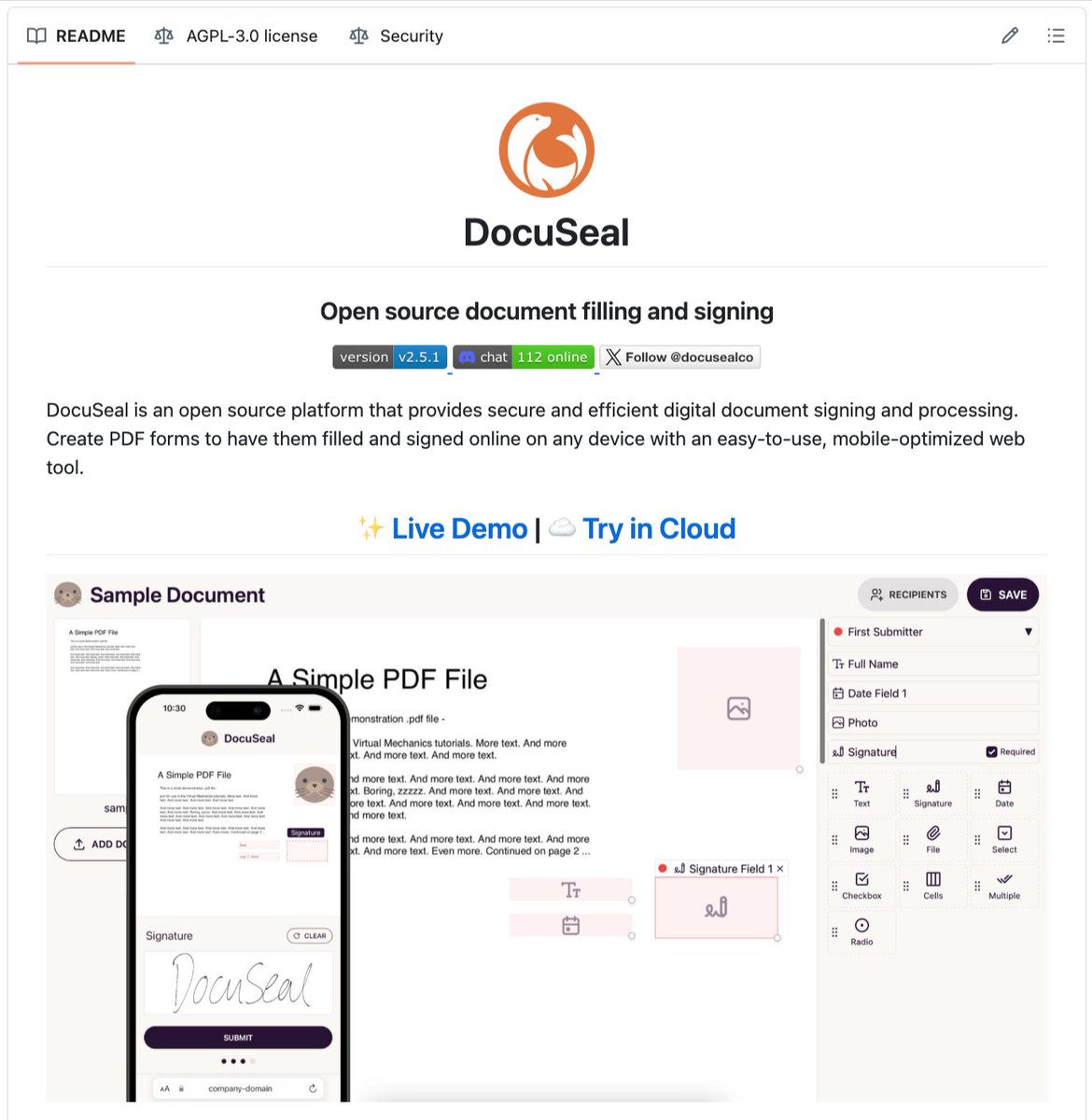
Now meet DocuSeal.
A free and open source alternative to DocuSign.
Created in 2023 by a Ruby developer named Alex who was simply trying to sign one document and realised every solution online was overpriced or required a subscription.
Three weeks later he had a working alternative. He pushed it to GitHub under the AGPL-3.0 license.
Today it has 11,800+ stars and over 1,000 forks. Bootstrapped. No VCs. No paywalls.
Here is what DocuSeal does:
- Upload any PDF and turn it into a fillable, signable form
- Drag and drop signature fields, dates, checkboxes, file uploads, and 13 field types
- Send to multiple signers with custom signing order
- Automated email reminders
- Mobile signing on any device
- PDF signature verification built in
- Audit trail for every document
- Bulk send and templates
- Full API access
- Self-host with one Docker command
Here is what DocuSeal costs:
Zero. Forever. Unlimited documents. Unlimited signers. Unlimited storage.
DocuSign limits envelopes. DocuSeal doesn't.
DocuSign charges per SMS. DocuSeal doesn't.
DocuSign charges for ID checks. DocuSeal doesn't.
DocuSign sees your contracts on their servers. DocuSeal doesn't.
Here is the wildest part:
The median DocuSign contract per Vendr is $17,250 per year. One Reddit thread has people saying "they want me to pay $4.80 per e-signature."
Self-host DocuSeal on a $5 cloud server and a 50-person team can sign as many contracts as they want without paying a single dollar.
Your contracts never leave your server. Your client lists. Your NDAs. Your employment agreements. None of it touches a third-party company.
For individuals who only sign a few contracts a year, you save $180.
For small teams of 10, you save up to $7,800 a year.
For a 50-person company, you save up to $39,000 a year.
Your documents. Your signatures. Your server.
100% Open Source. (Link in the comments)
Every week someone launches an open-source alternative to @WisprFlow .
Clone the UX. Package it with Whisper. Post the GitHub repo. Collect the stars.
Few weeks later: the README says 'no longer actively maintained.'
That's not the death of SaaS.
That's proof that maintenance is the product.
When you pay for software, you're not buying what it does today. You're buying the team that'll still be updating it eighteen months from now."
I've heard commentators say Musk has nothing to lose from the lawsuit against OpenAI, even if he loses the case, but I don't think that's true. Now every time I see an xAI model release claim to match some other model at some benchmark, I just remember Musk saying at trial that xAI distills OpenAI models. Perhaps there's real technical advances here, or maybe it's all surreptitious distillation. Doubt has been cast.