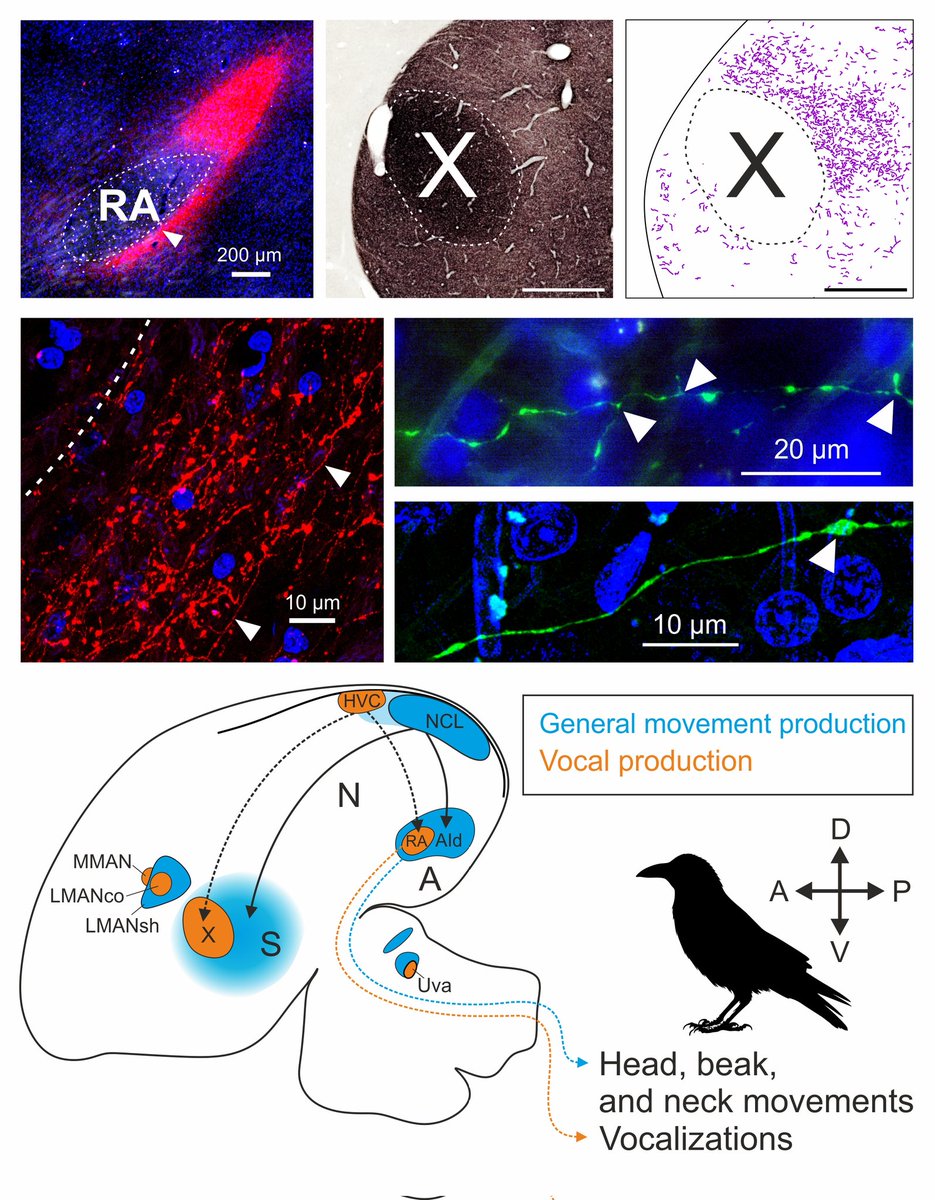
How might the general motor system and the song system interact and contribute to flexible vocal behavior? We discuss this question in our brand-new review with lead author @Birb_brains.
"Bridging the fields of cognition and birdsong with corvids"
https://t.co/5ERhvrqJJt
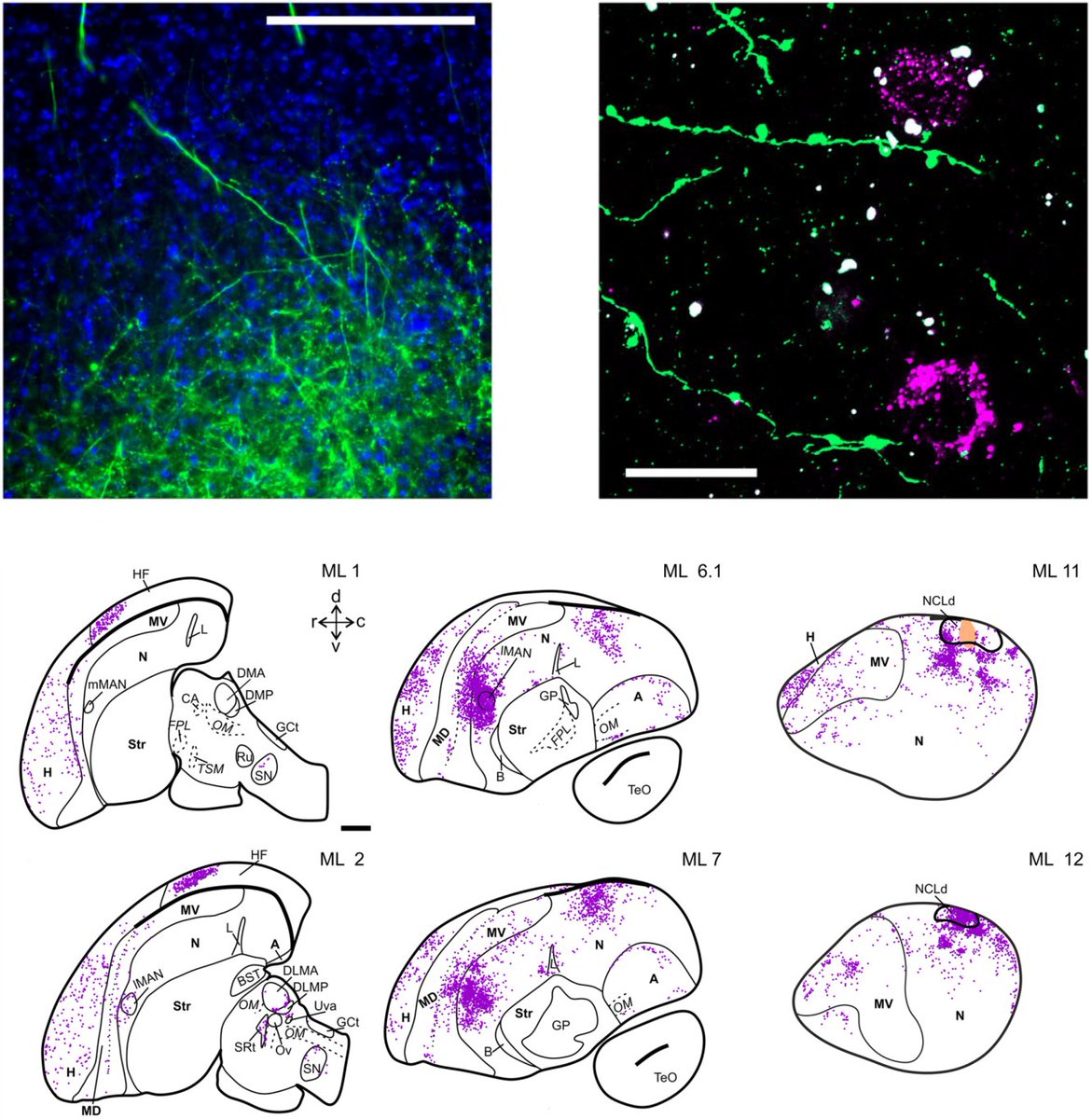
Now published in JCN: "Exploring Anatomical Links Between the Crow's Nidopallium Caudolaterale and Its Song System"
In crows (which are songbirds!), we show that the song system is paralleled by the 'general motor system'.
https://t.co/4AluJ3iRZ7
Check out the heroic PhD work led by Ellie Hozhabri in the Long Lab, uncovering cell-type-specific inhibitory roles in the HVC circuit during courtship song in zebra finches. So grateful to have been part of to this amazing story! 👇🏼
https://t.co/y2vk9XEfxO
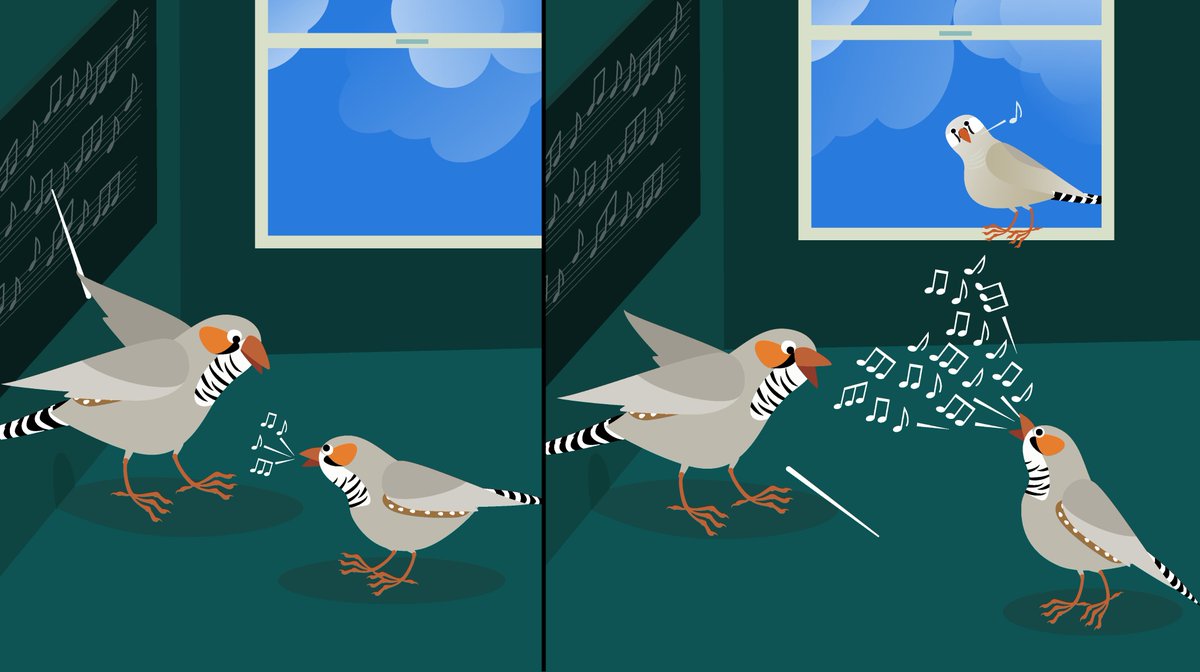
Underestimated females: A new study by @LabVallentin reveals the influence of females on song learning in zebra finches. Vocal feedback from females can activate a neural circuit in the brain of young males while they are learning their song, increasing its accuracy.
Read more: https://t.co/1U5jx8IJpO
Scientific publication: https://t.co/wrGnhJO06u
Art: @mulesome
Excited to see our work on motor thalamus #dbs for upper-limb motor deficits after cerebral lesions published today: #neurotechnology#womeninstem https://t.co/5okmE4GmAT
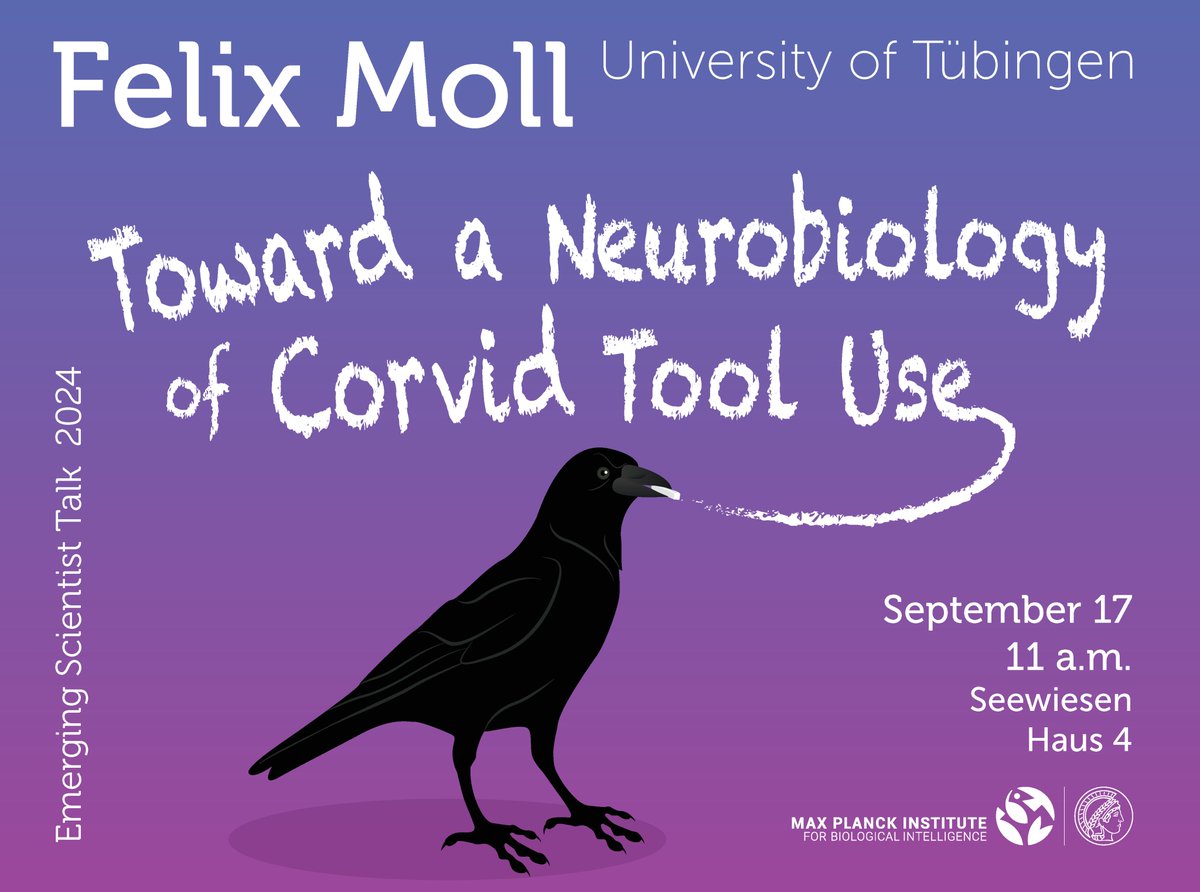
We are thrilled to welcome Felix Moll @MollFW, neuroscientist @uni_tue, at our Institute! Don't miss his talk in our "Emerging Scientist Series" and join us tomorrow at 11 am in house 4 at our Seewiesen location.
Art by @mulesome
Really excited to share the latest preprint from my lab @CSHL. Work done by @IskoEmily, a fantastic graduate student, in collaboration with @TonyZador.
So what is this paper about?
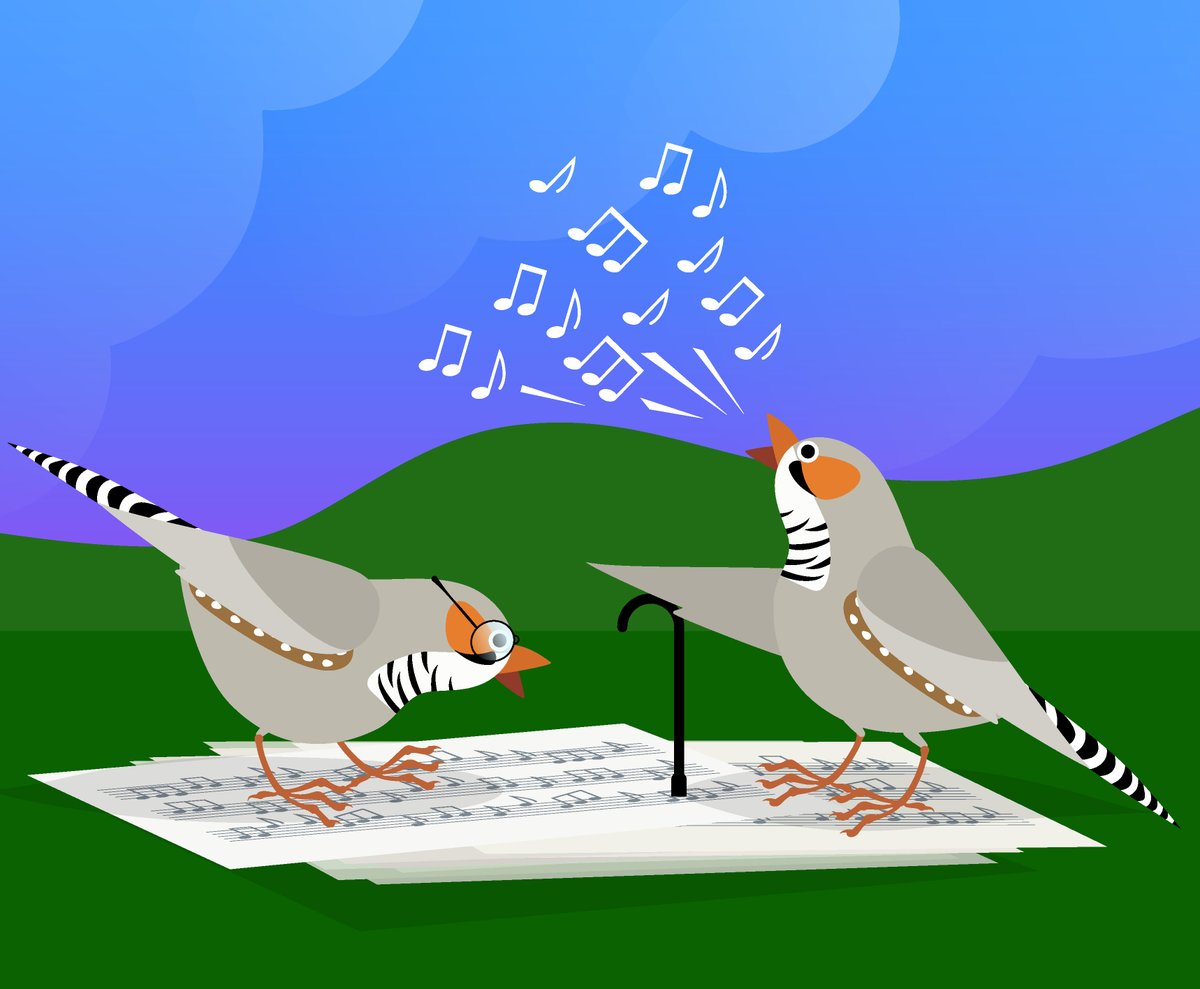
Reactivate lost learning abilities in old age? New study by @LabVallentin shows how adult zebra finches can learn new songs beyond their critical period by manipulating inhibitory neurons!
Find out more: https://t.co/4VOmKqF0dj
Art by @mulesome
New preprint:
The crow's "song system" appears to parallel the avian "general motor system" proposed by Farries (2001)
Check out our unprecedented crow brain histology. Many thanks to co-first author Ylva Kersten!
https://t.co/wNs2ItO13i
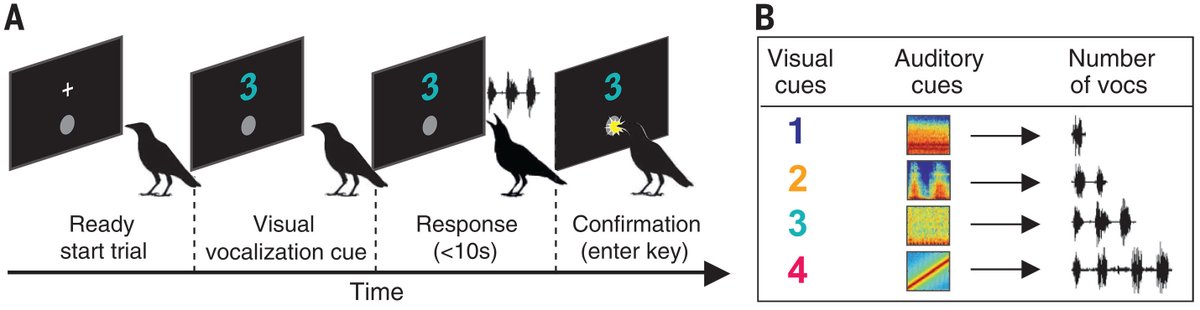
Our paper, Crows ‘count’ the number of self-generated vocalizations, is out! With this amazing team (@KatharinaBrecht, @lena_veit, A_Nieder), we uncovered that crows are able to control the number of vocalizations produced.
https://t.co/b9zpgV3qhC
Crows can control the number of vocalizations they produce, “counting” up to four in response to visual and auditory cues.
The results in Science suggest the birds show a level of vocal control that mirrors the early counting skills of human toddlers. https://t.co/BlMe7jomGy
Out now! Take a deep dive into the connections of the crow brain NCL (the "avian prefrontal cortex"). This research lays an anatomical foundation for my future functional studies of the crow brain.
Many thanks to co-first author Ylva Kersten!
https://t.co/zg85XZdCoN
Glad to see this study finally out in @NatureNeuro
Many thanks to all co-authors Feng Chen, @ShaulDr @mlong11215 @NYULH_Neuro@CSHL
https://t.co/alEtkn1llu
https://t.co/ZuzXglM3bc
I am excited to share my new paper with @KatharinaBrecht and Andreas Nieder in @CurrentBiology titled "Crows flexibly apply statistical inferences based on previous experience."
The zebra finch’s ability to transition between syllables in its courtship songs is driven by the influence of the thalamus region of the brain and a set of neurons in another region of the brain associated with birdsong, according to a paper in @Nature. https://t.co/BnNqfrtdqC
Nice wrap up of our (@mlong11215 , @elmaleh_m, @AriCorredera) recent work on how birdsong syllables can get initiated by thalamic drive in @NatRevNeurosci
https://t.co/Q6ldFRSwiz