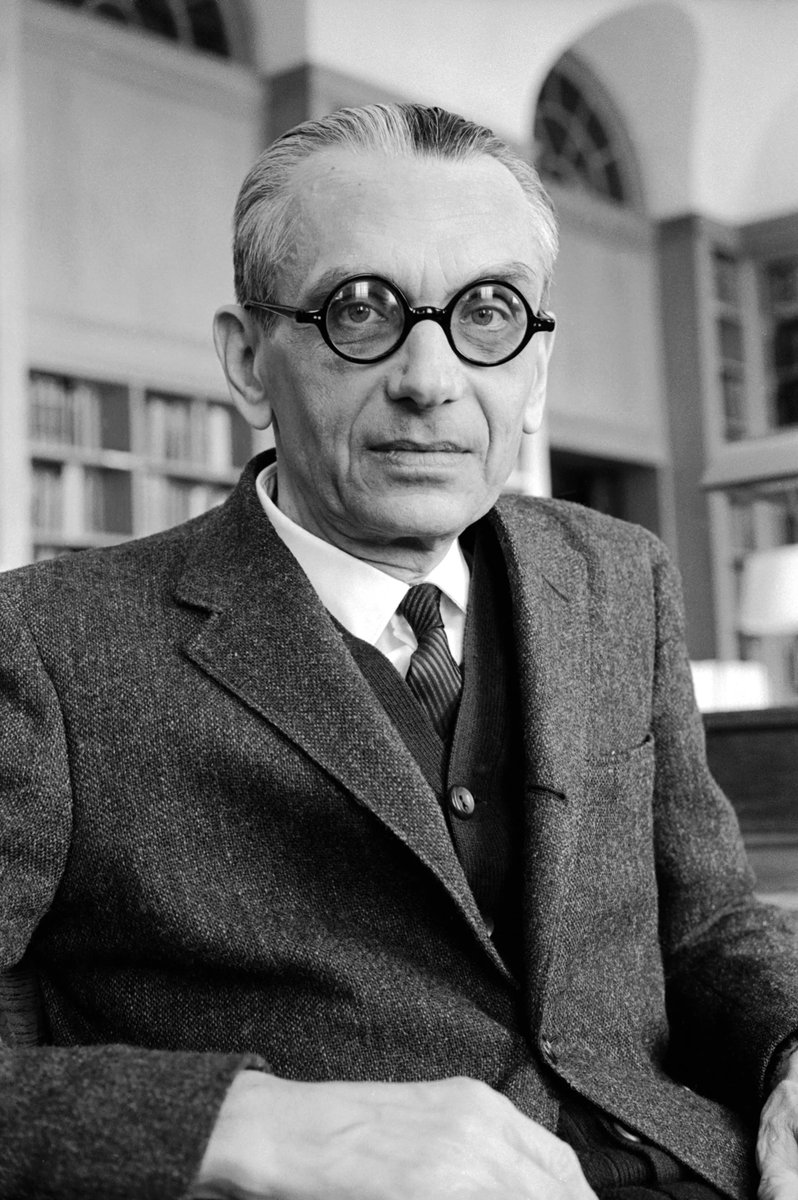
Tara Rezaei (@tararezaeikh), 23, Iranian, is one of the wildest new Silicon Valley talent stories.
IOAA medalist for Iran in 2021.
MIT in 2022.
OpenAI intern.
Now co-founder of @mirendil, a frontier AI company that just raised a $200M seed from @a16z, Kleiner Perkins, and NVIDIA.
All of this in 4 years.
Btw, this story probably wouldn’t have happened if a travel ban had existed in 2022.
Image: Tara on Iran’s IOAA team in 2021.
Really excited to open source a new project: Omnigent, a meta-harness for AI agents.
It lets you build multi-agent coding and custom agents, sitting above Claude Code, Codex, Pi, and agent SDKs to let you compose them. It also adds live collaboration and rich control policies.
Our internal data shows Claude is accelerating AI development—a possible path to recursive self-improvement, or AI autonomously building a more capable successor.
It’s happening faster than we thought, and the implications deserve greater attention. https://t.co/OVVPJO7VQx
Honoured that our 2016 paper, Robust Estimators in High Dimensions without the Computational Intractability, w/ Ilias Diakonikolas, Daniel Kane, Jerry Li, Ankur Moitra, Alistair Stewart, was awarded the 2026 Gödel Prize
This is the highest award for papers in theoretical CS. 1/7
Today, we share a breakthrough on the planar unit distance problem, a famous open question first posed by Paul Erdős in 1946.
For nearly 80 years, mathematicians believed the best possible solutions looked roughly like square grids.
An OpenAI model has now disproved that belief, discovering an entirely new family of constructions that performs better.
This marks the first time AI has autonomously solved a prominent open problem central to a field of mathematics.
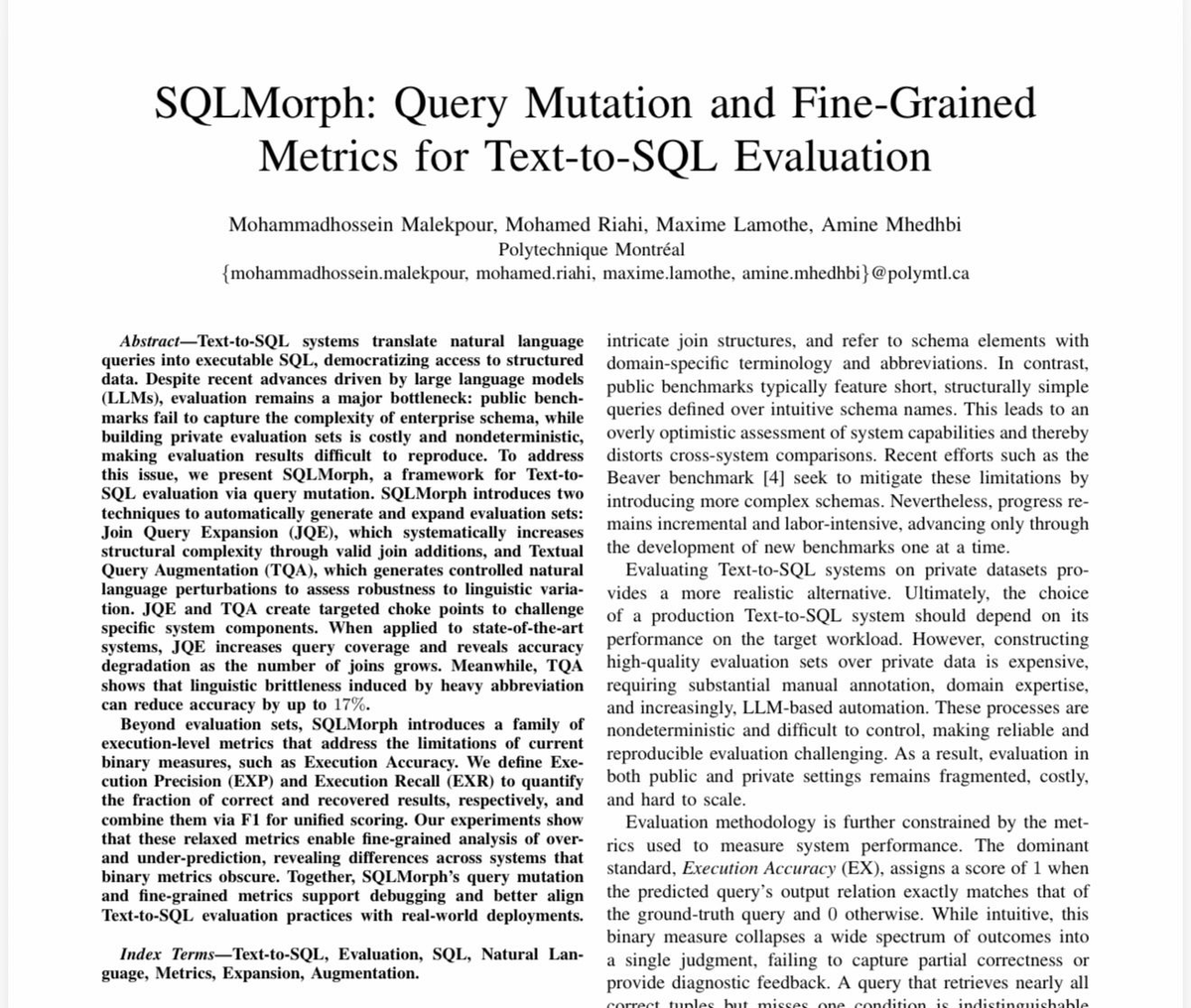
Happy to share that our recent work at @DAIS_PolyMTL, “SQLMorph: Query Mutation and Fine-Grained Metrics for Text-to-SQL Evaluation” has been accepted at @ICDEconf 2026, one of the top venues in data engineering. 🧵👇🏻
If you have access to classified info that promises regime change in the next 3 weeks, good for you. I don’t. I’ll say it clearly. No to war, starting now. The rest is up to the ppl of Iran and they’ll deal with the regime in their own time.
For me, we’ve already reached the point where I have to be anti-war. Targeting steel and pharma industries, serious threats to power plants and oil infrastructure, and talk of pushing the country back to the “stone age” is not sth I can accept, and I’m not afraid to say it.
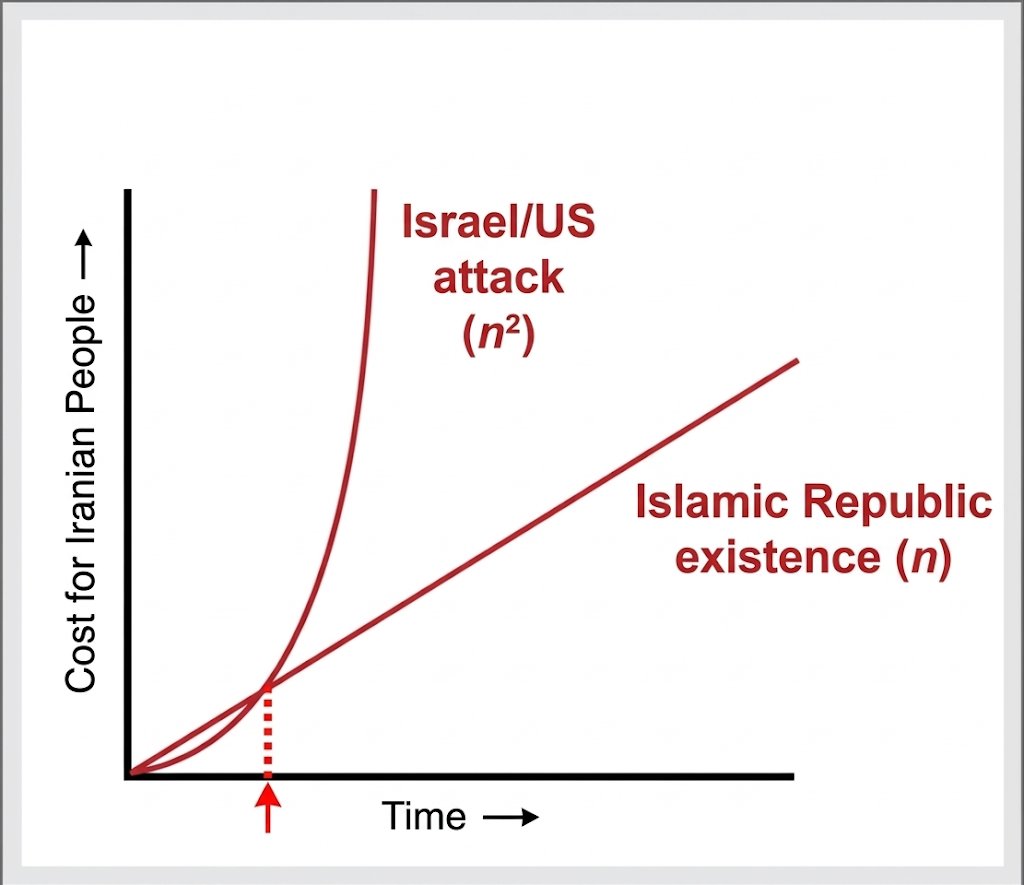
I drew this at the start of the conflict. my stance was clear: I won't be anti-war until we reach that red intersection point. we aren't there yet, but we're closer than ever. my hope is for a regime collapse before it's too late.
Today, we are emerging from stealth and launching PrismML, an AI lab with Caltech origins that is centered on building the most concentrated form of intelligence.
At PrismML, we believe that the next major leaps in AI will be driven by order-of-magnitude improvements in intelligence density, not just sheer parameter count.
Our first proof point is the 1-bit Bonsai 8B, a 1-bit weight model that fits into 1.15 GBs of memory and delivers over 10x the intelligence density of its full-precision counterparts. It is 14x smaller, 8x faster, and 5x more energy efficient on edge hardware while remaining competitive with other models in its parameter-class.
We are open-sourcing the model under Apache 2.0 license, along with Bonsai 4B and 1.7B models.
When advanced models become small, fast, and efficient enough to run locally, the design space for AI changes immediately. We believe in a future of on-device agents, real-time robotics, offline intelligence and entirely new products that were previously impossible.
We are excited to share our vision with you and keep working in the future to push the frontier of intelligence to the edge.
Introducing TurboQuant: Our new compression algorithm that reduces LLM key-value cache memory by at least 6x and delivers up to 8x speedup, all with zero accuracy loss, redefining AI efficiency. Read the blog to learn how it achieves these results: https://t.co/CDSQ8HpZoc
Happy to share that our recent work at @DAIS_PolyMTL, “SQLMorph: Query Mutation and Fine-Grained Metrics for Text-to-SQL Evaluation” has been accepted at @ICDEconf 2026, one of the top venues in data engineering. 🧵👇🏻
We're sitting on a gold mine of data for evaluation and post-training.
Hundreds of agentic benchmarks, rich structured environments, verifiable signal.
Most of it is sitting idle. Not because nobody wants it, but because the engineering to use it is brutal. 🧵
I drew this at the start of the conflict. my stance was clear: I won't be anti-war until we reach that red intersection point. we aren't there yet, but we're closer than ever. my hope is for a regime collapse before it's too late.
4) Grateful to my wonderful co-authors, Mohamed Riahi, Prof. Maxime Lamothe, and Prof. Amine Mhedhbi.
📄 Paper: https://t.co/z4HRjlULlL
💻 Code: https://t.co/rHPRvC6fpS
3) and Textual Query Augmentation (TQA), which introduces variations in the natural language questions. We also propose new fine-grained eval metrics: EXP, EXR, and F1, which go beyond traditional EX and provide a more detailed view of system performance instead of a simple 1/0.