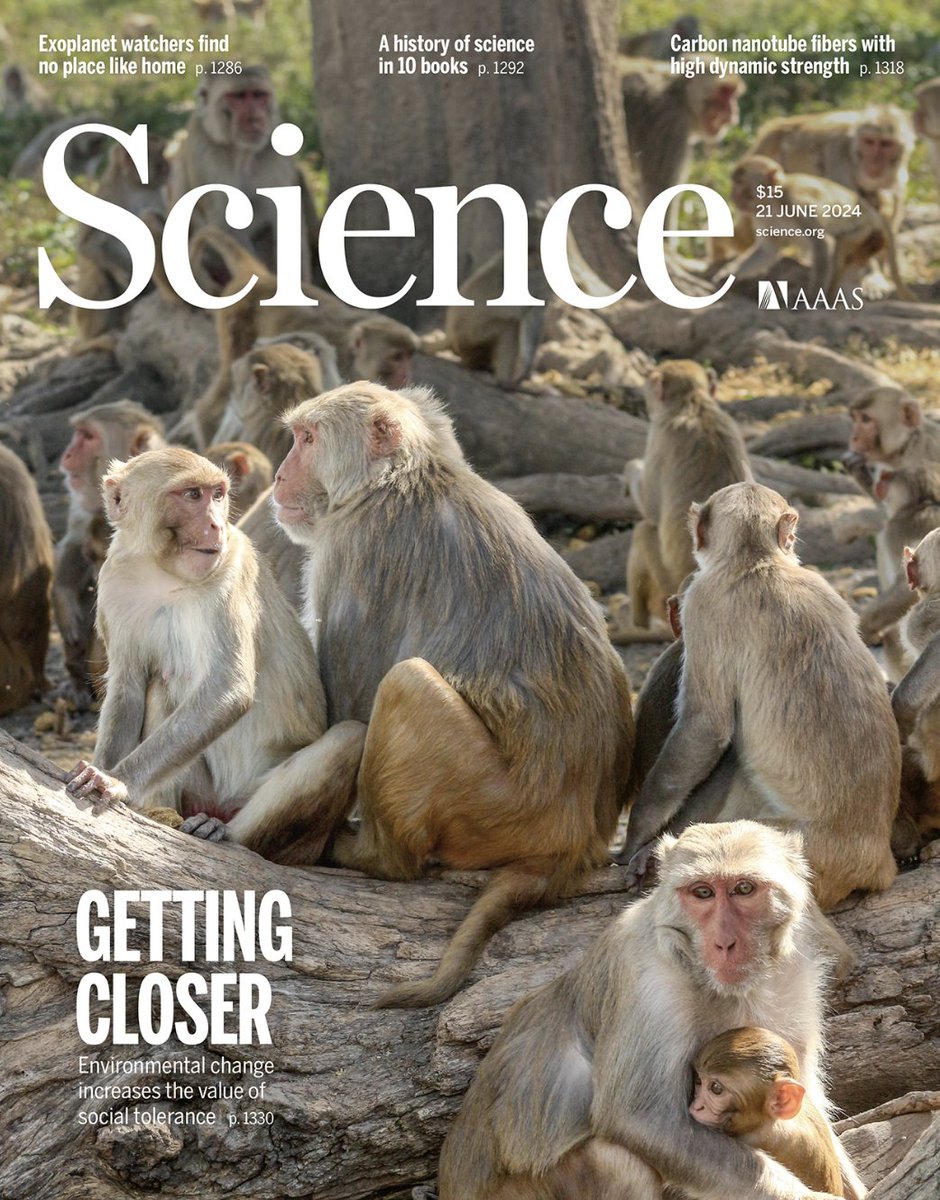
*Very* excited to see the last study of my PhD making the cover of @ScienceMagazine on the macaques of @CayoSantiagoPR.
We show that ecological disturbances can alter selective pressures on social ties leading to persistent societal changes.
https://t.co/Zt4EJY5XWw 🧵👇
Taking identity-by-descent (IBD) analysis into the wild! https://t.co/VduostwY6e
In this preprint, we leverage novel genomic methods to estimate fine-scale gradients of relatedness in animals and highlight their many applications in the field of ecology and evolution.🐒🧬 [1/3]
We will be on 60 Minutes this Sunday 5th Nov from 7pm ET (right after the NFL game) talking with Leslie Stahl about our work investigating hurricane impacts on Cayo Santiago.
https://t.co/Fyll3Vk1Sz
Our review of aging & sociality in the amazing @CayoSantiagoPR macaques is out now! Part of a great NBR series on social dimensions of aging. https://t.co/VQP1jYriv3 Fantastic to work w/ @CamilleTestard & many others in our multi-institute, multi-disciplinary #CBRU team
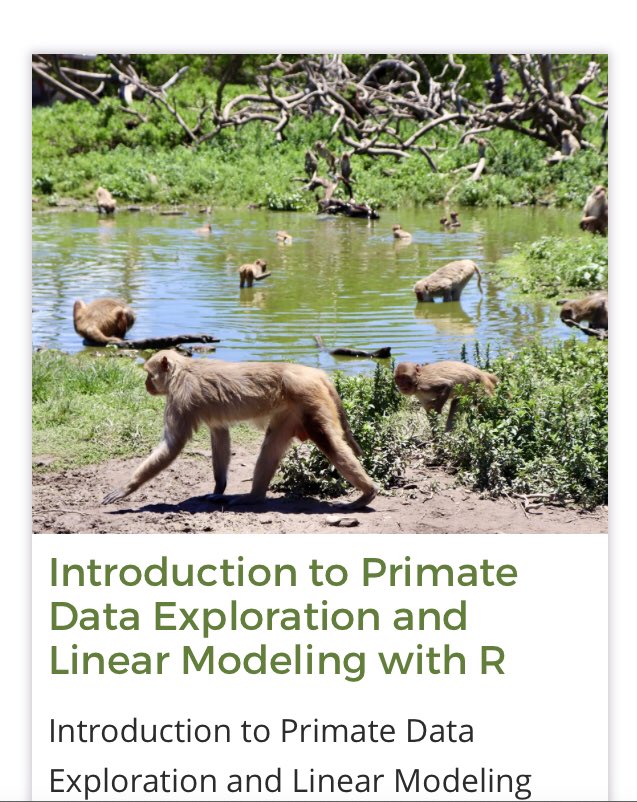
Open access training modules for research students now available @qubeshub 👇🏼 Share!
Introduction to Primate Data Exploration and Linear Modeling with R
https://t.co/pbiwYBgBfP
*Excited* to share our latest review with @LauraNewman33 & co about our team's multi-disciplinary efforts to characterize #aging and its modifiers in the @CayoSantiagoPR macaques: from immunity, to brain, microbiome, gene regulation and more.
https://t.co/tTflpapwIs
🧵👇
🚨 New paper alert! 🚨
We generated a huge transcriptomic (i.e., mRNA, gene expression) 🧬 dataset from the 🧠 of rhesus macaques 🐒 & compared age-related patterns to those in humans 👶🏻🧒🏾🧑🏼🧑🏽🦳🧓🏻
https://t.co/cpceIJyg5i
(1/10)
Our macaque epigenetic clock paper https://t.co/YTR5azvddV is on @biorx—we built an age predictor w/ DNA methylation data from @CayoSantiagoPR macaques & applied it to independent populations of rhesus macaques & of @AmboseliBaboons.
@KNSterner@SMack_Lab
What if we could quantify immunosenescence in wild populations without invasive blood sampling?
Our new paper shows that urinary neopterin, a biomarker of innate immune activity, is predictive of age in a free-ranging primate. Summary in 🧵 1/7
https://t.co/f06xrnJGU5
Excited to share the single-cell adult #macaque brain atlas—our contribution to a big week of #brainatlas preprints! W/ @XingfanH, @MichaelLouisPl1, @JShendure, & @SMack_Lab—we profiled 4.2M nuclei across 30 regions from females+males. Here’s what we found https://t.co/vffQ5vanXf
New paper out today in @ScienceAdvances!
We investigated how sociality relates to brain structure in a group of free-ranging rhesus macaques.
Co-authored w/ @MichaelLouisPl1, @jerome_sallet, Cayo Biobank Research Unit et. al
https://t.co/FjFsFWeBQq
(1/9) 🧵👇
What role do social connections play in resilience to stress? Check out this Q&A with recent SWC Seminar speaker Dr Michael Platt (@MichaelLouisPl1, @Penn): https://t.co/cmm3yLrv7J Image credit: Lauren Brent (@ljnbrent)
Hi twitterverse! I’m Beki (@bekihooper) and I’m taking the reins of the Cayo Santiago Biological Field Station account for #FieldworkFriday! Today I’ll be sharing a bit about my research questions, and why I’m working with the cheeky monkeys of Cayo Santiago
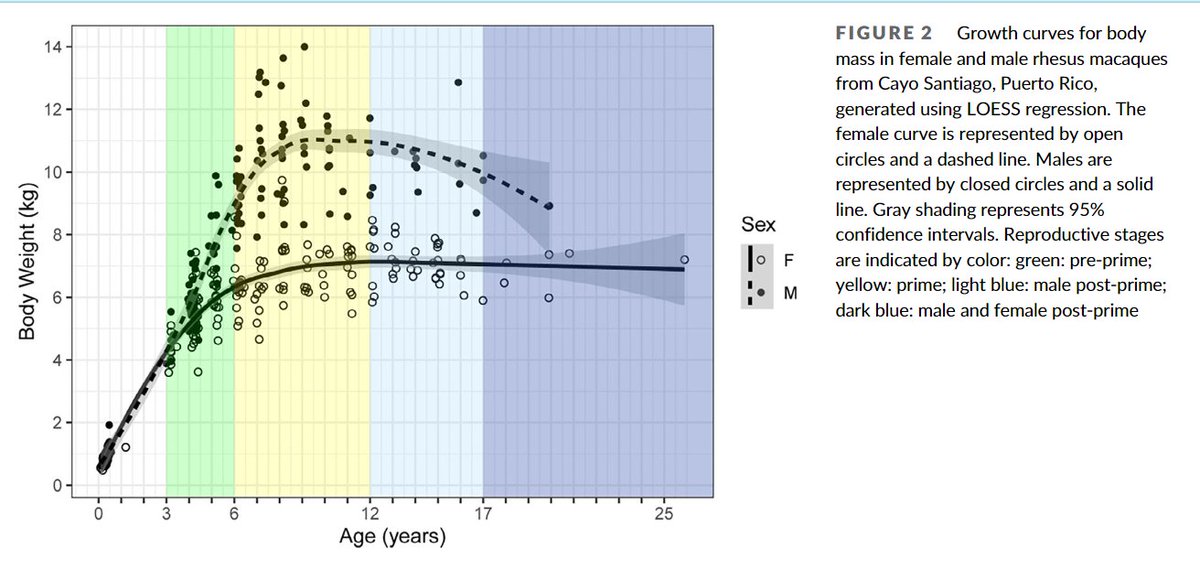
In our new #NSFfunded MS @AmJBioAnth led by Dr. Cas Turcotte, we show that sexual dimorphism in Cayo Santiago rhesus macaques (n=362) is produced by both later age at maturation, & accelerated growth during the pre-prime period. https://t.co/aH7NrYcKeB
We are hiring! Come join our thriving Cayo Santiago macaque project working w @ljnbrent@SMack_Lab@MichaelLouisPl1@monkeymullet. We have 2 new positions. Details in the next two tweets Apply! (1/3)
I am incredibly excited to share our preprint ‘Somatic mutation rates scale with lifespan across mammals’In this paper we provide an unprecedented description of somatic mutation across mammals.
https://t.co/qjOV7NrWS5
An illustrated tweetorial…[1/17]
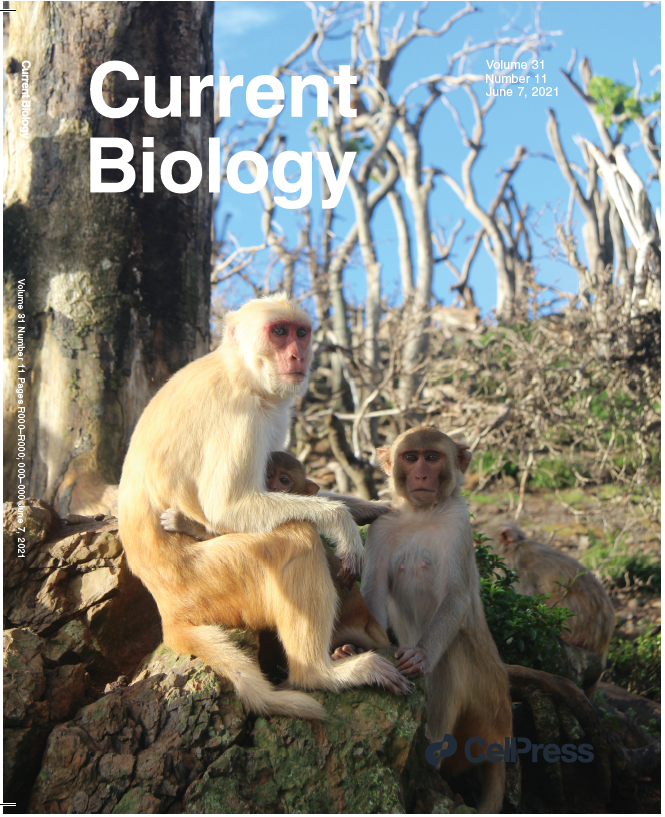
Delighted to have our paper https://t.co/iXZiJAOBcG featured on today’s cover of Current Biology! I took this shot 13mos after Hurricane Maria devasted Puerto Rico and @CayoSantiagoPR – it shows the sustained effects Maria had on the macaques who live there.
After Hurricane Maria in 2017, rhesus macaques on Cayo Santiago became more social, with monkeys that were isolated before the storm increasing their social connections most after it; monkeys built new relationships rather than strengthening existing ones https://t.co/2YfGiif8uS





![AnnikaFreudiger's tweet photo. Taking identity-by-descent (IBD) analysis into the wild! https://t.co/VduostwY6e
In this preprint, we leverage novel genomic methods to estimate fine-scale gradients of relatedness in animals and highlight their many applications in the field of ecology and evolution.🐒🧬 [1/3] https://t.co/x7FDtWLMca](https://pbs.twimg.com/media/GDmB47lXsAEDSdo.jpg)





![ATJCagan's tweet photo. I am incredibly excited to share our preprint ‘Somatic mutation rates scale with lifespan across mammals’In this paper we provide an unprecedented description of somatic mutation across mammals.
https://t.co/qjOV7NrWS5
An illustrated tweetorial…[1/17] https://t.co/PIN9RCY0Vv](https://pbs.twimg.com/media/E9OVz-pWUAE4I3a.jpg)