For a lot of those forty years we were one of the fastest growing countries in the developed world. If we’d maintained the 1979-2008 trend we’d have a budget surplus of *£200 billion* now.
Fahnbulleh’s problem isn’t with low growth or austerity, it’s with capitalism and markets.
Housing shortages drive rough sleeping by making spare bedrooms scarcer, which makes it harder for people in crisis (drugs, abusive relationships, mental health) to stay with someone who cares for them. Britain has some of the smallest homes in Western Europe.
https://t.co/13e24YxbCa
Chart of the Day 🤓
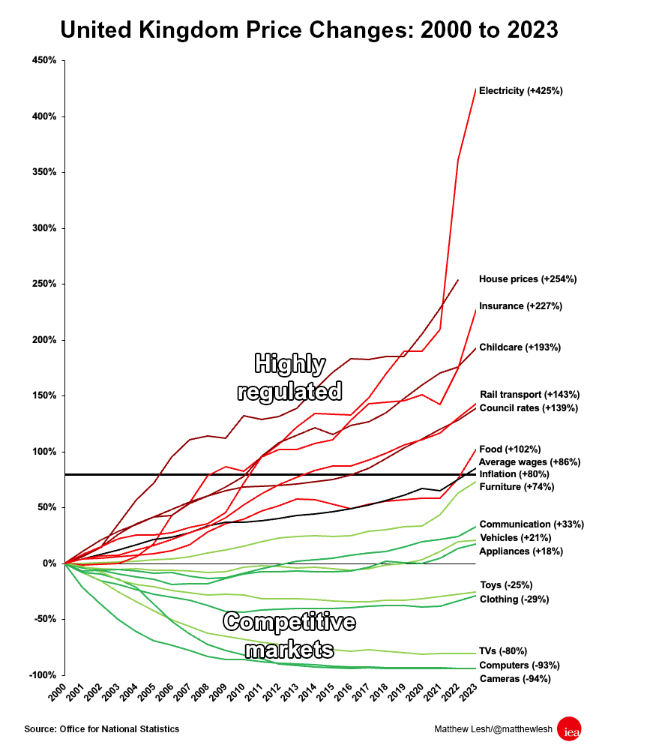
Andy Burnham: "if we don’t have sufficient public control over the cost of the essentials, how can we have control over inflation?"
Reality: prices have risen much more sharply in sectors with greater state intervention than in those led by market forces 👇
Sounds bad, but the Financial Times, the Economist and the Sunday Times all endorsed Labour for government in 2024 and I trust them, so I assume it's fine.
Excellent piece in the Britain section on the UK's social housing distortions this week. Enormous effective subsidies and lifelong tenancies encourage tenants to cling on to units, especially in London, causing an enormous misallocation of scarce stock.
https://t.co/olFg683lfl
Spain built a high speed line from Madrid to Seville for £1.89 billion in 1992.
Politicians at the time called it a failure.
HS2 (so far) has cost £44.2 billion. It will cost more than £100 billion.
And we are tunnelling through ... fields.
What are we doing so, so wrong?
There is a case that wind at £50/mwh makes uk energy prices cheaper. I’m not sure what the actual number is, it could be significantly lower given that spillover costs get worse & benefits get lower as more and more wind is added to the grid. But at £120 it is going to put significant upward pressure on UK electricity costs. Dangerous!
Really funny that we've had the longest period of stagnation in modern British history and it's still important to reassure people that we're not going to pursue the wrong kinds of growth, as if we're coming out of a period of double-digit China-style breakneck expansion.
Reminder: Hinkley Point C (7% of Britain's electricity needs) is at risk of delay due to Natural England's view that the £700m on fish mitigations isn't enough.
https://t.co/xnH9jma4xV
This is, perversely, good news for Britain, Australia, Japan, Europe, and other countries being cut off that would once have seen themselves as close allies of the United States.
It shows us what the future may hold if AI is the strategically and economically decisive technology of the 21st century and is controlled by the US and China. It is good news because *it may be happening early enough to give us time to act.*
I think this will be rescinded pretty soon, but it’s a sign of things to come. In a future where frontier models cannot be used outside the US, our industries and economies will fall behind and American businesses may not be able to operate overseas. We won’t be able to defend ourselves militarily with defence systems built on obsolete software. Europe 2031 is a good scenario of what a future like this could mean: https://t.co/AMc5LrFJeS
Some of the things we need to do are ‘no regrets’ measures we should do anyway. But some are genuinely costly and risky.
We need cheap electricity – powered by gas, coal (this is costly, coal is very bad), deregulated nuclear fission – whatever can provide *cheap, reliable, 24/7* power. This almost certainly excludes wind power, which is enormously expensive and unreliable. We need projects to be able to connect to the grid in days rather than years by paying for fast-track connections.
We need to make it incredibly easy to build data centres, with the property taxes retained locally and hypothecated for local tax cuts so there is some direct benefit for locals. This doesn’t need to be nationwide.
We need to create new regulatory regimes for innovative businesses that give them the right to hire and fire staff with ease. The difficulty and cost of firing staff is one of the main reasons Europe has fallen behind so badly. We need to create a parallel employment regime that companies and workers can opt in to: https://t.co/YaNOXK1Po2
Even though I think it will probably fail, I think we should probably try to create a good, non-American frontier AI lab. I am quite pessimistic about this – even extremely well-resourced, innovative software companies are struggling to do this. But the stakes are so high that not trying seems foolish.
One thing that might work in our favour is the number of brilliant AI engineers who are not US citizens, who under the current export controls do not have access to Mythos/Fable even if they live and work in the US. What happens to Demis Hassabis, Ilya Sutskever, Andrej Karpathy, and the many other Europeans, Canadians, etc who are working on AI models in Britain and America who are affected by this?
I do not think we should force our own companies to use model, because this would exacerbate their economic weakness – this lab should have to compete on an even playing field. I am deeply sceptical that this can work, but we cannot rule it out. If we do it, it has to be able to pay US salaries, operate without political constraints. https://t.co/Um05rUF4Vq
It is cope to tell yourself that Trump is an aberration or that these export controls are a one-off. To repeat, I think these specific controls will be lifted quickly and it will be easy to move on and forget it happened. But this is a look into a potential future. Every one of us that is not a US citizen is at risk. The standard political divides do not apply here; the question is whether you grasp the enormity of AI as a technology. We have to act!
Thomas Piketty and a large team have just proposed a worldwide tax & economic revolution:
⦿ Cap rich-nation growth near zero
⦿ Cut work hours in half
⦿ Cut material consumption by 1/3
⦿ 10% of GDP going into a global fund
⦿ Tax wealth to essentially end it
It's potty.
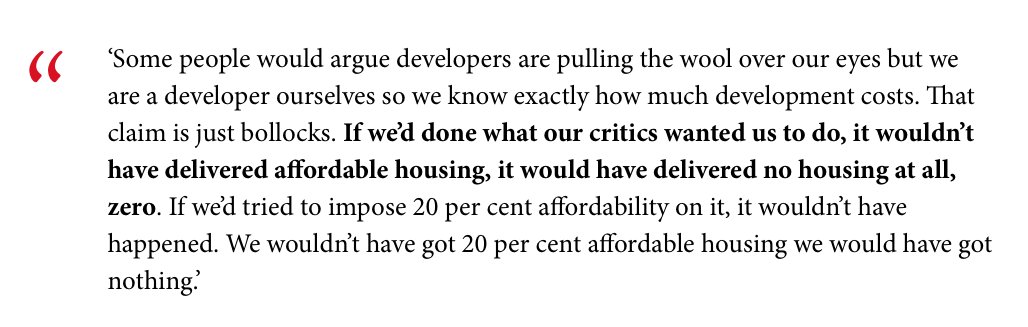
The irony of Burnham's bollocks about Right to Buy and council housing is that the secret of Manchester's housing success was literally the exact opposite - prioritising maximum private building over number of subsidised units. Here's (Labour) council leader Richard Leese.