Satya Nadella just posted something that validates the entire AI buildout thesis from the very top of the stack.
The model is commoditizing. The durable value is the learning loop a company builds on top of the model.
He splits it into two assets:
Human capital -- the knowledge, judgment, relationships, and pattern recognition of your people.
Token capital -- the AI capability the firm builds and owns.
He says the real opportunity is building a learning loop where human capital and token capital compound together.
If the model layer is commoditizing then the durable returns are not in the model makers. They are in the infrastructure that powers every company building its own loop. Compute. Memory. Interconnect. Power.
The full stack underneath the application layer.
The model wars will have winners and losers. The infrastructure underneath gets bought either way.
Bullish the AI buildout.
Every layer. If you want to understand them in detail, check out my Substack.
https://t.co/Wna5UzCOVT
How I use AI to spot altcoins BEFORE they pump.
I'm about to reveal my cracked AI research system.
This thread is a goldmine. Bookmark it.
🧵: My full crypto x AI research flow (prompts attached).👇
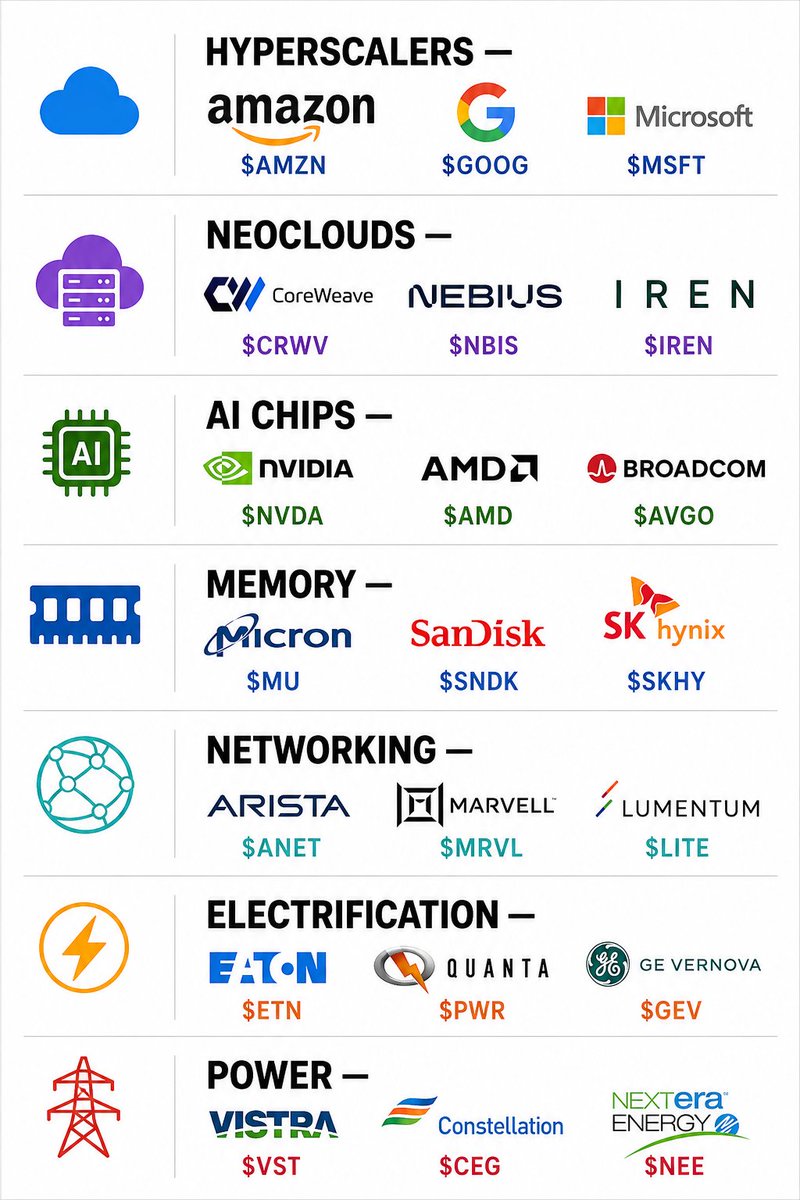
🚨 NVIDIA’S $500B AI BUILDOUT IS SHOWING YOU WHERE THE MONEY IS HEADING.
HYPERSCALERS — $AMZN $GOOG $MSFT
NEOCLOUDS — $CRWV $NBIS $IREN
AI CHIPS — $NVDA $AMD $AVGO
MEMORY — $MU $SNDK $SKHY
NETWORKING — $ANET $MRVL $LITE
ELECTRIFICATION — $ETN $PWR $GEV
POWER — $VST $CEG $NEE
AI is bigger than chips. It’s an entire infrastructure boom.
👀 ARE YOU POSITIONED?
👇 Want my latest high-potential stock picks?
Tap the link in my bio and join my community for FREE daily stock ideas, market updates, and watchlists.
🚨 Top 10 Stocks to Watch If You Believe Photonics Is the Next Big AI Theme:
$COHR — Coherent
$LITE — Lumentum
$TSEM — Tower Semiconductor
$GLW — Corning
$CIEN — Ciena
$VIAV — Viavi Solutions
$AEHR — Aehr Test Systems
$AXTI — AXT
$AAOI — Applied Optoelectronics
$MRVL — Marvell
⚡ AI isn’t just about GPUs anymore.
As data centers scale, the demand for faster optical connectivity, photonics, networking, and high-speed data transmission could become one of the next major investment themes.
These are the names I’m watching closely.
📌 Save this list.
Which one would you buy today?
🔔 Follow my profile for daily stock ideas, high-potential watchlists, and market updates.
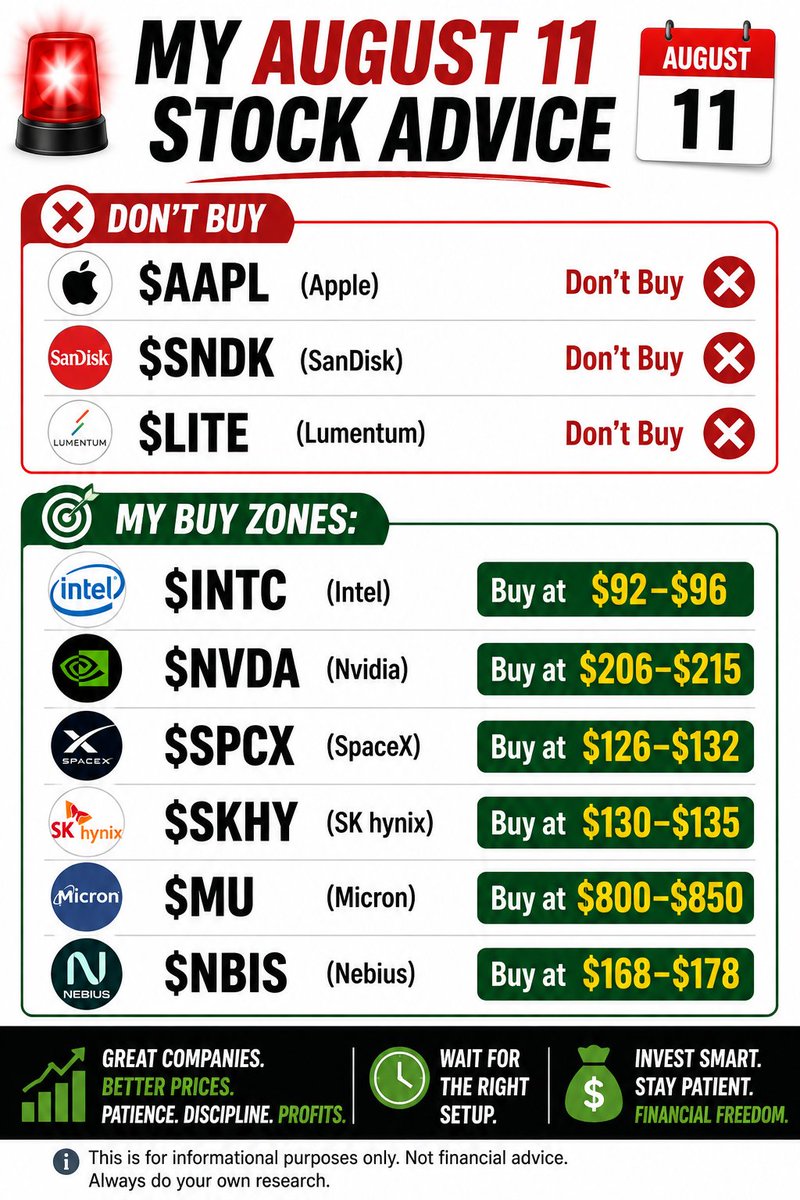
🚨 My August 11 Stock Advice:
❌ $AAPL (Apple) — Don’t Buy
❌ $SNDK (SanDisk) — Don’t Buy
❌ $LITE (Lumentum) — Don’t Buy
🎯 My Buy Zones:
$INTC (Intel) — Buy at $92–$96
$NVDA (Nvidia) — Buy at $206–$215
$SPCX (SpaceX) — Buy at $126–$132
$SKHY (SK hynix) — Buy at $130–$135
$MU (Micron) — Buy at $800–$850
$NBIS (Nebius) — Buy at $168–$178
📌 Save this list.
Earnings, financing, and major contracts will determine which names deserve the next move.
I’m watching these levels closely — and my next stock alert is coming soon.
🔔 Follow my profile and turn on notifications so you don’t miss the next update.
📈 For daily high-quality stock ideas, watchlists, and market updates, check my profile.
The most valuable company on earth runs on these names and people think the AI trade is done?
$AAPL apple’s entire supply chain reads like the AI trade itself. TSMC $TSM (A17 chip), Samsung $SSNLF, SK Hynix $SKHY + Kioxia $KXIAY (memory/storage), Qualcomm $QCOM, Broadcom $AVGO, Cirrus Logic $CRUS, Texas Instruments $TXN, Corning $GLW, Sony $SONY.
-RM
Retail is panicking, but look at what the institutions are doing with $AAOI.
Institutional ownership is hitting all-time-high while the stock price is taking a heavy beating.
Who do you think is right here - panicking retail or the smart money?
source: Fintel io
NFA
The Serenity Doomsday ETF:
25% | $FAZ
25% | $GUSH
20%| $LCID Short
10% | $SQQQ
10% $UVIX
10% | $NVDA Puts
Rationale:
$FAZ / 3x short financial - Private Market liquidity play on Middle Eastern capital abandoning private markets if all their oil fields get blown apart.
$GUSH / 2x Long US OIl and Gas - Global crude prices that will likely skyrocket, and American producers reap record windfall in profits.
$SQQQ / 3x short Nasdaq - Google, Amazon, Apple, Microsoft forced selling if liquidity gets pulled.
$LCID Short / 60% owned by Saudi Arabia Public Investment Fund. If the Saudis suffer from liquidity shock, there goes Lucid.
$UVIX/ 2x long volatility - If there's black swan events, volatility goes up.
$NVDA Puts - Last bastion for the $SPY as largest weighting. If capex gets pulled, index sells off will Nvidia go down the hardest.
I only see this scenario if US sends ground troops to Iran and Iran blows everything around it up.
Let's pray for Taco Tuesday.
Let me dive a bit deeper in what I think is the difference in business model between $NBIS and $IREN.
I've seen a couple of panels, quick fire chats, and keynotes from both companies and they are emphasizing different kind of things. I write this with a neutral stance where I see positives and negatives in both models.
The first thing I want to emphasize is that the demand is real. During the conference there was never a question on whether the demand is real and/or sustainable. The main question was how to get the best ROI out of AI. Which business model and pricing model works best and where do companies find gaps in the market.
A second thing is that I look at the bigger picture, I don't go into the details/calculation of any deals. I'm just connecting the dots.
The Layers
To understand the difference in business model, you have to be aware of the three layers both companies speak about.
1. The hardware: The first layer is the hardware layer. Basically the GPU's. I'm sure a lot can be said and done on this layer and there are differences between both but I don't see a major difference in business model between the two companies here. Let's just assume they both have access to hardware.
2. The cloud: This is the core of both Iren and Nbis. Both are selling cloud solutions. This basically means that companies can rent the GPU perfomances per hour. The big difference with Hyperscalers like AWS and CGP is that Iren and Nebius have way more access to power and compute. The goal for this power should be to train models on that raw power. It is not possible on the older datacenters of AWS and CGP because they don't have the compute to possibly do this. The compute they have available is meant to store HR/IT/Sales platforms on for enterprises.
3. The application: The application layer is what you build on top of the cloud layer. It's for enterprises who don't want to manage raw severs. You can immedatly design and install the nessecary applications. The space is very crowded here, you compete directly to competitors like Anthropic and SiliconFlow.
The Hyperscalers
To my understanding, up to 70% of the demand comes from Hyperscalers who are looking to buy raw compute for the Cloud. They got their own software to build on top of the cloud and they just need the compute to train their models on.
In this sence both business models do not differentiate much from each other. What I did notice is that $IREN is a bit more focussed on protecting the bottom line, while $NBIS of focused on getting sold-out and getting deals done. The demand from Hyperscalers is big and they are coming to Iren and Nebius to find deals. But there are some other players in the field, Hyperscalers are actively looking for the best deals.
I sometimes see new deals around with new datacenter companies I never heard about. When experts do the calculations, it looks like the gross profit of those deals aren't specatacular. Hyperscalers know this and they will use this to their advantage. Iren being this protective will defend their bottom line a lot but will automatically make you miss out on some potential deals. But the demand is only rising and the available power is shrinking, so patience might be the best deal here.
The enterprises
The big difference on the business models is how they are looking to approach the other 30% of the market.
IREN
$IREN is solely focusing on the second layer: "cloud for everyone". Ken spoke about: "Wanting to become a Hyperscaler". The deal with Mirantis is another clear statement that they want to be focussed on this segment.
The thing here is that you narrow yourself a bit down to AI labs who are looking to train open source models on the cloud of $IREN. Companies like Blackbox AI, Cline, Mistral all fit this category, they are all looking for compute to train their open source models on. Mirantis helps smaller open source companies to build cloud software on top of IREN's infastructure and power.
So the cloud is basically the raw compute you buy in GPU per running hour. Mirantis helps to build a software on top of this cloud. Some premium customers from Mirantis are $ADBE and $PYPL, who don't nessecary buy cloud from $IREN.
I think outside the Hyperscalers, the open-source companies are the main ones $IREN is looking for but Ken talking about wanting to become a Hyperscaler and wanting to have cloud for everyone, does not really fit this picture. Hosting HR/IT/Sales platforms on your cloud has a way lower ROI than hosting training models. The raw power and compute Iren has, is an overfit for this business model. It also does not really fit the picture of protecting your bottom line, as you are going for lower ROI sales. I think becoming a Hyperscaler might be a long-term dream but the main focus right now is on the open source models.
Nebius
$NBIS solves this enterprise problem in a different way: tokens. They opened the Nebius token factory where you and I can start interacting with models directly via a simple API. The positive here is that you can target enterprises from all levels and even individuals. Some examples from token customers here are Revolut, $BKNG, and $SHOP.
According to Rod Evans of Nvidia the ROI of selling tokens vs selling cloud is 2x higher. So big customers who have their own infastructure do not want to buy tokens but cloud directly. The smaller customers can buy tokens directly.
The positive here is that you create a tailor made solution for every customer. They don't want to buy raw power, they only want to buy what they need. The customer also does not has the hustle of builing and managing raw servers. As I said before, the space here is extremely crowded. Anthropic and Siliconflow are some examples.
Conclusion
For all investors who follow both companies a lot, this was probably already clear. But for me this brought me some more insights in both companies.
It has been said a couple of times during the conference, it is also a business model evolution. From SK Hynix to Nvidia to Cybersecurity companies. Whoever executes best on business model, will win. Demand is real, growth will come, the right business models will stay.
We only write 1-2 primers a year because we want them to be durable. It’s simple to publish something market relevant for 6 months, but our goal is a piece you can return to years later and still derive value.
Our Robotics primer meets that standard.
https://t.co/qPSAXaLgYN
This stock is different from the typical bottleneck stock that's pitched on twitter... especially a physical AI one.
$NVEC has:
- 60% net margins
- 93% institutional ownership
- $450M market cap
- $5M quarterly net income
- $1M debt
- $400M enterprise value
Give it a read
@RJCcapital I've analyzed his tweets and the returns people would have gotten if they invested into every call. Performance really is crazy but only the last few months.
link:
https://t.co/sPmGjyOKBC
PSA: I’ve flipped fully bullish on $ETH.
The biggest crypto bull on CT managed to buy maximum optimism at the HTF highs and has now discovered maximum fear near the HTF lows.
This is a stronger signal than any RSI divergence I’ve ever seen.
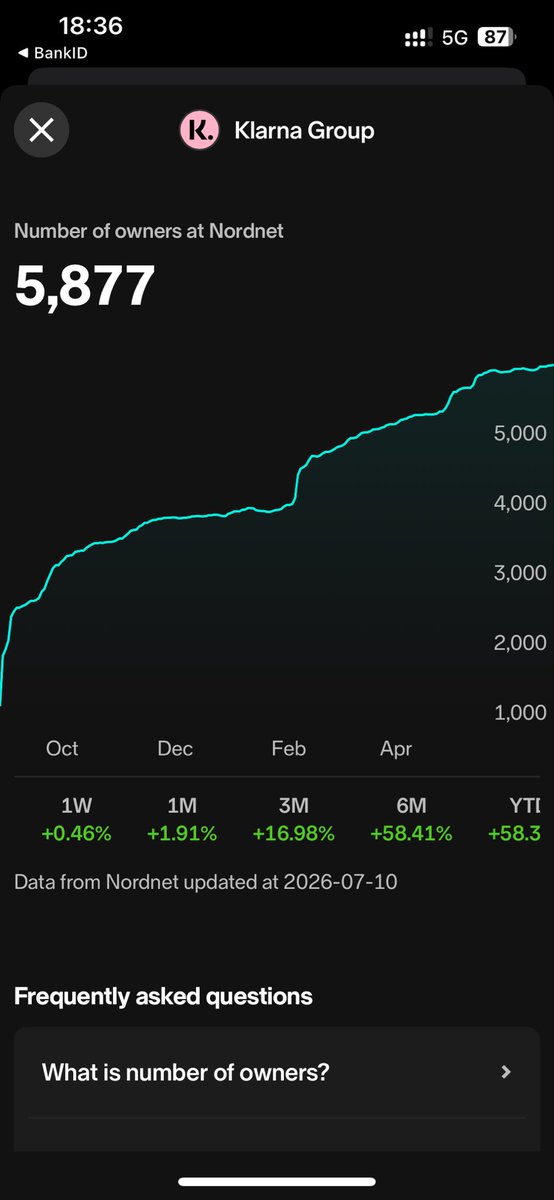
@aleabitoreddit@2147gp But if I compare to Klarna ipo which is very well known in Sweden then we see that the user base is in similar level. That means that the Swedish retail investors are very aware of SIVE.
@aleabitoreddit@2147gp@aleabitoreddit - a glimpse of my local Swedish provider called Nordnet. It is one of the two most popular providers in Sweden. The ticker popularity is increasing but in a very linear manner.
@aleabitoreddit@2147gp I suspect that one reason for this is that the platform itself restricts people from buying it as it is not a normal stock but a SPAC merger. So in order to buy it you have to pass some extra tests in the platform.